


Most planners don't lose events to bad programming or weak sponsorships. They lose sleep — and sometimes their margin — to the gap between three parties who never quite agree on who owns what: the venue's operations team, the municipal offices that issue permits, and their own internal crew. Each runs on a different clock, uses different language, and assumes someone else is handling the thing that quietly falls through.
When a fire marshal shows up during load-in asking for a stamped occupancy plan nobody submitted, that's not a paperwork problem. That's a coordination system that never existed. This piece is about building the system — the calendar, the ownership map, the escalation anchors, and the templates that make municipal coordination boring and predictable instead of a fire drill three days out.
Why venue and municipal coordination breaks in the first place
The core issue is that a venue booking feels like a single transaction, but it triggers a web of dependencies spread across completely different organizations. You sign a contract with the venue. Fine. But that contract almost never covers the noise variance from the city, the street closure permit from the transportation department, the temporary food service permit from the health office, or the special event insurance rider the risk office wants on file.
Each of these has its own lead time, its own submission window, and its own point of contact who does not talk to any of the other humans involved. The venue coordinator assumes you're handling permits. You assume the venue "usually takes care of the fire stuff." Nobody's technically wrong — the ownership was just never written down.
What actually falls apart as events scale
A 150-person meeting in a hotel ballroom needs almost no municipal coordination. The venue absorbs it. That's partly why so many planners never build a real system — the early events don't punish you for not having one.
Eliminate event chaos with Festoly.
Manage every aspect of your event seamlessly — from planning to execution.
- Centralized event scheduling
- Real-time attendee tracking
- Vendor & resource coordination
No credit card required
The trouble starts when the footprint grows. Outdoor components, multiple entrances, alcohol service, amplified sound past a certain hour, tented structures, generator placement, road-adjacent staging — each one adds a permit, an inspector, and a stakeholder who can shut you down. A common version of this: an organizer runs three clean years of indoor conferences, then adds an outdoor evening reception in year four. Suddenly they need a temporary structure permit, a fire inspection for the tent, a noise variance, and a food handler certification check — four new dependencies, all discovered piecemeal, most of them late.
-
The unowned permit. Everyone assumed someone else filed it. Discovered at inspection.
-
The stale contact. The city liaison from last year retired, and nobody has the new person's direct line.
-
The silent dependency. The generator can't be placed until the fire inspection clears, but the inspection was scheduled after load-in started.
-
The escalation vacuum. Something goes sideways at 6 a.m. on show day and no one knows who has authority to make a call with the venue.
-
The version drift. The site plan the fire marshal has doesn't match the one your production team is building to.
None of these are exotic. They're the same handful of gaps repeating across events that outgrew their original template. Coordination doesn't fail loudly at scale — it fails quietly, in the seams between organizations.
The permit calendar: the backbone everything hangs on
If you build one thing, build this. A permit calendar is not a to-do list. It's a backward-planned schedule anchored to each permit's statutory lead time, not your internal comfort level.
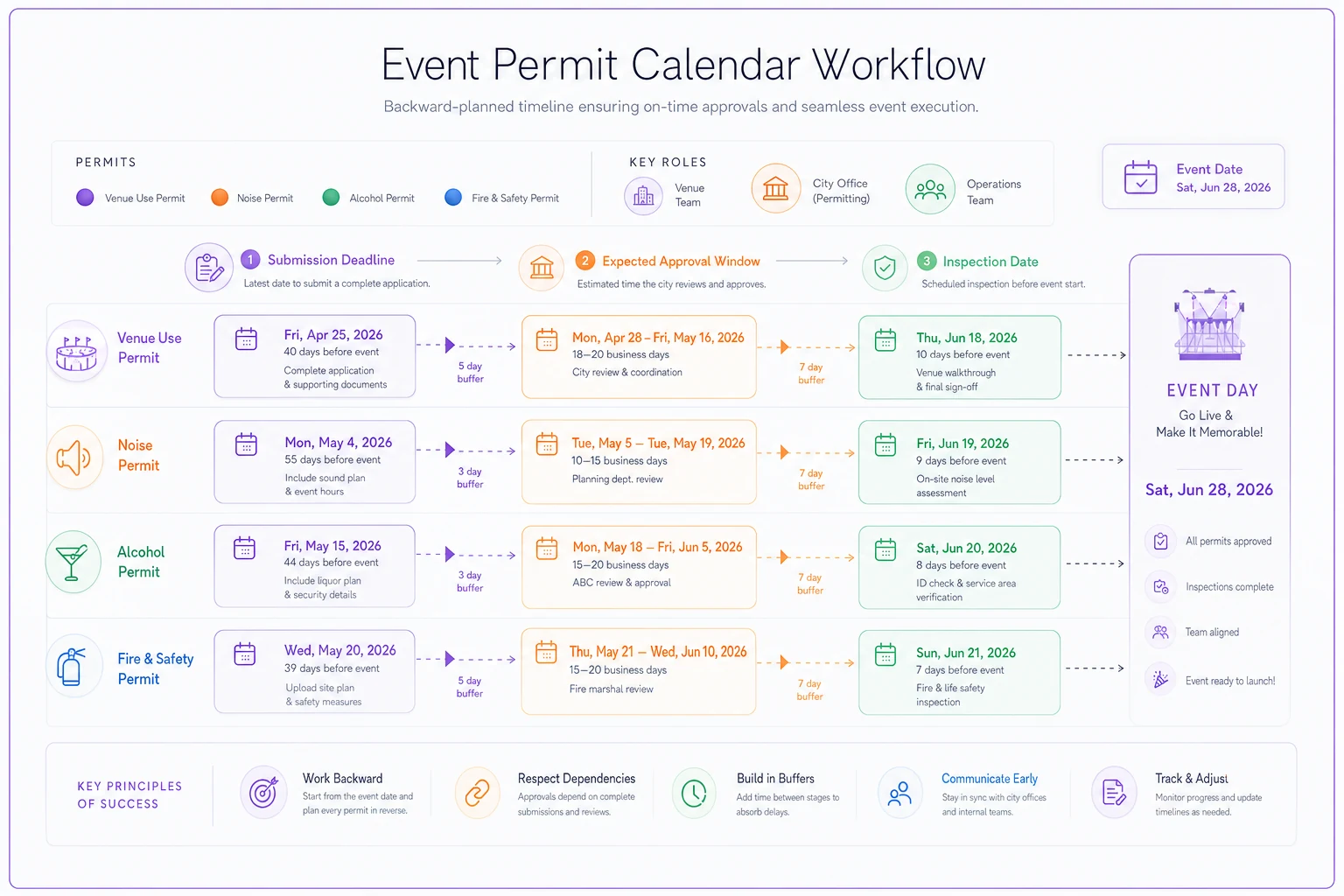
The move most people miss: calendar the submission deadline, the expected approval window, and the inspection date as three separate events — because each can fail independently. A permit submitted on time can still stall in review, and an approved permit can still fail inspection. Tracking only "submitted" hides two of the three risk points.
Here's a simplified version of how a permit calendar maps out for a mid-sized outdoor-plus-indoor event:
| Permit / Requirement | Owner | Statutory Lead Time | Submit By (T-minus) | Inspection / Confirm By |
|---|---|---|---|---|
| Special event permit | Ops Lead | 45 days | T-60 | T-14 |
| Street closure | Transport Liaison | 30 days | T-45 | T-7 |
| Temporary structure (tent) | Production Mgr | 21 days | T-35 | T-2 (on-site) |
| Noise variance | Ops Lead | 20 days | T-30 | N/A |
| Temp food service | Catering Lead | 14 days | T-25 | T-1 (on-site) |
| Fire / occupancy sign-off | Safety Lead | 10 days | T-20 | T-1 (on-site) |
The buffer between "submit by" and "statutory lead" is deliberate. If the city needs 30 days and you submit at exactly 30, one clarification request kills you. Submitting at T-45 for a 30-day requirement gives review cycles room to breathe. Buffer isn't padding — it's where the back-and-forth correspondence actually lives.
This diagram illustrates the backward-planned permit timeline and the three risk points: submission, approval, and inspection.
If you build one thing, build this.
Stakeholder RACI: making ownership impossible to dodge
Every permit line above has a named owner, and that's not an accident. Coordination collapses almost always because of ambiguous ownership, and a RACI map is the cheapest fix for it.
Keep the RACI narrow. Overbuilt charts with fifteen roles per task get ignored. For municipal coordination, you really only need clarity on four questions per item: who does the work, who signs off, who needs to be consulted before it moves, and who just needs to know it happened.
-
Responsible — the person physically preparing and submitting the document.
-
Accountable — one name, always. The person who eats it if the permit isn't secured. Never split this.
-
Consulted — the venue coordinator, legal, or the inspector's office, depending on the item.
-
Informed — the internal ops group and, often, the finance owner tracking permit fees.
The single most common mistake is listing two people as "accountable" for the same permit. That guarantees neither is. When you review the chart, scan the Accountable column first — if any name appears next to something they can't actually control, or if any permit has a blank, you've found tomorrow's crisis today.
When you review the chart, scan the Accountable column first — if any name appears next to something they can't actually control, or if any permit has a blank, you've found tomorrow's crisis today.
One thing worth connecting here: permit fees and inspection costs belong in the same view as your event budget. Fees drift, rush charges appear, and last-minute variances cost real money. If you're already running live budget forecasting with spend triggers, fold permit fees into that same forecast so a $1,200 expedite fee doesn't ambush the month-of numbers.
Escalation anchors: deciding who calls the shots before you need to
An escalation anchor is a pre-agreed answer to the question, "It's going wrong right now — who decides?" You define these before the event, when everyone is calm, because the middle of a problem is the worst time to negotiate authority.
The pattern that works is tiered by decision type, not seniority alone:
-
Operational decisions (gate timing, minor layout shifts, staffing reallocations) — resolved on-site by the Ops Lead without escalation.
-
Compliance decisions (an inspector flags something, a capacity question arises) — escalate immediately to the Safety Lead, who has direct authority to pause the affected activity.
-
Contractual or financial decisions (venue wants to charge for overtime, a permit needs an emergency amendment) — escalate to the person who signed the contract, full stop.
-
Public-safety decisions (weather, structural, medical scale-up) — a named decision-maker with pre-cleared authority to stop the event, no committee required.
For each tier, write down the primary name, the backup name, and the phone number that person actually answers. The backup matters more than people think. The Ops Lead being in a tunnel with no signal at 7 a.m. is not a rare event.
Escalation systems fail not because people don't know there's a problem, but because they don't know they're allowed to act. Pre-assigning authority removes the hesitation that turns a ten-minute fix into a two-hour stall.
Liaison templates: standardizing how you talk to the city
Municipal offices respond faster to organizers who make their job easy. That means consistent, complete submissions and communication that references the right permit numbers, the right ordinance, and the right prior correspondence.
-
Initial permit inquiry — introduces the event, dates, footprint, and asks which permits apply. This one is underrated; asking the city what you need is far better than guessing.
-
Formal submission cover — references the permit type, event dates, contact info, and a checklist of attached documents so nothing gets bounced for a missing form.
-
Clarification response — a fast, structured reply to review questions that keeps your file moving instead of drifting to the bottom of a reviewer's queue.
-
Inspection scheduling request — proposes specific date/time windows aligned to your staging timeline.
-
Post-approval confirmation — logs the approval, permit number, conditions, and any restrictions the whole team needs to respect on show day.
The point of templates isn't polish. It's consistency across events and across whoever happens to be doing the coordination this year. When a new team member inherits the liaison role, the templates carry the institutional knowledge that would otherwise walk out the door with the last person.
Pre-event staging walkthrough timelines
The last piece ties permits to physical reality. A permit means nothing if the inspection happens after the thing it's inspecting is already built and load-in has begun. Staging timelines need to be sequenced so every inspection lands before the dependent work starts.
Tent erection → Fire inspection (tent) → Generator placement & electrical → Food service inspection → General load-in & decor → Final occupancy confirmation
The temporary structure crew arrives first and erects the tent. The fire inspection for the tent must clear before interior rigging or generator placement — so the inspection is scheduled for the morning after tent-up, not the afternoon of show day. Once the tent passes, generator placement and electrical can proceed. In parallel, catering setup waits on the temporary food service inspection, scheduled early enough that a failed inspection still leaves time to correct before service opens. Only after all safety inspections clear does general load-in and decor open up. Show-day morning is for final occupancy confirmation, not first-time inspections.
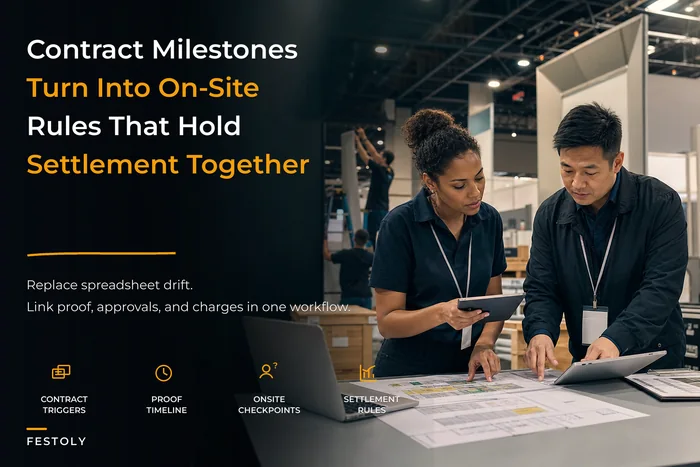
This is the same dependency discipline that governs exhibitor and vendor timing. If you've already mapped how contract milestones connect to on-site rules, the staging walkthrough is the safety-and-permit layer that sits underneath it — vendors can't set up in a zone that hasn't cleared inspection, regardless of what their contract says.
The mistake to avoid: treating the walkthrough as a single event the day before. Real staging timelines are a sequence of gated checkpoints spread across two to four days, each one unlocking the next. Compress them and one failed inspection cascades into everything behind it.
A real scenario: the reception that almost didn't open
A regional trade association ran a two-day indoor conference for years without incident. In their fourth year they added an outdoor evening reception for roughly 400 guests — tent, generator, and a bar. They planned it the way they planned everything else: internally, on a compressed timeline.
Ten days out, they discovered the tent needed a temporary structure permit and a fire inspection, neither of which had been filed. The noise variance for the amplified band hadn't been requested either. The team scrambled, paid around $1,400 in combined expedite and rush fees, and got the structure permit through with about 48 hours to spare. The noise variance didn't clear in time — the band went acoustic and the DJ cut off at 9 p.m. instead of the planned 11.
The following year, they built the full model: a backward-planned permit calendar anchored to statutory lead times, a RACI with a single accountable name per permit, and liaison templates for each city office they dealt with. Permit-related surprise costs dropped to essentially zero. The coordinator figured they saved somewhere around 20–25 hours of frantic month-of phone-tag, and the reception ran its full schedule. Same event, same city, same permits — the only thing that changed was the system around them.
When this framework is worth building — and when it isn't
Build the full model when: your events include outdoor components, temporary structures, road impact, amplified sound, alcohol, or open-flame food service — anything that pulls in a municipal inspector. Also build it if you run recurring events, because the calendar and templates compound in value each cycle.
Keep it lightweight when: you're running fully indoor events in venues that absorb the permitting, or one-off small gatherings where the venue's operations team owns compliance end to end. In those cases a full RACI is overhead you don't need.
Who should not overbuild this: newer planners doing their first few contained indoor events. Spend that energy on the venue relationship and the run-of-show. Add the municipal coordination layer the moment you take the event outdoors or across a property line — not before.
Most organizers land somewhere in the middle: they need the permit calendar and the escalation anchors, and they can run a stripped-down RACI. Match the model to the actual regulatory surface of your event rather than adopting the whole framework because it looks thorough.
Keeping the system alive between events
The framework decays fast if it lives in one person's head or in a folder nobody opens between events. The permit calendar should carry forward year over year with dates that recalculate against the new event date. The RACI needs a review each cycle because people leave and roles shift. Liaison contacts need verifying too — calling last year's city contact and reaching a disconnected line is one of the most reliable failure patterns across recurring events.
A shared system of record matters more here than any individual template. When the calendar, the ownership map, the escalation contacts, and the correspondence log all live somewhere the whole team can see, coordination stops depending on whoever happened to run it last time. That's the real goal — not more documents, but fewer surprises, because the handoffs between your team, the venue, and the city finally have somewhere to live instead of falling into the gaps between them.
The framework decays fast if it lives in one person's head or in a folder nobody opens between events. The permit calendar should carry forward year over year with dates that recalculate against the new event date. The RACI needs a review each cycle because people leave and roles shift. Liaison contacts need verifying too — calling last year's city contact and reaching a disconnected line is one of the most reliable failure patterns across recurring events.
Ready to elevate your event management?
Join 5,000+ event organizers using Festoly to save time, improve coordination, and deliver memorable experiences.