


The exhibitor contract lands in your inbox Thursday afternoon. Thirty-two pages. Payment schedule on page 8, booth setup requirements scattered across pages 14-19, deliverable deadlines buried in an appendix. Your operations manager has their own spreadsheet tracking floorplan compliance. Finance has another one for invoicing milestones. The on-site team uses a printed checklist that doesn't match either document.
By the time your 200-vendor trade show rolls around, you're managing exhibitor operations through seventeen different spreadsheets, three email threads per vendor, and a whiteboard system that only makes sense to the person who created it four events ago.
This disconnection between contract terms and operational execution isn't just messy—it's actively costing you money and creating vendor disputes that damage relationships.
The Hidden Complexity of Exhibitor Coordination
Most event organizers treat exhibitor management as three separate workflows: sales/contracting, on-site operations, and financial settlement. Makes sense on paper. Falls apart in practice.
Each department creates their own tracking system. Sales logs contract terms in their CRM. Operations builds booth assignment spreadsheets. Finance maintains payment tracking in accounting software. The floor manager walks around with a clipboard noting violations. Nobody's information matches because they're all tracking different aspects of the same vendor relationship.
The real operational challenge isn't managing exhibitors—it's maintaining a single source of truth about what each exhibitor owes, what they're allowed to do, and what they've actually delivered.
Consider a mid-sized consumer goods expo with 175 exhibitors. Each vendor has different contract terms based on when they signed up and what package they selected. Early-bird exhibitors get premium placement but stricter setup windows. Corner booths have different electrical requirements. Some vendors pre-purchased lead scanning, others will decide on-site. Premium sponsors have custom activation zones that override standard booth boundaries.
Now multiply those variations across all your exhibitors, add in the reality that contracts get amended, payments arrive late, and on-site requests constantly change the original agreement. Without a unified exhibitor operations framework, you're essentially running 175 separate mini-events within your main event.
Mapping Contract Terms to Operational Reality
The exhibitor operations framework starts with understanding that every contract clause creates an operational requirement. Payment terms trigger invoicing workflows. Booth specifications require setup verification. Deliverable deadlines need proof of completion. Marketing benefits demand fulfillment tracking.
Eliminate event chaos with Festoly.
Manage every aspect of your event seamlessly — from planning to execution.
- Centralized event scheduling
- Real-time attendee tracking
- Vendor & resource coordination
No credit card required
Contract Clause → Operational Checkpoint → Verification Method
| Contract Element | Operational Trigger | Proof Required | Responsible Team |
|---|---|---|---|
| 50% deposit due 90 days out | Invoice generation at T-90 | Payment confirmation | Finance |
| Final payment 30 days out | Access credential hold if unpaid | Bank verification | Finance + Registration |
| 10x10 booth dimensions | Floor marking at T-2 days | Setup photo + measurements | Operations |
| 500 lb weight limit | Load-in inspection | Scale ticket or engineer cert | Facilities |
| Logo due for program | Design lock at T-45 days | Approved artwork file | Marketing |
| Lead scanner rental | Device assignment at check-in | Serial number log | Technology |
| Breakdown by 6pm Sunday | Dock access scheduling | Exit checkpoint signature | Operations |
The framework transforms vague contract language into specific operational checkpoints with clear ownership and verification requirements.
Most exhibitor management breaks down at the handoffs between these checkpoints. Finance confirms payment, but operations doesn't know to release the booth space. Marketing receives the logo but registration doesn't update the badge printing queue. The lead scanner gets assigned but nobody tells the help desk who's authorized to pick it up.
Building Settlement Workflows That Scale
Settlement is where bad exhibitor operations really show their teeth. Three weeks after the event, you're still chasing down overtime charges, electrical overages, and damage assessments. Your accounting team is reconciling against contracts they've never seen. Exhibitors are disputing charges based on verbal agreements made on the show floor.
A scalable settlement workflow needs three components: pre-defined charge triggers, real-time documentation, and automated reconciliation rules.
-
Electrical usage over contract allocation
$75 per additional 20-amp circuit
-
Booth extension beyond boundaries
$500 per linear foot
-
After-hours forklift service
$200 per 15-minute increment
-
Cleaning service for excessive debris
$150 flat fee
-
No-show without 48-hour notice
Forfeit 100% of booth fee
These aren't just policies—they're operational rules that can be systematically applied and automatically calculated.
Real-time documentation means capturing violations and additional services as they happen, not reconstructing them from memory later. When an exhibitor requests an extra table at 7am on show day, that request needs to be logged with timestamp, authorizing person, and delivery confirmation. When their booth extends six inches into the aisle, that measurement gets recorded with photographic evidence during the morning walkthrough.
The reconciliation workflow pulls together contract terms, operational checkpoints, and documented exceptions into a single exhibitor settlement statement. Instead of manually creating invoices based on scattered notes, the system automatically generates base contract fees, payment status, successfully completed milestones, additional services requested and delivered, violations with documentation, and final balance with supporting evidence.
WORKFLOW: Exhibitor Settlement Process
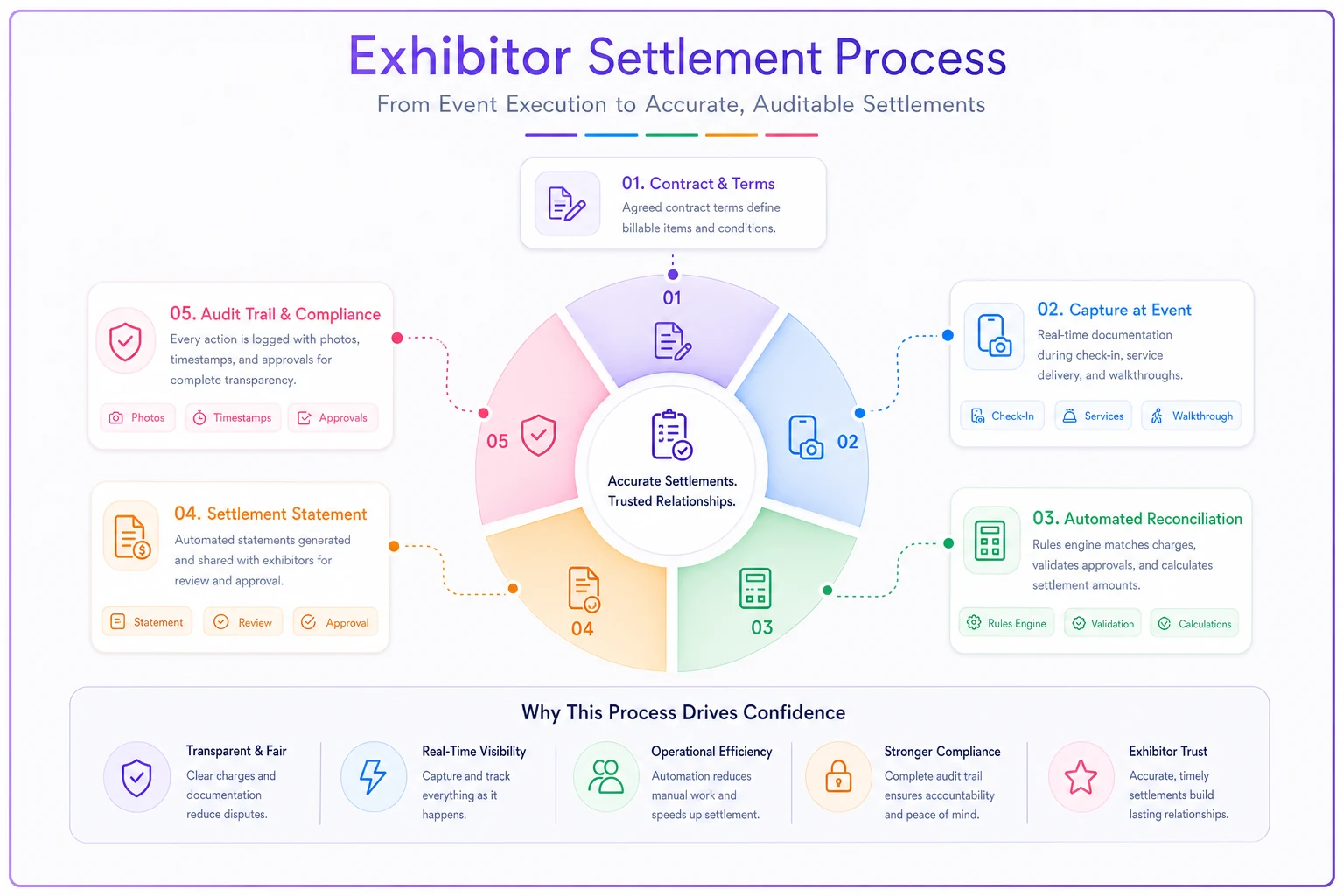
This graphic represents the core flow from contract terms to final settlement and the documentation points to capture along the way.
The Floorplan Compliance Challenge
Booth boundaries seem simple until you're managing them at scale. The approved floorplan shows clean 10x10 squares. Reality on show day includes display materials creeping into aisles, tall signage blocking sightlines, unofficial "overflow" areas behind booths, vendors who swapped spaces without telling anyone, and premium sponsors with negotiated exceptions nobody documented.
Traditional approach: print the floorplan, walk the floor with a tape measure, write violations on paper, argue with exhibitors, maybe follow up later.
Systematic approach: pre-mark booth boundaries with floor tape, photograph each booth at specific checkpoints (setup completion, daily opening, breakdown start), map violations to specific contract clauses, generate compliance reports with visual evidence.
The difference is moving from subjective enforcement to objective documentation. When an exhibitor claims they "always set up this way," you have timestamped photos showing exact measurements against marked boundaries. When they dispute an aisle blockage charge, you have the image from the 11am safety walkthrough.
This isn't about being punitive—it's about fairness and consistency. The exhibitor operations framework ensures every vendor gets treated according to their actual contract terms, not based on who complains loudest or knows someone on the organizing team.
Proof Artifacts and Milestone Verification
Every exhibitor contract includes deliverables, but few events have systematic ways to verify completion. The sponsor who promised social media posts—did they actually post them? The vendor who committed to staffing their booth during all show hours—were they actually there? The exhibitor who agreed to submit lead data within 48 hours—did it arrive?
Creating proof artifacts for common milestones works better than hoping people remember to follow through.
Pre-Event Milestones:
Certificate of insurance requires PDF upload with expiration date tracking.
Marketing materials approval needs screenshots of final approved versions.
Staff registration demands named lists with badge numbers assigned.
Freight tracking requires carrier confirmation with delivery timestamps.
On-Site Milestones:
Booth setup completion needs photos showing full display before show open.
Staffing presence requires badge scans or visual checks at specified times.
Demo schedule adherence demands timestamp logs of actual vs planned demos.
Lead scanner return needs device check-in with data sync confirmation.
Post-Event Milestones:
Breakdown completion requires empty booth photos with timestamps.
Lead data submission needs file receipts with record counts.
Survey participation requires response confirmation from survey platforms.
Final payment needs bank transfer confirmation numbers.
The key is making proof collection part of the natural workflow, not an additional burden. When the operations team does their morning floor walk, they're already taking photos—those become staffing verification artifacts. When exhibitors check out their lead scanners, the serial number log becomes the equipment tracking artifact.
Technology Integration Points
The exhibitor operations framework breaks without the right connection points between systems. Your registration platform knows who's checked in. Your payment system knows who's paid. Your floorplan software knows who's assigned where. But if these systems don't talk to each other, you're back to manual spreadsheet reconciliation.
Critical integration points for exhibitor operations include registration connecting to payment systems so credentials don't activate until payment clears. Floorplan software needs to connect to operations checklists so when booth assignments change, every downstream checklist gets automatic updates. The electrical contractor, carpet installer, and cleaning crew all need the current layout, not the version from two weeks ago.
Contract databases should connect to settlement systems so additional charges and credits pull directly from documented contract terms. When an exhibitor orders extra furniture on-site, the pricing should match their contract rate, not require manual lookup.
On-site documentation needs to flow to accounting so photos, violations, and service requests captured during the event flow directly into settlement calculations, not sit in someone's phone until three weeks later.
Common Failure Points at Different Scale Thresholds
The exhibitor operations framework that works for 25 vendors breaks at 75. What handles 75 falls apart at 200. Each scale threshold introduces new failure points.
-
25-50 Exhibitors Manual tracking still possible but error-prone. One person knows all the special arrangements, but if they're sick on show day, chaos ensues.
-
50-100 Exhibitors Spreadsheet systems start breaking. Version control becomes impossible. Main failure point is handoff communication. Different teams have different information, and reconciling becomes a full-time job.
-
100-200 Exhibitors Cannot function without systematic workflows. Main failure point is exception handling. Standard processes exist, but every vendor seems to need a special accommodation that breaks the system.
-
200+ Exhibitors Requires full operational framework with automated workflows. Main failure point is real-time coordination. By the time violations are documented and processed, the event is over and leverage is gone.
The solution isn't just adding more staff or better spreadsheets. It's building an exhibitor operations framework that scales through process standardization, systematic documentation, and automated reconciliation.
Preventing Scope Creep Through Operational Boundaries
Every exhibitor wants something extra. A little more space. Earlier setup access. Custom electrical configuration. Exclusive category protection. Without clear operational boundaries, these requests compound into unmanageable complexity.
The exhibitor operations framework prevents scope creep by defining what's possible at an operational level, not just a contractual one. Yes, the premium sponsor's contract says they can have a 40-foot display. But if the ceiling height is only 30 feet, that's an operational boundary that overrides the contract term.
Operational boundaries to define upfront include maximum booth dimensions based on aisle requirements, electrical capacity per floor section, weight limits based on venue flooring, setup and breakdown windows based on dock access, noise levels based on concurrent programming, and storage limitations based on available space.
When these boundaries are documented in the exhibitor operations framework, you can respond to requests with objective limitations rather than subjective decisions. "We'd love to accommodate your 50-amp request, but this hall section only has 200 amps total for eight booths" is very different from "That seems like too much power."
Building Reconciliation Workflows That Don't Require Archaeology
Three weeks after an event, trying to figure out why an exhibitor was charged $400 shouldn't require detective work. But in most organizations, it means digging through email threads, checking multiple spreadsheets, and calling three different people to reconstruct what happened.
A proper reconciliation workflow captures everything in real-time and maintains the audit trail through service request logs with timestamps, requester details, authorizer information, and delivery confirmation. Violation documentation needs photo evidence, measurement data, and specific contract clauses violated. Exception approvals require documentation of who approved what variance from standard terms and when.
Payment timelines track when invoices were sent, payments received, and credits applied. Dispute resolution documents exhibitor complaints, resolution decisions, and supporting documentation.
This documentation lives in the exhibitor operations framework, not scattered across departments. When finance needs to explain a charge, they can pull the complete history: original contract terms, operational checkpoints, documented delivery, and payment records—all in one place.
When Manual Frameworks Hit Their Limit
Even the best manual exhibitor operations framework eventually breaks. The complexity compounds. The exception list grows longer than the standard process. The reconciliation spreadsheet takes three hours to update after each event.
This is where AI-powered operational software becomes transformative for exhibitor management. Instead of manually mapping contract terms to operational checkpoints, the system automatically parses contracts and generates checkpoint schedules. Rather than walking the floor with clipboards, teams capture violations through a mobile app that automatically links photos to booth assignments and contract terms.
The real value isn't replacing human judgment—it's eliminating the manual busywork that prevents your team from exercising that judgment effectively. When AI automation handles routine tracking, documentation, and reconciliation, your operations team can focus on solving exhibitor problems rather than just documenting them.
Our exhibitor management platform helped events reduce settlement disputes by 70% just through maintaining clear documentation trails. One conference with around 180 exhibitors went from spending two weeks on post-event reconciliation to having preliminary settlements ready within 48 hours. The operational playbook approach they'd implemented for general operations became the foundation for systematizing exhibitor workflows.
Making the Framework Stick
Creating an exhibitor operations framework is one thing. Getting your team to actually use it during the chaos of event execution is another. The framework only works if it becomes the default way of operating, not an additional layer of bureaucracy.
Start by simplifying the on-site tools. If your floor team needs to log into three systems to document a booth violation, it won't happen. If settlement requires manually copying data between platforms, errors will proliferate. The framework should make their jobs easier, not harder.
Consolidate on-site logging into a single mobile workflow to increase compliance and reduce missed checkpoints.
Train on the why, not just the how. When your team understands that documenting booth violations protects against disputes, they're more likely to be thorough. When they see that checkpoint verification prevents last-minute payment surprises, they'll maintain the discipline.
Most importantly, close the feedback loop. After each event, review what broke and adjust the framework. Maybe the electrical checkpoint happens too late. Perhaps the booth photo requirement creates bottlenecks. The exhibitor operations framework should evolve based on operational experience, not theoretical perfection.
From Reactive to Systematic
The difference between exhibitor chaos and exhibitor control isn't about having more staff or better vendors. It's about building an exhibitor operations framework that connects every contract term to an operational checkpoint, maintains clear documentation throughout execution, and automatically reconciles variances into accurate settlements.
This systematic approach transforms exhibitor management from a reactive scramble into a predictable operation. Instead of discovering payment issues on setup day, you know weeks in advance. Rather than arguing about booth violations after the fact, you have photographic evidence captured in real-time. Instead of spending weeks on settlement, the framework generates preliminary statements before breakdown is complete.
The exhibitor operations framework isn't just about avoiding problems—it's about scaling your capacity to handle more exhibitors without proportionally scaling your operational overhead. When the framework for tracking ROI and metrics shows strong exhibitor satisfaction scores alongside reduced operational costs, you know the system is working.
For events serious about growth, exhibitor operations can't remain a collection of spreadsheets and good intentions. The complexity will eventually overwhelm manual systems. Building a proper exhibitor operations framework—whether through disciplined process design or AI-powered platforms—is the difference between managing 50 exhibitors with stress and handling 200 with confidence.
The framework exists. The question is whether you'll build it before or after your next exhibitor management crisis.
Ready to elevate your event management?
Join 5,000+ event organizers using Festoly to save time, improve coordination, and deliver memorable experiences.