

Most power failures at festivals don't happen because the generator died. They happen because someone plugged a 40kW LED wall into a leg already carrying most of the food court, tripped a breaker at 8:40 PM during headliner load, and nobody had a written procedure to bring it back without cascading the outage. The generator sat there humming, perfectly fine, while half the site went dark.
That's the frustrating part about temporary event power. The equipment is usually rated correctly. The failures come from load math done on the back of a napkin, phases that drift out of balance as the night goes on, and start/stop sequences that live in one contractor's head instead of on paper.
This spec is built for the 5k–20k attendee range — multiple stages, a vendor row, production offices, and enough distributed load that "just rent a big genset" stops being a real plan. We'll work through actual load-sizing math, phasing rules that hold under real draw, staged start/stop procedures, a failover drill cadence you can actually run, and a genset-staging manifest example you can adapt.
Start with the load math, not the generator catalog
The number one mistake is sizing from a spreadsheet of nameplate ratings and adding them up. Nameplate is worst-case continuous draw, and almost nothing on your site runs at nameplate continuously. But the opposite mistake — eyeballing it low because "we did fine last year" — is how you end up with a genset running at 92% load with zero headroom for a motor start.
Step 1: Separate your loads into three buckets.
-
Continuous loads — things that run all day at a steady draw
LED lighting rigs, refrigeration, production trailers, comms.
-
Cyclic loads — HVAC compressors, water pumps, ice machines. These have inrush spikes when they kick on.
-
Peak-coincident loads — audio, video walls, stage lighting that all ramp during a show and drop between acts.
Step 2: Apply a demand factor per bucket, not a blanket one.
Say your vendor row has 30 food stalls, each with a 3kW nameplate draw for fridges, warmers, and lights. Nameplate total is 90kW. But not all 30 run their full load simultaneously — warmers cycle, some stalls open late. In real operations, a demand factor of around 0.7 for a food row is realistic, bringing your planning number to roughly 63kW. Refrigeration you keep near 1.0 because it doesn't stop.
Step 3: Add motor-start headroom, separately.
This is where people get burned. A 5-ton HVAC compressor might draw 6kW running but pull 3–4x that for a second or two on start. If three cooling units on the same genset happen to cycle together, that inrush can nose past your breaker even though your steady-state math looked fine. Size for the largest probable simultaneous motor start on top of your continuous load — not averaged in.
A worked example
| Load group | Nameplate (kW) | Demand factor | Planned load (kW) |
|---|---|---|---|
| Stage lighting rig | 48 | 0.75 | 36 |
| Line array + amps | 30 | 0.60 | 18 |
| Video wall (LED) | 40 | 0.85 | 34 |
| Production/FOH trailer | 12 | 0.90 | 11 |
| HVAC (2 units) | 14 | running 1.0 | 14 |
| Subtotal (continuous) | 113 kW |
Now add the largest probable motor start. One HVAC compressor inrush adds roughly 18–21kW of transient demand on top. So your instantaneous peak sits near 131–134kW.
A 150kW genset here puts you at 75–89% depending on the moment — fine for peak, but leaves almost nothing if the video wall content spikes white. The right move for a stage zone is usually a 175kW–200kW unit, targeting a comfortable 60–70% steady-state load. That band matters: diesel gensets that idle under ~30% load for hours wet-stack and foul, and running above ~85% for long stretches kills your recovery headroom.
The pattern worth remembering: size continuous load to sit in the 60–70% band, and confirm your peak-plus-largest-motor-start stays under ~85%. Two separate checks, not one.
Phase balancing is a live problem, not a setup task
Three-phase gensets have three legs, and your job is to keep the load roughly even across all three. If you dump 70kW on L1, 40kW on L2, and 20kW on L3, the generator "sees" 70kW as its limiting leg — you'll trip or overheat the overloaded phase while two-thirds of your capacity sits unused.
Eliminate event chaos with Festoly.
Manage every aspect of your event seamlessly — from planning to execution.
- Centralized event scheduling
- Real-time attendee tracking
- Vendor & resource coordination
No credit card required
The part people miss: phase balance drifts during the event. You balance it at load-in when everything's off. Then the food row powers up at different times, the video wall comes on, an exhibitor plugs a space heater into whatever outlet is closest, and by evening L1 is carrying 25% more than L3.
-
Assign phases on the manifest, not in the field. Every distro tap gets a designated leg written down before load-in. "Coffee stalls 1–8 → L1, stalls 9–16 → L2" and so on. Field electricians balancing by feel under time pressure is where drift starts.
-
Balance the big movers first. Video walls and stage lighting are your largest, spikiest loads. Spread those across all three legs deliberately, then fill in smaller loads around them.
-
Read your legs at the peak, not at setup. Have someone log per-phase amps at each distro during the highest-draw window (usually headliner). If any leg is more than about 15–20% off the others, rebalance during the next changeover.
Log per-phase amps at peak and rebalance during the next changeover if a leg is >15–20% off.
The failure signature of bad phasing is a genset tripping at, say, 65% of its rated total load — which makes no sense until you check individual legs and find one sitting at 95%.
Staged start-up and shutdown procedures
Bringing an event's power up all at once is asking for a nuisance trip. Every load's inrush hits the genset simultaneously, and the combined transient can exceed what steady-state math predicted. Staged sequencing solves this — and shutdown sequencing prevents the "everything back on at once" surge when you restore after a fault.
Start-up sequence (per genset zone)
-
Genset online, no load. Let it stabilize voltage and frequency. 60–90 seconds.
-
Continuous base loads. Production trailers, comms, lighting distros first. These are steady and give the genset a stable base.
-
Large cyclic loads, one at a time. HVAC units staggered by 15–30 seconds so their inrush doesn't stack.
-
Peak/show loads last. Video walls, line arrays, stage lighting — brought up after everything else is stable, ideally during a soundcheck window, not cold at doors.
Shutdown sequence
Reverse it. Drop peak/show loads first, then cyclic, then base, and only then take the genset offline. If you kill the genset with full load connected, restart puts every load back at once — and that's the surge that trips you during a recovery you can't afford.
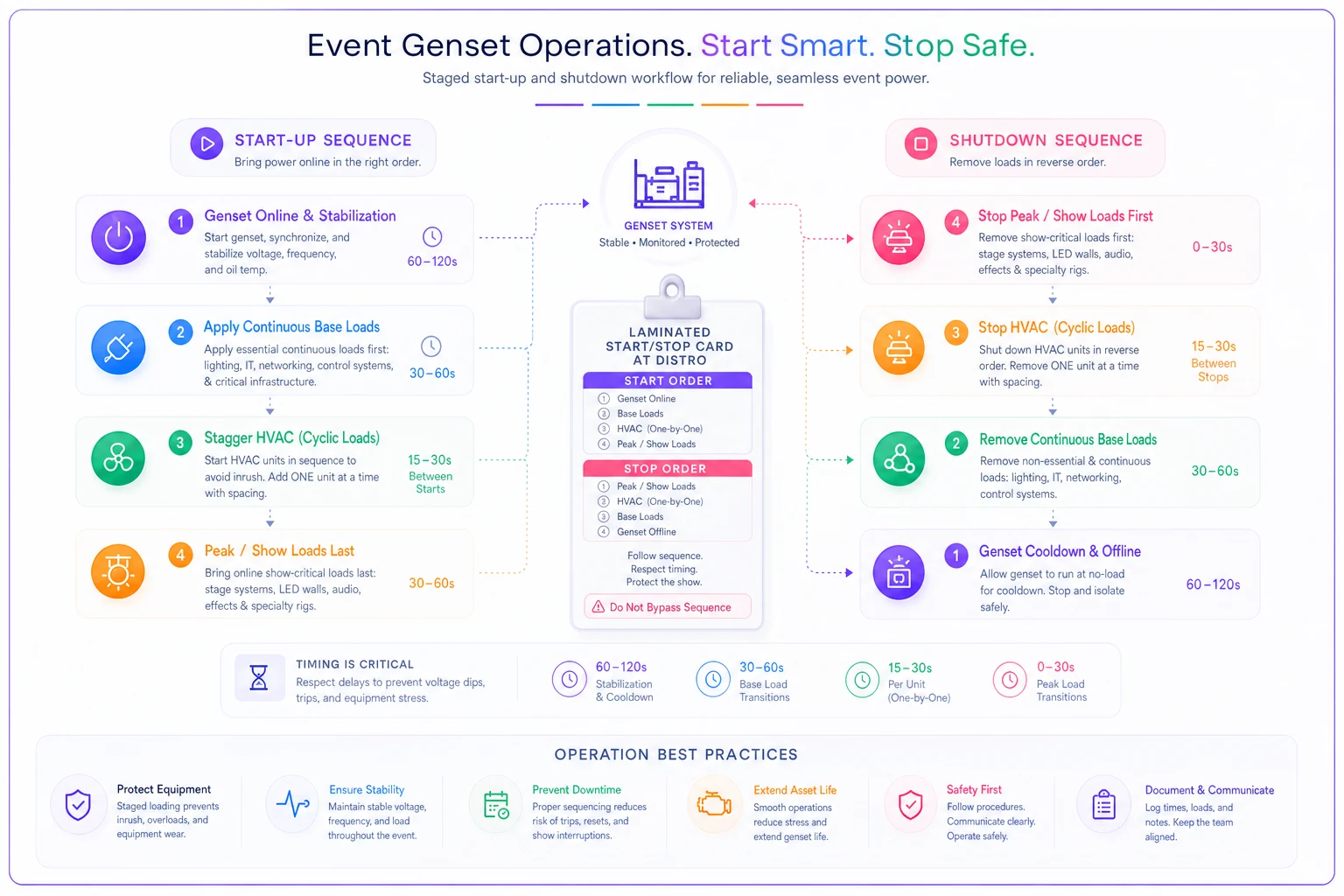
A quick visual of the staged start/stop workflow for crews.
Write these sequences on a laminated card at each distro. The most valuable habit here is that start/stop is a documented procedure, not a person. When your lead electrician is dealing with something else during a fault, the second-in-command needs to run the exact same sequence without guessing.
Failover: N+1, transfer, and the drill cadence
Redundancy on paper is worthless if nobody has practiced the switchover. There are two common redundancy models for mid-size festivals:
| Model | How it works | Best for |
|---|---|---|
| N+1 standby | A spare genset sits idle, manually or auto-transferred if a primary fails | Cost-sensitive sites where a 2–4 min gap on non-critical loads is acceptable |
| Paralleled / synchronized | Multiple gensets share load; one can drop without the others going down | Critical loads — main stage, medical, comms — where zero-gap is required |
For most mid-size festivals, the practical answer is paralleled gensets on your critical zones (main stage, medical, production comms, emergency lighting) and N+1 standby on non-critical zones (vendor row, secondary activations). You don't pay for zero-gap redundancy on a coffee stall.
Drill cadence
-
Pre-event (during commissioning) Full failover test on every critical zone. Deliberately drop a primary and time the transfer. Log the gap in seconds. Anything over your spec — say 2 seconds for auto-transfer — gets fixed before doors.
-
Doors-day morning A single "cold" transfer test per zone before the public arrives, confirming overnight nothing drifted (fuel, connections, controller settings).
-
Between show changeovers (multi-day) One tabletop walkthrough per day with the on-shift crew — who does what, in what order, when a genset drops. No live switch, just the sequence spoken aloud so the current shift owns it.
-
Post-incident Any real trip or transfer gets a 10-minute debrief logged the same night, not "we'll discuss it Monday."
Teams that drill failover before doors recover in seconds. Teams that skip it discover their auto-transfer switch was mis-set while 8,000 people stand in the dark. This connects to broader contingency planning too — if you're building out your full incident response, our Event Risk & Resilience Framework covers how power failover fits into the wider operational trigger structure.
A generator-staging manifest example
The manifest is what turns all this into something a crew can actually execute. It ties each genset to its zone, its assigned phases, its loads, and its failover partner. A stripped example for a three-zone site:
| Genset | Zone | Rating | Target load | Failover | Critical? |
|---|---|---|---|---|---|
| G1 + G2 (parallel) | Main stage | 2× 200kW | ~130kW each | Shared parallel — either can drop | Yes |
| G3 | Vendor row | 250kW | ~165kW (~66%) | G-Standby (auto-transfer) | No |
| G4 | Production + comms + medical | 150kW | ~95kW (~63%) | G-Standby (manual) | Yes |
| G-Standby | Roaming spare | 250kW | 0 (idle) | Serves G3 or G4 on failure | — |
Alongside this, each genset gets a per-phase load sheet:
-
G3 Vendor Row phase assignment
-
L1
Food stalls 1–10, ATM bank → ~55kW
-
L2
Food stalls 11–20, ice/refrigeration → ~57kW
-
L3
Stalls 21–30, vendor row lighting → ~53kW
Balance check window: 7:30–8:30 PM. Rebalance threshold: >15% leg imbalance.
Fuel and refuel timing belong on the manifest too. A 250kW genset at 66% load burns roughly 12–14 gal/hr, so a 400-gallon tank gets you close to 28–32 hours — and you plan refueling during a low-draw window, never mid-headliner. The staging manifest also works alongside your load-in scheduling. Coordinating genset drops, fuel deliveries, and cable runs through timed gates is exactly the kind of thing our Load-In / Load-Out Scheduling Playbook is built to keep from colliding.
A real scenario
A two-day music festival, roughly 12,000 attendees across three stages, had been running a single large genset per zone with no documented phasing and a "spare on the truck" as their entire failover plan. Year one, the main stage genset tripped its L1 breaker during Saturday's headliner — not because it was overloaded overall, but because the video wall and half the stage lighting had ended up on the same leg. Recovery took around nine minutes because nobody had a start-up sequence written down. They were restarting loads by trial and error and tripping again.
The next year they rebuilt around a manifest: paralleled gensets on the main stage, assigned phases per distro, a staged start-up card at every panel, and a full failover drill during commissioning that caught a mis-set transfer switch on the vendor zone before doors. Saturday night, one main-stage genset threw a fault — and the paralleled partner carried the load with what the crew described as a barely noticeable dip. No dark stage.
The vendor zone had one nuisance trip on the food row, recovered in under two minutes because the shutdown/restart sequence was laminated on the panel. The equipment budget went up modestly — a second parallel unit and better distro. The operational difference came from having a documented spec instead of tribal knowledge living in one electrician's head.
When this level of rigor makes sense — and when it doesn't
When it's worth it: Multi-stage events above roughly 5k attendees, anything with critical loads (medical, comms, mass-notification), multi-day runs where fatigue erodes field judgment, and any site where a dark stage means refunds or safety exposure. At this scale, the cost of one documented failure exceeds the cost of doing the math properly.
When it's overkill: A single-stage community event with one modest genset, mostly lighting and a small PA, and non-critical vendor load. Full paralleled redundancy and phase-assignment manifests for a 1,500-person afternoon event is engineering effort you won't recover. A correctly sized single genset with a tested spare is enough.
Who should not run this themselves: If you don't have a licensed electrical contractor doing the actual connections, phasing, and load calcs, this is not a DIY spec. The framework here is for coordinating and documenting the operation — the physical work and final load engineering belong to qualified electricians, and permitting requirements vary by jurisdiction.
The one habit that prevents most of it
If you take a single thing from this: write the power plan down as a manifest, phase assignments included, and drill the failover before doors.
Nearly every ugly outage at this scale traces back to load math that lived in someone's head, phases that drifted unwatched through the evening, or a redundancy plan that had never actually been tested under load.
If you take a single thing from this: write the power plan down as a manifest, phase assignments included, and drill the failover before doors. Nearly every ugly outage at this scale traces back to load math that lived in someone's head, phases that drifted unwatched through the evening, or a redundancy plan that had never actually been tested under load.
Ready to elevate your event management?
Join 5,000+ event organizers using Festoly to save time, improve coordination, and deliver memorable experiences.