
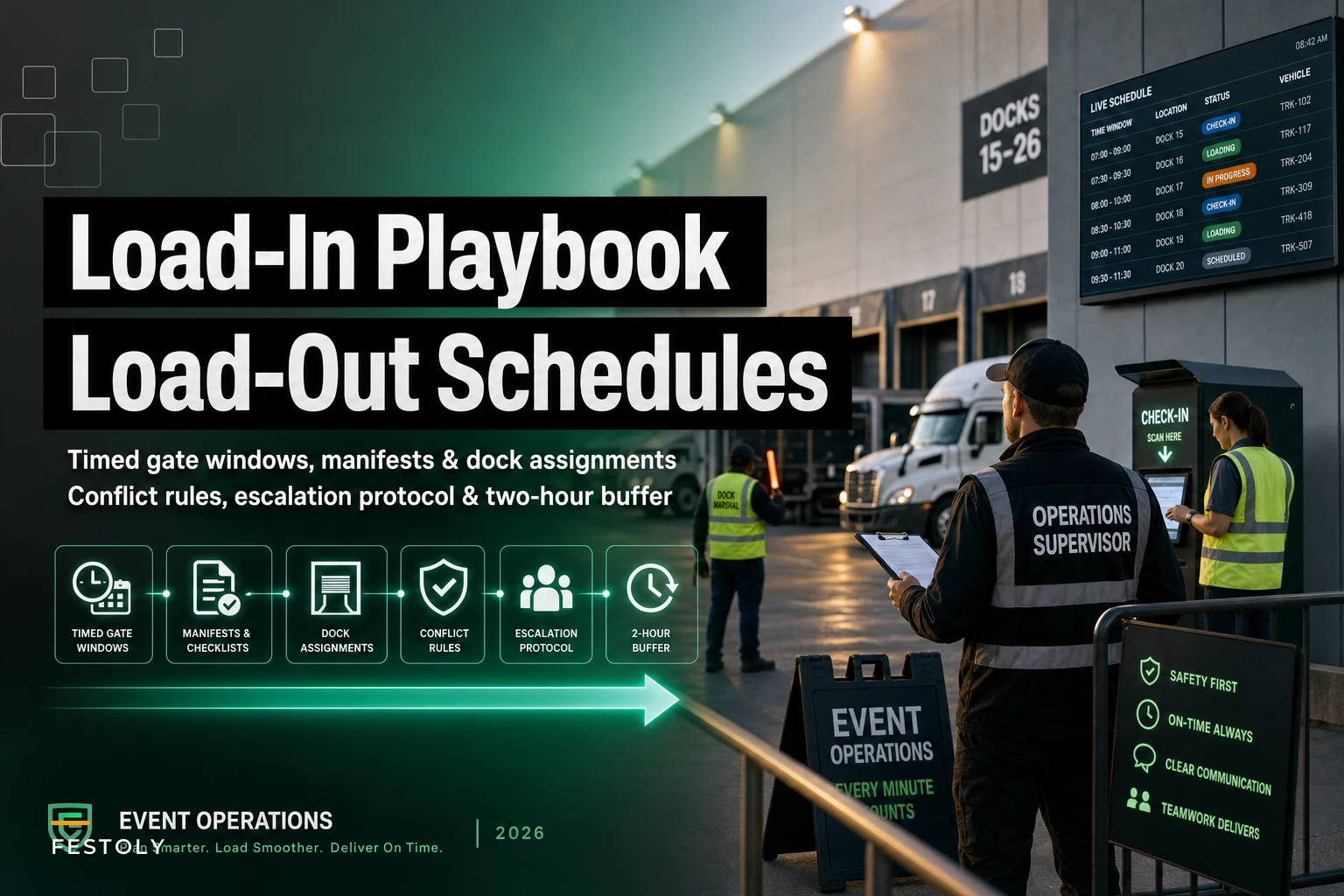

Move-in morning is where a lot of otherwise well-run events quietly fall apart. You can nail your run-of-show, your catering timing, your speaker rehearsals — and still lose four hours because two box trucks showed up at the same gate at the same minute, neither driver has a dock assignment, and the freight elevator is jammed with a piano case that was supposed to arrive the night before.
This piece is narrow on purpose. It's about the mechanics of moving exhibitors, vendors, and production gear in and out of a venue on a controlled schedule: how to build a load-in load-out schedule template that actually holds under pressure, what belongs in a manifest, how to resolve the inevitable gate conflicts without a screaming match at the dock, and how to build a short escalation ladder so problems get solved in minutes instead of half the morning.
Start with the constraint that actually breaks: gate throughput
Most schedules get built around when exhibitors want to arrive. That's backwards. The thing that limits you isn't demand — it's how many vehicles your gates and docks can physically absorb per hour.
A typical mid-size convention hall might have three roll-up doors and two dock levelers. If it takes an average of 35–45 minutes to back in, unload, and clear a 26-foot truck, then each dock realistically clears somewhere between 1 and 1.5 trucks per hour — once you account for the awkward reversing, the missing pallet jack, and the driver who wandered off to find coffee. Two working docks means you're moving maybe 2–3 trucks an hour, not the 8 you optimistically penciled in.
So the first number you need isn't a wish list. It's this:
> Gate capacity per hour = (number of usable docks) × (60 ÷ average dwell time in minutes)
Everything else in the schedule flows from that. If your capacity is 3 trucks an hour and you have 40 exhibitor deliveries, you're looking at roughly 13–14 hours of continuous unloading. That reality either reshapes your timeline or forces you into overnight staging. Better to know it a week out than at 6 a.m.
One pattern worth flagging: planners consistently underestimate dwell time for the smallest deliveries. A single-pallet exhibitor doesn't get in and out faster — they often take longer, because they don't bring their own labor, they don't have a dock plan, and they treat the loading area like short-term parking while they go set up their booth. Those are the ones that clog the gate.
Timed gate windows: assign slots, not free-for-all mornings
Once you know your hourly capacity, you slice the load-in period into windows and assign vehicles to them. The goal is simple: never have more trucks arriving in an hour than your gates can clear in that hour.
Eliminate event chaos with Festoly.
Manage every aspect of your event seamlessly — from planning to execution.
- Centralized event scheduling
- Real-time attendee tracking
- Vendor & resource coordination
No credit card required
Windows usually work best at 30- or 60-minute granularity. Any tighter and you're managing chaos; any looser and you lose the whole point. A window isn't a promise the truck goes in instantly — it's the time the driver must be staged and checked in at the marshaling area, ready to be called forward.
-
Production and rigging first. Anything that hangs from the ceiling or feeds power/data has to be in before booths. If audio, lighting, and rigging aren't done, exhibitors can't safely set up under them anyway.
-
Large custom builds next. Island booths, two-story structures, anything needing forklift time and a build crew. These block aisles, so you want them done before the aisles fill.
-
Standard inline exhibitors. The bulk of your traffic, spread across the widest part of the window.
-
Small deliveries and self-load exhibitors last. They're fast to place but slow to clear the dock, so they go when pressure is lowest.
-
Perishables and AV rentals timed to setup, not to convenience. Cold storage and rented gear shouldn't sit for six hours.
A quick reality check most people skip: build the load-out schedule at the same time you build load-in. Load-out is worse. Everyone wants to leave at once, drivers are tired, and half the exhibitors "forgot" their outbound shipping labels. If you sequence load-in but leave load-out as a mad dash, you've solved the easy half of the problem.
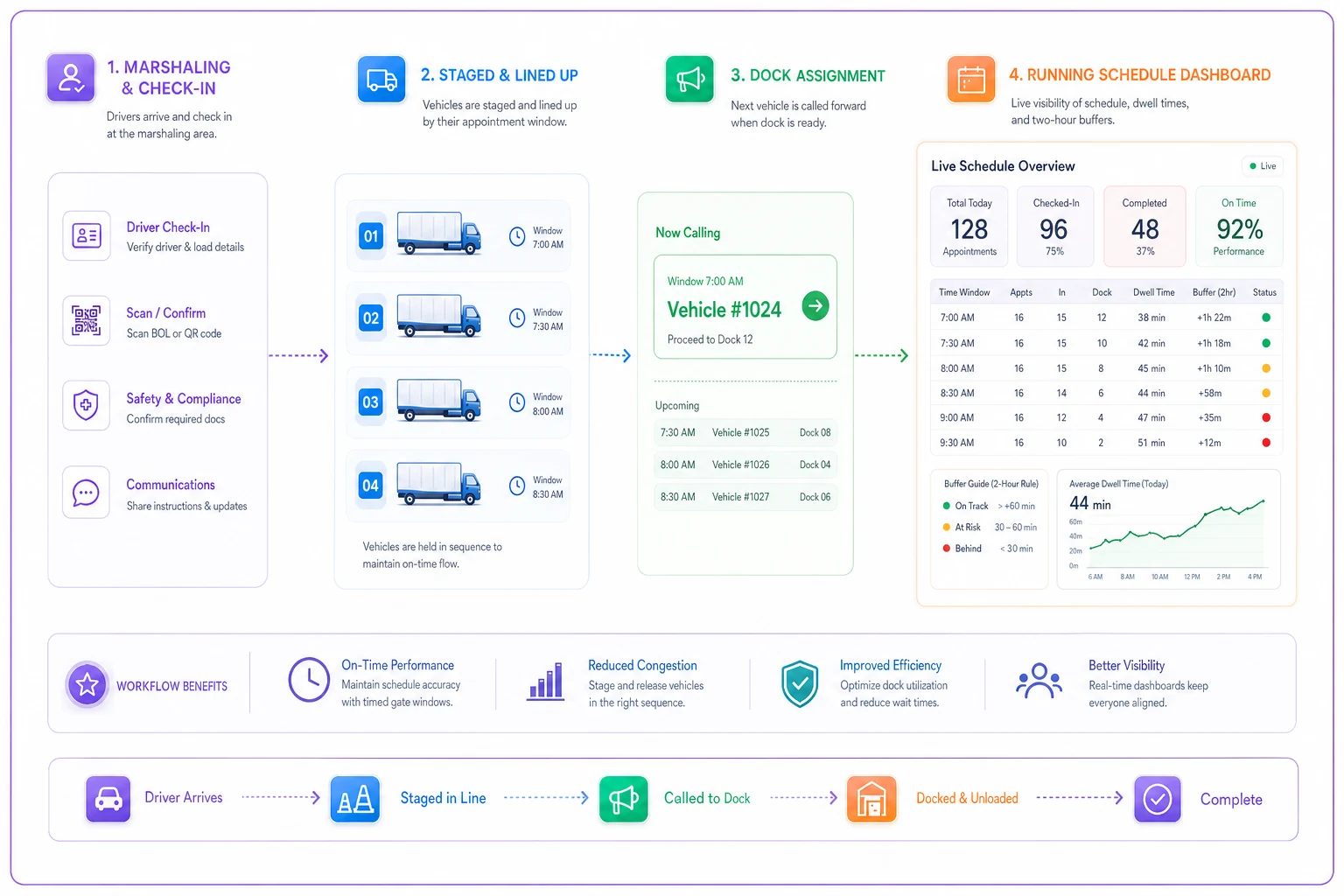
This sketch shows the basic flow from marshaling to dock assignment and how buffers absorb slips.
The manifest: what actually needs to be on it
A manifest that just lists company names is useless at the dock. The person waving trucks in needs to make a decision in about 15 seconds per vehicle, and they can only do that if the document tells them everything at a glance.
Here's a manifest structure that works in the field:
| Field | Why it's there |
|---|---|
| Slot / window | When they're expected staged |
| Company + booth # | Ties the truck to a physical destination |
| Vehicle type & length | Determines which dock/gate they can use |
| Driver name + cell | So you can call them forward or chase them |
| Dock assignment | Removes the "which door?" confusion at arrival |
| Labor needs (crew/forklift) | So the right equipment is waiting, not scrambled |
| Priority tier | Critical vs standard — drives conflict decisions |
| Est. dwell time | Feeds the running schedule |
| Contact on floor | Who signs for it / where it goes |
The two fields people leave off and regret: vehicle length and priority tier. Length matters because a 53-foot trailer physically cannot use a gate a box truck can, and finding that out when the trailer is halfway backed in is a 20-minute recovery. Priority tier matters because when two vehicles collide on the schedule — and they will — you need a pre-decided answer for who goes first.
Sample manifest (single gate, morning window)
| Slot | Company | Booth | Vehicle | Dock | Labor | Tier | Dwell |
|---|---|---|---|---|---|---|---|
| 6:00 | Apex Rigging | — | 53' trailer | A | Crew + lift | Critical | 90 min |
| 6:30 | BrightStage AV | — | 26' box | B | Crew | Critical | 60 min |
| 7:30 | Meridian Displays | 412 | 26' box | A | Lift | Standard | 45 min |
| 8:00 | Coastal Foods | 108 | Van (refrig) | B | Self | Critical | 30 min |
| 8:15 | Two Rivers Books | 233 | Sprinter | A | Self | Standard | 25 min |
| 8:45 | Nordic Home | 319 | 26' box | B | Lift | Standard | 45 min |
Double-check vehicle length and priority tier on every row during check-in — those two fields prevent most downstream recoverable failures.
Notice Apex and BrightStage both carry "Critical," but Apex gets the longer window and the earlier slot because rigging gates everything downstream. Tiering isn't just about VIPs — it's about dependency.
Conflict-resolution rules: decide the fights before they happen
Gate conflicts aren't rare edge cases. On a busy load-in, you'll hit several. A truck shows up 40 minutes early and wants in now. Two trucks arrive for the same window because one was delayed and drifted into the next. A "critical" exhibitor rolls up with no slot at all.
The mistake is resolving these in real time by whoever argues loudest. That's how the well-connected sponsor's furniture goes in before the power distribution the entire hall needs. Write the rules down before the day, and the dock manager can point to them instead of negotiating.
-
Scheduled beats unscheduled, always. A vehicle with a valid slot goes before one without, regardless of who they are. No exceptions signed off day-of.
-
Within the same window, priority tier wins. Critical before standard. If tiers are equal, first-arrived-and-staged goes first.
-
Early arrivals wait; they don't jump. An early truck can be called forward only if its dock is idle and no scheduled truck is due within the dwell time.
-
A late truck loses its slot after a grace period (commonly 20–30 minutes) and gets reinserted at the next open window. This one has to be enforced early in the day or it collapses by mid-morning.
-
Blocking beats non-blocking. A vehicle whose contents block aisles or gate access takes precedence over one that can wait in staging.
The single most useful habit here is keeping a live running clock of the actual schedule versus the planned one. When you're 25 minutes behind by 8 a.m., you already know it, and you can compress the small self-load slots to recover — instead of discovering the slip at noon. This kind of running handoff discipline is the same muscle described in our multi-day operations playbook on daily handoffs and RACI charts — clear ownership of who's allowed to make the call at the gate matters more than the schedule itself.
The two-hour buffer rule for critical exhibitors
Here's a rule worth adopting outright: every exhibitor or vendor whose absence would delay the whole event gets a two-hour buffer built into their scheduled slot.
Critical means anything downstream depends on it — rigging, power distribution, the main stage set, the registration hardware, refrigeration for a food hall. If any of these slip, dozens of other exhibitors can't start, and the delay compounds.
The buffer works like this. If rigging must be complete by 10 a.m. for booths to start building under it, you don't schedule the rigging truck to arrive at 8 and finish at 10 with zero margin. You schedule it to arrive by 6 and be done by 8, leaving two full hours before the downstream deadline. That buffer absorbs the flat tire, the wrong dock, the missing forklift operator — the things that always happen.
Why two hours? Because the typical recoverable failure — a late truck, a labor no-show, a dock mix-up — costs somewhere between 45 minutes and 90 minutes to resolve once someone actually notices it. Two hours covers most of those without cascading. One hour usually doesn't; you burn it just realizing there's a problem.
Standard exhibitors don't need this. Building buffers into all 40 deliveries would blow up your timeline. The point is to spend your slack where a slip actually propagates. A late books vendor at booth 233 delays one booth. Late power distribution delays the hall.
When timed gates make sense — and when they're overkill
Timed gate scheduling has real overhead. Building the manifest, assigning slots, staffing a marshaling area, and enforcing windows takes work. It's not always worth it.
It makes sense when:
-
You have more inbound vehicles than gate hours (roughly 15+ deliveries against limited docks)
-
Your venue has tight dock access, shared loading with other tenants, or street-level constraints
-
You have critical-path dependencies (rigging, power, staging) that can't be reordered
-
Load-out has a hard deadline — the venue books another event the next morning
It's overkill when:
-
You've got a handful of vendors and an open lot they can pull into freely
-
Setup happens over multiple relaxed days with no traffic pressure
-
The venue provides and manages its own dock scheduling (some large convention centers do — confirm this before duplicating their system)
Who should not run their own gate schedule: first-time organizers at a large venue that already has a house dock operation. Layering your schedule on top of theirs creates two sources of truth, and the drivers will follow whichever one yelled at them last. Coordinate into the venue's system instead.
A short escalation protocol
The value of an escalation ladder is that it stops small problems from swallowing the wrong person's attention. Your dock manager should not be calling the event director because a Sprinter van is 15 minutes late. But when the main power distribution truck is missing at its buffer deadline, that does need to jump up fast.
-
Level 1 — Dock lead resolves. Late standard truck, wrong dock, minor labor gap. Handled at the gate using the conflict rules. No escalation. Logged, not called up.
-
Level 2 — Load-in coordinator. Critical exhibitor delayed, a dock down, or the running schedule slips past roughly 30 minutes behind. Coordinator can reshuffle windows, pull backup labor, and reassign docks.
-
Level 3 — Event operations lead. A critical-path failure that the buffer won't absorb, a safety issue, or anything requiring money or a vendor-contract decision. This is the "we may miss doors" tier.
The trigger that should always jump straight to Level 2 or 3: a critical exhibitor hitting the halfway point of their two-hour buffer with no vehicle on site. That's your early warning that the buffer is being consumed, and it's the moment to start the backup plan — not when the buffer runs out.
A quick real scenario
A regional trade show — around 90 exhibitors, two working docks, one freight elevator serving a second-floor hall. The previous year they ran open load-in: doors open at 6, everyone shows up whenever. By 8 a.m. there were 11 trucks stacked on the access road, the fire lane was blocked, and the rigging crew couldn't get in because a furniture vendor's trailer was wedged at the only usable gate. Rigging finished around 1 p.m. instead of 9. Booth builders sat idle for hours, and the show floor wasn't ready until well into the evening — some exhibitors were still setting up as doors opened the next morning.
The following year they moved to timed windows: 45-minute slots, a manifest with vehicle lengths and priority tiers, a marshaling area two blocks away where drivers checked in and waited to be called, and a two-hour buffer on rigging and power. Rigging arrived at 6, finished before 8. The road never stacked more than two or three trucks. They still had hiccups — a late AV truck, a no-show forklift operator — but both got absorbed at Level 1 and 2 without touching the critical path. The floor was ready with time to spare. Nothing exotic happened. They just stopped letting demand set the schedule and let gate capacity set it instead.
Where scheduling software quietly earns its keep
Most of this can run on a well-built spreadsheet and a disciplined dock lead, and for smaller events it should. The place tooling starts to matter is the live side — when the plan meets reality and the schedule needs to shift on the fly.
The painful parts are keeping the manifest current when slots move, getting the updated dock assignment to a driver sitting in the marshaling lot, and knowing at a glance which critical exhibitor is eating into its buffer. AI-assisted operations platforms handle the mechanical work here: recalculating the running schedule when a truck slips, flagging when a critical slot is at risk, and pushing the new window to the right driver and dock lead without someone manually retyping it. That's less about automation for its own sake and more about removing the retype-and-relay lag that turns a 20-minute problem into a two-hour one.
You don't need it to run a good load-in. But once you're past a couple dozen vehicles with real critical-path dependencies, keeping everyone on the same current version of the schedule stops being a spreadsheet problem.
Load-in and load-out reward planning that starts from physical limits rather than preferences. Figure out how many trucks your gates actually clear per hour, sequence around your dependencies, protect the critical path with real buffers, and pre-decide the conflicts so nobody's negotiating at 6 a.m.
The manifest and the escalation ladder aren't paperwork for its own sake — they're what let a dock lead make a fast, defensible call without pulling you off whatever else is on fire. And if you're building the schedule alongside vendor agreements, it's worth checking your delivery-window and penalty language too, which we cover in vendor contract traps to avoid — a clear late-arrival clause makes your grace-period rule enforceable instead of aspirational.
Ready to elevate your event management?
Join 5,000+ event organizers using Festoly to save time, improve coordination, and deliver memorable experiences.