

Most sustainability efforts at events die in the same place: the gap between what the sponsorship deck promised and what the loading dock actually did on show day. The deck says "zero waste commitment." The loading dock has three unlabeled 40-yard roll-offs, a caterer who brought single-use plastic because nobody told them not to, and a waste hauler who commingles everything the moment it leaves the gate because segregation on-site fell apart by 2pm.
The problem isn't ambition. Sustainability gets treated as a theme instead of an operating model. A theme lives in marketing. An operating model lives in procurement contracts, vendor onboarding, bin placement, staff rolebooks, and a reporting cadence that produces numbers you can actually defend when a sponsor or municipality asks for proof.
This piece walks through how the whole system connects — from how you buy, to how vendors behave on-site, to where waste physically goes, to what you report afterward. The goal is an enforceable playbook, not a feel-good pledge.
Why Sustainability Falls Apart Operationally
Sustainability breaks at events for a boring, structural reason: the people who make the commitment aren't the people who execute it, and there's no enforcement layer connecting them.
The organizer's team writes the goal. Procurement signs the vendors. The ops team runs the floor. The waste hauler does whatever is cheapest and fastest. Each handoff loses information. By the time a bin is placed on-site, the original intent — "we committed to diverting 60% from landfill" — has evaporated into "put the trash cans near the food court."
A typical example: an organizer commits to a sustainability standard in the city permit. Procurement runs the catering RFP but scores entirely on price and menu, with no line asking about packaging or food-waste handling. The caterer wins, shows up with foam clamshells, and now the waste stream is contaminated before the first attendee arrives. Nobody did anything wrong according to their own job description. The system just had no gate that forced sustainability into the buying decision.
The commitment and the execution live in different documents that never talk to each other. The pledge is in the marketing plan. The behavior is governed by vendor contracts that never mention it. Close that gap and most of the chaos disappears.
Start With Procurement: The Preference Hierarchy
Sustainability is decided before anyone shows up. Roughly 70–80% of an event's waste profile is locked in by what you buy and who you hire. If you don't control procurement, everything downstream is just cleanup.
Eliminate event chaos with Festoly.
Manage every aspect of your event seamlessly — from planning to execution.
- Centralized event scheduling
- Real-time attendee tracking
- Vendor & resource coordination
No credit card required
The fix is a written procurement preference hierarchy — a ranked order of what you buy, in what material, under what conditions. It doesn't need to be complicated, but it needs to be enforceable, meaning it shows up as scored criteria in the RFP and as clauses in the contract.
-
Eliminate — Don't buy it at all. No printed programs if a digital version works. No giveaway items that end up in landfill by Monday.
-
Reuse — Rented or returnable infrastructure over single-use. Reusable serviceware, crate systems, refillable water stations.
-
Recyclable or compostable — Only where you have a confirmed downstream processor that will actually accept it (more on this later, because "compostable" without a composter is just expensive trash).
-
Recycled content — When you must buy new, require minimum recycled content.
-
Offset — Last resort, for the unavoidable remainder.
The common mistake is jumping straight to "compostable everything" without checking what your waste hauler can actually process. Compostable cups that go to a facility with no compost line end up in landfill, cost more than regular cups, and give you a false diversion number. Elimination and reuse always beat material substitution. Fewer things bought means fewer things to divert.
When procurement scoring includes sustainability as a weighted category — not a tiebreaker, an actual 15–25% of the score — vendors respond. They'll bring the reusable option when they know it wins the contract. This connects directly to how you write and negotiate agreements in the first place; if you're not careful with clause language, your sustainability requirements become "best efforts" wording that means nothing, which is exactly the kind of trap covered in Vendor Contract Traps to Avoid: Clause-Level Language and Negotiation Moves for Medium Events.
Vendor Sustainability KPIs That Actually Mean Something
This is where most programs go soft. Organizers ask vendors for a "sustainability statement," get back a paragraph of nice words, file it, and never reference it again. A statement is not a KPI. A KPI is a number the vendor agrees to hit and that you can measure on-site.
The key is picking KPIs that are observable on event day, not aspirational commitments that can only be verified months later. If you can't check it with a clipboard or a scale during load-out, it won't hold.
| Vendor Type | Weak "KPI" (avoid) | Enforceable KPI (use) |
|---|---|---|
| Caterer | "Committed to sustainability" | % of serviceware that is reusable or confirmed-compostable; food donation of edible surplus logged by weight |
| Décor / Staging | "Eco-friendly materials" | % rented vs. purchased; take-back of all structural materials verified at load-out |
| Print / Signage | "Recycled where possible" | Signage with no event-specific dates (reusable year to year); recycled content % on remainder |
| Waste Hauler | "Full-service recycling" | Documented diversion rate by weight with facility weigh tickets; separate streams maintained to the processor |
| Merchandise | "Ethically sourced" | Packaging-free or minimal-packaging; unsold inventory return policy |
The pattern worth noticing: the enforceable column is always a number or a yes/no that produces evidence. A caterer who commits to "90% reusable serviceware" either hit it or didn't — you can count it. "Committed to sustainability" can't fail, which means it can't succeed either.
One underrated KPI is the take-back rate for structural vendors. Décor and staging generate enormous waste when vendors leave broken or cheap materials behind because hauling them back costs money. Writing a verified take-back requirement into the contract — checked at load-out before final payment releases — flips that incentive immediately.
Waste‑Stream Mapping: Know Where Everything Goes Before It's Generated
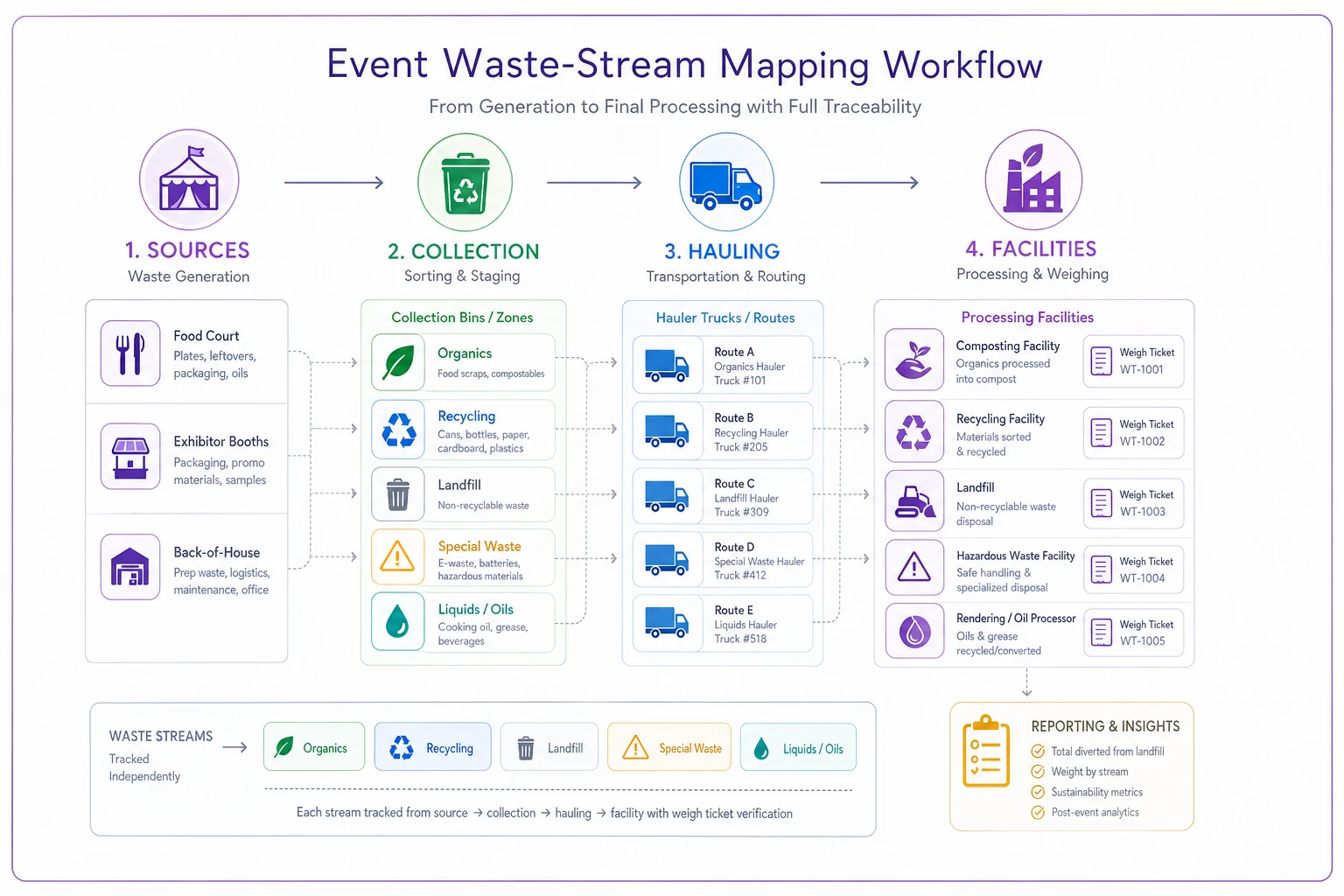
This is the part almost everyone skips, and it's the part that makes the numbers real. Waste-stream mapping means tracing every category of waste your event will generate, from where it's created to where it ultimately ends up — the actual processing facility, not just the dumpster.
The reason it matters: your diversion rate is only as good as your weakest downstream link. You can segregate perfectly on-site and still land a 0% compost rate if your hauler trucks it all to the same landfill. Mapping forces you to confirm the destination before you build the collection system around it.
-
What generates it? (Food court, exhibitor booths, back-of-house, attendee areas)
-
What's the material? (Food waste, mixed recyclables, compostable serviceware, cardboard, general waste)
-
Where is it collected? (Which bins, which zones, who services them)
-
Who hauls it? (Specific hauler, specific truck, specific route)
-
Where does it actually end up? (Named facility, with a weigh ticket as proof)
Visualize the steps from generation to final processing to make the map actionable.
Cardboard is usually your biggest, easiest win and the most commonly wasted opportunity. Exhibitor load-in generates mountains of clean cardboard in a short window. A dedicated cardboard capture during load-in — flattened, staged, hauled separately — can divert a meaningful tonnage with almost no attendee behavior involved. Most events let it get commingled with general waste during setup chaos and lose the easiest 10–15% of diversion they'll ever get.
Map before you procure the bins. The bin plan should be the output of the map, not a guess made by whoever ordered the receptacles.
On‑Site Segregation: Where the Plan Meets Reality
You can have perfect procurement and a solid waste-stream map, and it all collapses at the bin if attendees and staff don't segregate correctly. On-site segregation is where sustainability becomes a people-and-logistics problem rather than a paperwork one.
Contamination is the enemy. A single bag of food waste thrown into the recycling can get an entire load rejected at the facility and downgraded to landfill. In practice, contamination usually happens when bins are inconsistent, unclear, or unstaffed during peak periods.
-
Pair bins, never place them alone. Every recycling or compost bin needs a general-waste bin right beside it. A lone recycling bin becomes a general trash can within an hour.
-
Standardize across the entire footprint. Same colors, same signage, same three-stream (or two-stream) setup everywhere. People learn the system once and apply it site-wide. Mixed setups in different zones guarantee contamination.
-
Staff the peaks. Bin monitors during food-service rushes and load-out do more for your diversion rate than any sign. Someone gently redirecting a cup into the right bin beats the best graphic.
-
Match bins to what's actually sold. If your map says all food vendors use compostable serviceware, your bins should be compost-dominant in the food court. If serviceware is mixed, segregation becomes nearly impossible — fix the procurement, not the bins.
Pair bins, never place them alone.
The non-obvious failure point is back-of-house, not attendee-facing areas. Attendees get the attention and the signage. Meanwhile the caterer's prep area, exhibitor move-in, and production crew generate the bulk of the tonnage with zero segregation infrastructure. Put your bins and monitors where the waste actually is, which is usually behind the curtain.
The Reporting Cadence: Making Outcomes Auditable
A sustainability program that can't produce auditable numbers isn't really a program — it's a vibe. The reporting cadence is what turns all the upstream work into something you can hand a sponsor, a city, or a board, and have survive scrutiny.
Auditable means two things: the number is backed by physical evidence (weigh tickets, facility receipts, donation logs), and the chain from commitment to outcome is traceable. "We diverted 58% from landfill" should be followed by "here are the weigh tickets by stream that add up to it."
-
Pre-event (procurement close) Baseline report. What did we commit to? What are the vendor KPIs on paper? What's the projected waste profile from the stream map?
-
Load-in First real data point. Cardboard tonnage captured, vendor compliance on packaging. This is where you catch a vendor who ignored the procurement spec while you can still correct it.
-
Daily during show Light-touch log. Bin contamination spot-checks, food donation weights, any stream failures. A single shared number sheet, not a formal report.
-
Load-out The big capture. Take-back verification before final payments release, final waste weights by stream, facility tickets collected.
-
Post-event (within roughly two weeks) The audit-ready report. Diversion rate by weight, vendor KPI scorecard, variance against the baseline commitment, and the evidence appendix.
The mistake is treating reporting as a single post-event document. By then the evidence is gone — the hauler's trucks have left, the vendors are home, and you're reconstructing numbers from memory. The cadence has to run during the event so evidence gets captured while it still exists. A diversion claim with no weigh tickets is an opinion.
This reporting discipline overlaps with budget discipline, because sustainability choices have real cost implications you need to track in real time — the same logic that governs spend controls, as laid out in Live Budget Forecasting and Spend Controls for Events. Reusable systems often cost more upfront and save on waste-hauling fees downstream, and if you're not tracking both sides live, you can't tell whether the program is paying for itself.
How the System Scales (and Where It Breaks)
A one-day, 2,000-person event can run sustainability on a spreadsheet and a couple of diligent people. The map lives in one person's head, vendor count is small enough to manage by email, and segregation can be hand-managed.
What breaks at scale is coordination, not intent. Push to a multi-day festival with 80 vendors and the cracks appear in predictable places:
-
Vendor compliance stops being checkable by one person. Eighty food vendors, each with their own serviceware decisions, can't be verified by a single coordinator walking the floor.
-
Waste-stream mapping gets stale. Vendors swap out, menus change, a new food truck appears — and the bin plan built three weeks ago no longer matches reality.
-
Reporting evidence fragments. Weigh tickets come from multiple haulers, donation logs from multiple shifts, KPI checks from different staff. Without a central place to assemble them, the post-event report becomes a scavenger hunt.
-
Segregation decays across days. Day one is clean. By day three, tired staff and tired attendees contaminate everything, and nobody re-briefs the crew.
This is the point where the operating model needs a shared system of record rather than scattered spreadsheets and email threads. Vendor KPIs, procurement specs, the waste-stream map, and the reporting cadence need to live in one place where the ops team, procurement, and sustainability leads all see the same current version. Operational platforms that centralize vendor requirements and let you log evidence against each commitment as the event runs are what make the difference between a program you can audit and a pledge you can only hope held up. The value isn't the software — it's that everyone stops working from different copies of the truth.
When This Level of Rigor Makes Sense — and When It Doesn't
When it's worth it: Events with sustainability clauses in their permits, sponsor sustainability requirements, public-sector clients, or any event where a diversion claim will be published. If you're going to put a public number out there, you need the system to defend it. Also any recurring event — the upfront work on procurement specs and waste maps pays back every year.
When it's overkill: A small, one-off internal event with no external commitments. Running a full waste-stream map and a five-stage reporting cadence for a 300-person company meeting is wasted effort. Do the basics — eliminate single-use where easy, pair your bins — and move on.
Who should not do this halfway: Organizers who want to claim diversion numbers without building the evidence chain. A published "zero waste" claim that turns out to be unsupported is worse than saying nothing. If you're not willing to capture the weigh tickets, don't publish the percentage.
A Real Scenario
A regional two-day food and music festival, roughly 9,000 attendees, had been publicly claiming a "strong recycling program" for years with no actual diversion data behind it. One sponsor finally asked for the numbers, and there weren't any.
The rebuild started at procurement. The catering RFP got a sustainability category worth about 20% of the score, requiring confirmed-compostable or reusable serviceware. They built a waste-stream map and discovered their hauler had been commingling the compost and recycling streams the whole time — the "program" had been diverting essentially nothing. They switched to a hauler with real compost processing and weigh-ticket reporting, added a dedicated cardboard capture during load-in, and staffed bin monitors through the food rushes.
The first measured year came back at roughly 45–50% diversion by weight, with weigh tickets to back it. Not spectacular, but real, and defensible for the first time. Waste-hauling costs went up modestly from the added streams but were partly offset by lower total landfill tonnage. The cardboard capture alone accounted for a meaningful chunk of the diversion with almost no attendee behavior involved. The sponsor got a report with actual evidence instead of a paragraph of claims.
The lesson wasn't about recycling bins. The previous "program" had no procurement gate, no stream map, and no reporting cadence — so it was never really a program, just a hopeful label. Once those three layers existed and connected, the number became both real and repeatable.
Bringing It Together
Sustainable events work when the commitment and the execution finally share the same documents. Procurement decides most of your waste profile before anyone arrives. Vendor KPIs only matter if they're numbers you can check on-site. Waste-stream mapping tells you whether your segregation effort will actually produce diversion or just sort trash into prettier bins. And the reporting cadence captures evidence while it still exists, so your outcomes are auditable instead of aspirational.
None of these layers works alone. Great procurement specs with no on-site segregation leaks diversion at the bin. Perfect segregation with a commingling hauler produces zero real outcome. The whole thing is a chain, and it's worth exactly as much as its weakest confirmed link. Build all the links, connect them, and keep the evidence — that's the difference between an event that says it's sustainable and one that can prove it.
Ready to elevate your event management?
Join 5,000+ event organizers using Festoly to save time, improve coordination, and deliver memorable experiences.