


Most event organizers sign vendor contracts thinking about price and delivery dates. They miss the operational clauses that determine whether their event succeeds or becomes a financial nightmare. After reviewing hundreds of vendor agreements across corporate conferences, trade shows, and community festivals, vendors protect themselves with vague language while leaving organizers exposed to scope creep, surprise charges, and operational chaos.
A standard catering contract can balloon from $12,000 to $19,000 through carefully worded change order clauses. AV vendors routinely charge 3x rates for "emergency" requests that should have been included in base pricing. Insurance requirements buried on page seven can leave you personally liable for $100,000+ in damages.
This event vendor contract checklist breaks down the exact language to watch for, what to negotiate, and how to protect your operations without alienating vendors you need.
Scope Creep Clauses: Where $500 Becomes $5,000
The most expensive sentence in vendor contracts starts with "services include but are not limited to." This gives vendors unlimited flexibility while locking you into whatever they decide falls outside the base agreement.
A corporate summit in Austin shows exactly how this works. The lighting vendor's contract stated they would provide "standard event lighting appropriate for the venue." Their definition of standard meant four uplights and two spotlights for a 300-person ballroom. Every additional fixture cost $275, plus a $150 "programming fee" per change. The final lighting bill hit $8,400 on a $3,000 original quote.
The Language That Protects You
Instead of: "Vendor will provide appropriate AV support for event"
Use: "Vendor will provide:
-
2x wireless handheld microphones (Shure or equivalent)
-
1x wireless lavalier microphone
-
1x 16-channel mixing board
-
4x JBL EON612 speakers (or equivalent 1000W powered speakers)
-
All necessary cabling for 200-person theater setup
-
1x dedicated AV technician for full event duration (8am-6pm)
The specificity eliminates interpretation. When the vendor tries adding a "cable management fee" or "power distribution charge," you point to the contract language that includes "all necessary cabling."
Negotiation Move: The Inclusion Test
Before signing, run the inclusion test. Ask the vendor: "If I requested X during the event, would that be included in our current agreement or would it be an additional charge?" Run through five realistic scenarios:
-
Moving a speaker 20 feet
-
Adding background music during breaks
-
Adjusting microphone levels
-
Playing a client video from USB
-
Switching from handheld to podium mic
Document their answers in email. These become part of your agreement and eliminate day-of surprises.
Change Order Traps and Emergency Pricing
Change orders generate the highest margins for vendors. The standard language reads: "Any modifications to original scope will be billed at vendor's current rates plus applicable rush fees."
Eliminate event chaos with Festoly.
Manage every aspect of your event seamlessly — from planning to execution.
- Centralized event scheduling
- Real-time attendee tracking
- Vendor & resource coordination
No credit card required
Translation: they can charge whatever they want when you're desperate.
A nonprofit gala learned this when their keynote speaker requested a confidence monitor 90 minutes before going on stage. The AV vendor charged $850 for a $200 monitor rental because it qualified as an "emergency addition." The vendor was already on-site with extra equipment. They just leveraged the situation.
Protective Contract Language
Change Order Rate Caps: "Any additions or modifications will be charged at no more than 125% of comparable items in the original agreement. Rush fees cannot exceed 50% of base item cost."
Pre-Approved Change List: "The following common modifications are pre-approved at listed rates:
-
Additional wireless microphone
$75/unit
-
Extra hour of service
$150/hour
-
Additional speaker placement
$50/speaker
-
Video recording setup
$300 flat fee
Change Order Process: "All change orders require written approval (email acceptable) with clear pricing before work begins. Verbal approvals are not binding. Changes made without written approval will not be charged to client."
The 48-Hour Rule
Include a clause that eliminates rush fees for requests made 48+ hours before the event. This incentivizes you to finalize details early while protecting against vendor exploitation of timeline pressure.
"Modifications requested more than 48 hours prior to event start incur no rush or expedite fees. Standard rates apply as outlined in Exhibit A."
Insurance Requirements: The $100K Surprise
Insurance clauses hide massive financial exposure. Standard vendor contracts require you to add them as additional insured on your policy, provide $1-2 million in general liability coverage, indemnify them against all claims, and sometimes carry errors & omissions coverage.
So your DJ shows up drunk, injures an attendee, and suddenly you're liable because you agreed to indemnify "vendor against any and all claims arising from event."
Mutual Indemnification Language
Replace: "Client agrees to indemnify and hold harmless Vendor from any claims arising from event"
With: "Each party agrees to indemnify the other only for damages arising from that party's negligence or willful misconduct. Neither party indemnifies the other for the other party's negligent or intentional acts."
Insurance Minimums Table
| Vendor Type | Your Coverage Requirement | Their Coverage Requirement | Additional Insured? |
|---|---|---|---|
| Catering | $1M per occurrence | $2M per occurrence | Yes, mutual |
| AV/Production | $1M per occurrence | $1M per occurrence | Yes, mutual |
| Entertainment | $1M per occurrence | $1M per occurrence + E&O | Yes, mutual |
| Transportation | $1M per occurrence | $5M commercial auto | No |
| Décor/Rental | $500K per occurrence | $1M per occurrence | Optional |
Require certificates of insurance 30 days before your event. No certificate, no final payment.
Timeline Penalties That Actually Work
Standard vendor contracts include vague timeline language: "Vendor will arrive in sufficient time for setup" or "Services commence at agreed time."
This creates operational chaos when your caterer shows up 30 minutes before guests arrive for a setup that needs two hours.
Specific Timeline Requirements
Setup Requirements: "Vendor arrival time: 2:00 PM Setup completion: 4:30 PM Guest arrival: 5:00 PM Service start: 5:30 PM Late arrival penalty: $200 per 30-minute increment Setup incomplete by 4:30 PM: $500 penalty Service delay beyond 5:45 PM: 50% reduction in service fee"
Critical Checkpoints: "Vendor must confirm the following via text/email:
-
Departure from warehouse/previous location
-
Arrival at venue
-
50% setup complete
-
Ready for service
Missing checkpoint notifications: $50 per missed confirmation
The Vendor Coordination Matrix
"When multiple vendors interact, add coordination requirements:"
-
Catering vendor agrees to coordinate with
- AV vendor for dinner announcement timing
-
Entertainment for performance breaks
-
Venue for kitchen access and load-out
Failure to attend mandatory 4:00 PM vendor briefing: $200 penalty
Equipment Substitution and Quality Standards
"Or equivalent" destroys events. Your contract specifies high-end wireless mics, you get budget equipment that cuts out during the keynote. The vendor claims their gear is "equivalent."
Detailed Equipment Specifications
Primary: "4x Chauvet DJ Intimidator Spot 355 IRC moving heads"
Acceptable substitutions:
-
ADJ Focus Spot 4Z
-
Elation Platinum Spot 5R Pro
-
Martin MAC 101
Unacceptable: Any fixture with less than 75W LED, under 13 DMX channels, or without motorized focus
Substitution notification: "Any equipment substitution requires 72-hour advance notice with technical specifications. Client reserves right to reject substitutions that don't meet original specifications."
Cancellation and Force Majeure Reality
Standard force majeure clauses protect vendors, not you. They keep deposits for "acts of God" while you scramble to reorganize.
Balanced Cancellation Terms
Structure cancellation around actual costs, not arbitrary penalties:
-
60+ days
Return of deposit minus documented non-refundable expenses (must provide receipts)
-
30-59 days
25% of total contract or actual costs incurred, whichever is less
-
14-29 days
50% of total contract or actual costs incurred, whichever is less
-
0-13 days
75% of total contract
Mutual Force Majeure: "In case of force majeure, both parties are released from obligations. Vendor returns all payments minus documented non-recoverable costs (receipts required). Force majeure includes: natural disasters, government restrictions, venue closure, public health emergencies, or events beyond reasonable control of either party."
Payment Terms That Maintain Leverage
Never pay 100% upfront. Standard vendor payment schedules often demand 50% deposit and balance two weeks before the event. This eliminates your leverage when problems arise.
Strategic Payment Structure
Recommended Schedule:
-
Contract signing
25% deposit
-
30 days before
25% progress payment
-
Day of event (after setup inspection)
40%
-
48 hours post-event
Final 10%
Performance-Based Holdings: "Client reserves right to withhold up to 20% of final payment for:
-
Late arrival (per timeline penalties)
-
Equipment substitutions without approval
-
Incomplete setup
-
Early breakdown
-
Contract violations documented day-of
Include a dispute resolution timeline: "Vendor must dispute any payment withholding within 7 days with documentation. Undisputed amounts become final."
The Operational Safety Net
The best contract protection means nothing if you can't track violations in real-time. Build documentation requirements into your agreements:
Vendor Check-in Protocol:
-
Respond to texts/calls within 15 minutes during event hours
-
Have authority to make operational decisions
-
Provide hourly status updates for long-term setups
Photo Documentation:
-
Completed setup (before guests)
-
Equipment model numbers/specifications
-
Any damage or issues discovered
-
Final breakdown state
This creates an evidence trail when disputes arise. That $850 "emergency" monitor? Photo evidence shows three monitors already on-site and unused.
Managing Multi-Vendor Dependencies
When your catering depends on rental equipment, or AV relies on venue power, standard contracts leave gaps that become your problem.
Dependency Acknowledgment:
-
Vendor acknowledges dependency on
- [Other vendor/service]
-
Expected interface/handoff
-
Contingency if dependency fails
Vendor maintains responsibility for their deliverables regardless of third-party failures unless explicitly documented in advance.
Joint Liability Clause:
"When vendor failure impacts other contracted services, vendor accepts liability for cascading impacts up to 50% of their contract value."
A photo booth vendor once caused $4,000 in catering delays because they blocked kitchen access during setup. This clause would have made them partially liable for the cold food and overtime charges.
The Negotiation Conversation
Vendors expect pushback on price. They don't expect operational expertise in contract language. Start negotiations with: "I'm fine with your pricing, but I need to adjust some operational terms based on problems we've encountered before."
This positions you as experienced rather than difficult. Then work through your changes:
"We've been burned by vague scope language before. Can we itemize deliverables?"
"Last year a vendor charged us $3,000 in surprise fees. These change order caps protect both of us."
"Our insurance requires mutual indemnification. It's a standard adjustment."
Frame each change as protecting both parties from miscommunication rather than protecting yourself from them.
When AI-Powered Operations Software Becomes Essential
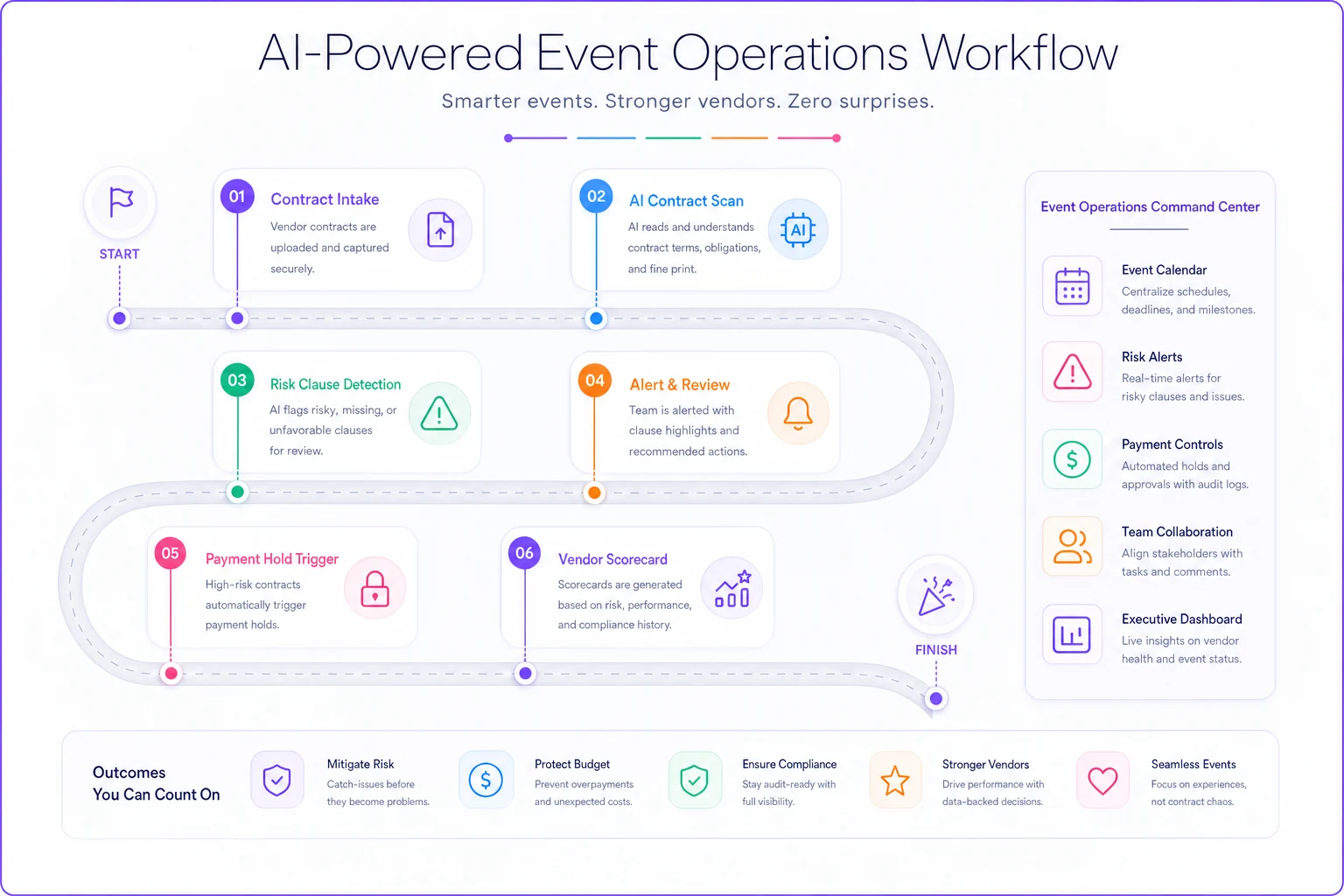
Tracking these contract details across multiple vendors becomes impossible with spreadsheets and email. Modern event operations platforms centralize vendor contracts, flag concerning clauses, track compliance, and document issues in real-time.
The operational advantage isn't just organization. It's being able to instantly pull up clause 7.3.2 when a vendor tries to charge a rush fee you've already excluded. Automatically triggering payment holds when timeline penalties apply. Maintaining a searchable database of every vendor interaction that becomes evidence when disputes arise.
Some platforms now use AI automation to scan contracts for risky language, suggest negotiation points based on your history, and generate vendor scorecards from past performance. This turns contract management from defensive paperwork into operational intelligence that improves with each event.
Here's a simple diagram of that workflow.
The operational advantage isn't just organization. It's being able to instantly pull up clause 7.3.2 when a vendor tries to charge a rush fee you've already excluded. Automatically triggering payment holds when timeline penalties apply. Maintaining a searchable database of every vendor interaction that becomes evidence when disputes arise.
The Bottom Line on Contract Protection
Strong vendor contracts aren't about being difficult or distrustful. They're about clearly defining success for both parties. Vendors who resist reasonable operational protections often reveal themselves as vendors you don't want anyway.
The event vendor contract checklist comes down to specificity over flexibility, mutual responsibility over one-sided protection, and maintaining leverage through strategic payment structures. Each clause should answer: what happens when things go wrong?
In event operations, things always go wrong. The difference between a minor hiccup and a major crisis often comes down to a single paragraph buried on page five of a contract you signed three months ago.
Ready to elevate your event management?
Join 5,000+ event organizers using Festoly to save time, improve coordination, and deliver memorable experiences.