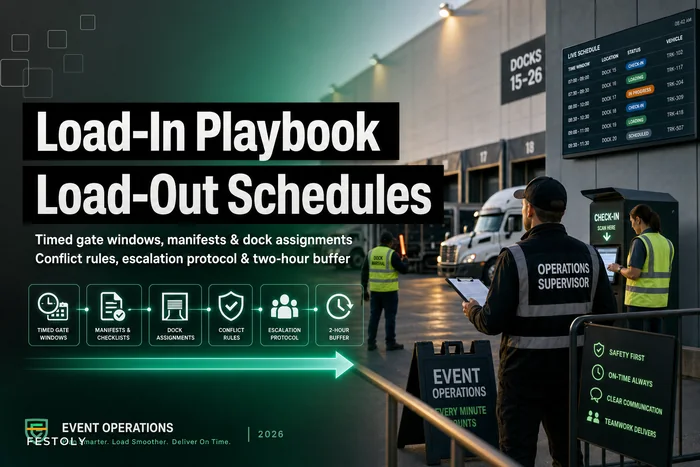

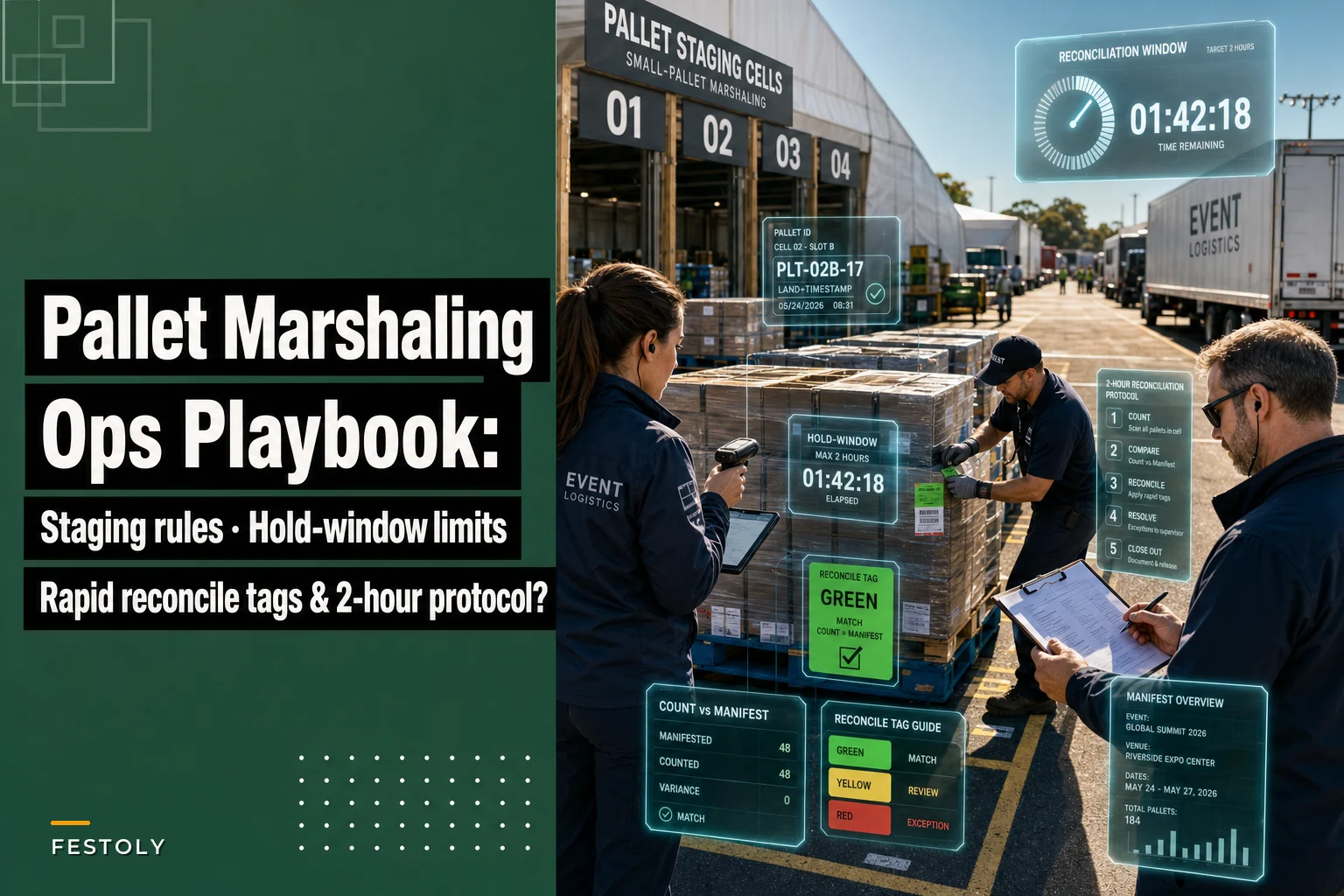

Most dock chaos on event days doesn't come from the big stuff. The 53-foot trailers are scheduled, metered, and babysat by someone with a clipboard. The problems come from the in-between deliveries — the 5 to 50 pallet range. The AV subcontractor's two pallets of cable ramps. The sponsor activation's eleven pallets of branded furniture. The caterer's seven pallets that show up on the wrong box truck with a bill of lading that doesn't match anything you have.
These mid-size freight drops are too small to warrant a dedicated gate slot and too big to hand-carry past security. So they pile up. A driver sits at the dock for 40 minutes while someone figures out whose pallets these are, where they go, and whether the count is even right. Multiply that by fifteen deliveries across a morning and your dock dwell time quietly eats your entire load-in buffer.
This post is about one specific fix: a marshaling system for small freight that uses a shared manifest template, hard pallet-staging rules, timed hold windows, and a reconcile-tag standard that lets any two people on your dock clear a delivery in under two hours without a phone tree. If you want the broader gate scheduling picture, that's a separate discipline — this is the layer underneath it that usually gets ignored.
Why small freight is where dwell time actually hides
Big deliveries get planned because they're scary. Everybody respects a semi. The 5–50 pallet drops get waved through "whenever they arrive" because individually they feel manageable. That's the trap.
In real operations, the dwell cost compounds in a way that's invisible on any single delivery. A single pallet delivery that takes 25 minutes to reconcile feels fine. But small freight almost never arrives alone — it clusters in the first three hours of load-in because every vendor's logistics person picked "early" as their safety margin. So you get nine partial deliveries hitting a two-bay dock inside a 90-minute window, each needing a different person to verify, and no shared record of what's been staged versus what's still on a truck.
What this looks like on the ground:
-
A driver with seven pallets and no one authorized to sign
-
Two deliveries for the same sponsor arriving from different carriers, neither knowing about the other
-
A pallet count that reads "12" on the BOL and "10" on the physical skids, with nobody empowered to decide whether that's a problem now or later
-
Staged freight blocking the lane the next truck needs
The core issue isn't bad vendors. It's that small freight lives in a coordination gap. It falls below the threshold where your formal load-in and load-out scheduling kicks in, but above the threshold where someone can just carry it in and forget about it. Nobody owns it, so everybody touches it, which is the slowest possible arrangement.
The manifest template that actually prevents arguments
A marshaling manifest is not a packing list. A packing list tells you what's in a box. A marshaling manifest tells your dock team what to do when freight shows up — who it belongs to, where it stages, who can release it, and what "correct" looks like.
Eliminate event chaos with Festoly.
Manage every aspect of your event seamlessly — from planning to execution.
- Centralized event scheduling
- Real-time attendee tracking
- Vendor & resource coordination
No credit card required
The template below is deliberately narrow. The goal is that someone who has never met the vendor can process the delivery.
| Field | What it holds | Why it matters on the dock |
|---|---|---|
| Delivery ID | Short unique code (e.g. SPN-04) | The reconcile tag references this, not a vendor name |
| Vendor / Area | Who it's for + their event zone | Tells the staging crew the destination before the truck opens |
| Expected pallet count | Hard number (e.g. 11) | Half of all disputes die here |
| Carrier | Who's physically delivering | Lets you catch split shipments early |
| Hold window | Earliest + latest acceptable arrival | Keeps the dock from flooding at 7am |
| Staging zone | Physical grid cell (e.g. B3) | No "put it over there" guessing |
| Authorized releaser | Name + backup name | Driver always has someone who can sign |
| Reconcile rule | Count / count+condition / count+seal | Defines what "verified" means for this load |
| Special notes | Temp, fragile, stack limits | Prevents the expensive mistakes |
Fill this out per delivery, not per vendor. A sponsor with three separate drops gets three rows and three Delivery IDs. The whole system falls apart the moment two trucks share one manifest line, because now your reconcile tag can't point at a single thing.
One pattern worth stealing: lock expected pallet counts 72 hours out and treat any change after that as an exception that needs a name attached. Vendors pad their estimates when nobody holds them to a number. The act of committing to "11 pallets" three days ahead cuts phantom freight more than any dock-day effort does.
Pallet-staging rules: a grid, not a pile
The single biggest dwell reduction comes from deciding where freight goes before it arrives, not after. Staging by vendor feels natural and is almost always wrong, because vendors arrive in unpredictable order and you end up shuffling skids to keep each vendor's stuff together.
Stage by release sequence instead — the order freight leaves the dock to go to its zone.
-
Grid your staging area into labeled cells. Chalk or tape, letters across, numbers down. B3 is a real place. "Near the roll-up door" is not.
-
Assign cells by exit timing, not owner. Freight that moves to the floor first stages closest to the forklift path. Freight that can wait stages at the back.
-
One Delivery ID per cell until reconciled. Don't let two deliveries blend in the same cell. You can't reconcile a pile.
-
Cap stack height by note, not by eye. If the manifest says stack limit 2, the crew doesn't get to judge. Crushed sponsor furniture is a real line item.
-
Keep a live lane. One lane never gets staged on, ever. It's the path trucks and forklifts use. The instinct to "just set it there for a second" is how docks seize up.
The payoff is that staging and reconciling become two different jobs that can happen in parallel. A crew can drop freight into B3 while someone else is reconciling what's already in B1. When you stage by vendor, those steps collide, because the person verifying has to wait for the person placing.
A small operational note most people miss: the staging cell label should get written on the reconcile tag the moment freight lands. That's the link between the physical pile and the paper record. Lose that link and you're back to walking the dock asking "whose are these."
Write the staging cell on the reconcile tag immediately when freight lands so the pile and record never drift apart.
The staging cell label should get written on the reconcile tag the moment freight lands. That's the link between the physical pile and the paper record. Lose that link and you're back to walking the dock asking "whose are these."
Hold windows: stop the 7am flood
Hold windows are the least glamorous part of this and the one that moves dwell time the most. A hold window is just an earliest and latest acceptable arrival for each delivery — but the earliest is the one that saves you.
Left alone, every vendor's freight targets the same early slot. A typical morning has 60–70% of small freight trying to land in the first 90 minutes because nobody wants to be the late one. Your dock can't absorb that, so trucks queue, drivers wait, and dwell time balloons on deliveries that could easily have come at 10am.
Assign staggered earliest-arrival times tied to release sequence. Freight that goes to the floor last gets the latest window. Build the windows into the manifest, send them to carriers, and — this matters — turn trucks that show up more than 30 minutes early back to a waiting area or a side street with a check-in time. Accepting early freight teaches everyone that windows are fake.
Realistic window spacing for a mid-size load-in:
-
Window A (opens first) structural, flooring, anything the floor build depends on
-
Window B (+90 min) AV, rigging-adjacent freight, booth hardware
-
Window C (+90 min) sponsor activations, furniture, soft goods
-
Window D (late) consumables, signage, last-mile items
The quiet win here is that hold windows make your staging grid breathe. Instead of nine deliveries fighting for cells at once, you get three or four per window, which your crew can actually stage and reconcile before the next wave lands.
The two-hour reconciliation protocol
Reconciliation is where freight either becomes "accounted for" or becomes a 9pm mystery. The two-hour rule is simple: every delivery must be fully reconciled within two hours of landing on the dock, or it gets escalated with a named owner. Not reconciled "eventually." Two hours, clock starts when wheels stop.
Two hours is long enough to handle a count dispute without stopping everything, and short enough that problems surface while the driver and the paperwork are still reachable. Freight that sits unreconciled past two hours is where chain-of-custody gets fuzzy and where "we're short two pallets" conversations happen the next morning with no one to call.
The protocol itself:
-
Land + timestamp. Freight hits a staging cell. Write the cell and arrival time on the reconcile tag. Clock starts.
-
Count against manifest. Physical pallet count versus the locked expected count. Match or no match — record it, don't debate it yet.
-
Condition check per reconcile rule. Count-only, count+condition, or count+seal, exactly as the manifest specifies. Don't over-inspect count-only freight; it wastes the window.
-
Tag status. Mark the reconcile tag GREEN (clean), YELLOW (discrepancy, driver notified, non-blocking), or RED (blocking problem, escalate now).
-
Release or hold. Green freight is cleared for the authorized releaser to move. Yellow and Red stay in cell with the tag updated and a name attached.
-
Escalate at 90 minutes if not Green. Anything not resolved by the 90-minute mark gets a named owner so there's buffer before the two-hour line.
The reason this works is that it forces a decision at the dock instead of deferring it. A pallet short gets logged as YELLOW with the driver's signature acknowledging it while he's standing there, not discovered at midnight when he's three states away. The whole protocol is really just a mechanism to keep the right people in the room long enough to decide.
Here's the protocol flow as a quick visual.
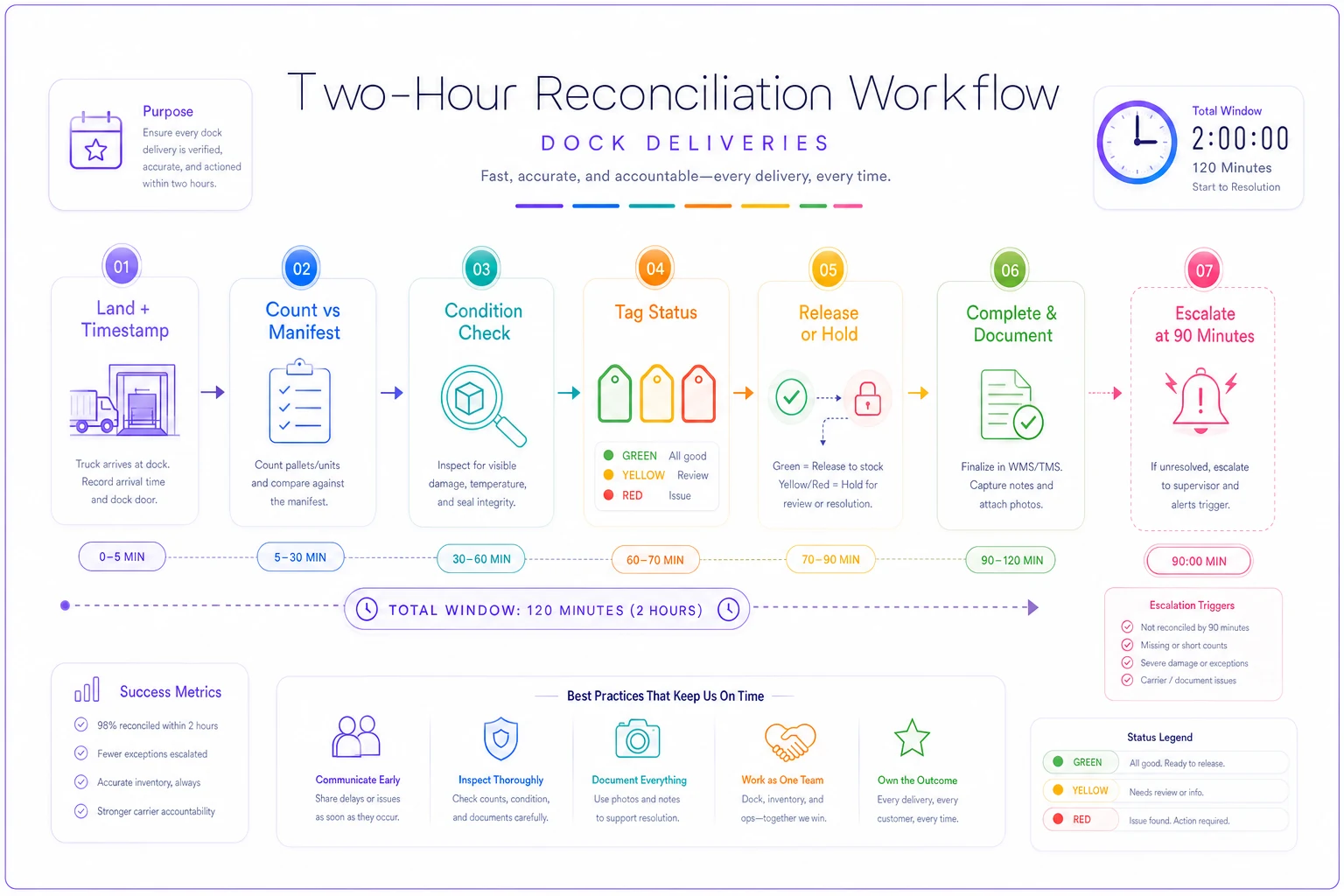
The protocol forces decisions at the dock and captures signatures and times while people are present, preventing next-day mysteries.
Reconcile-tag standards
The reconcile tag is the single most useful artifact in this whole system and the one most docks don't have. It's a physical tag — bright card stock, zip-tied or taped to the lead pallet — that carries the delivery's status with it. The tag is the source of truth on the floor. If the tag and someone's memory disagree, the tag wins.
A reconcile tag needs exactly these fields, and no more:
-
Delivery ID (matches the manifest — SPN-04, not "Sponsor stuff")
-
Staging cell (written on landing)
-
Arrival timestamp (starts the two-hour clock)
-
Expected / actual pallet count (the number that ends arguments)
-
Status color (GREEN / YELLOW / RED)
-
Reconciled-by initials + time
-
Authorized releaser (so anyone can clear it)
Color-code the card stock itself if you can — print or stock three colors so a supervisor can read the whole dock's status from across the floor in one glance. Green cells are clear. A cluster of yellow in C-row means a carrier is having a bad morning. A single red anywhere means walk over there now.
The discipline that makes tags work: no freight moves off the dock without a tag reading Green. This sounds rigid and it saves you constantly. The moment people start moving "obviously fine" freight without clearing the tag, you lose the thread on what's been counted, and the two-hour protocol collapses because there's no record of when anything landed.
When this full system makes sense — and when it's overkill
This is a real build. Gridding a dock, writing per-delivery manifests, and enforcing hold windows takes prep time and a crew that'll actually follow the rules. It's not free.
It's worth it when:
-
You've got 15+ separate small-freight deliveries on a single load-in day
-
Multiple sponsors or vendors share one dock
-
Your load-in buffer is tight enough that dwell time threatens the floor build
-
You've been burned by a missing-pallet dispute with no paper trail
It's overkill when:
-
You've got three or four deliveries total and one person can babysit them
-
Everything comes from a single carrier on a single truck
-
Your venue's dock crew already runs their own tight marshaling system (don't bolt a second system on top — coordinate with theirs)
Who should skip the grid specifically: very small events where staging space is a hallway. If you can see all your freight at once without walking, a grid adds paperwork without adding clarity. The hold windows and reconcile tags still help — the full staging grid is the part that scales with freight volume, not down.
A real scenario
A regional trade show with sponsor activations ran a two-bay dock for a one-day load-in. Prior year, they took small freight "as it came." The first three hours saw around 22 deliveries in the 3–14 pallet range, most of them targeting early arrival. Average dwell per delivery ran close to 35–40 minutes, drivers queued into the street, and two sponsor deliveries got partially mixed in staging — which turned into a next-day argument about two "missing" pallets that had actually been staged under the wrong vendor's pile.
The following year they ran per-delivery manifests, a taped staging grid, four hold windows, and colored reconcile tags. The early flood dropped because freight was spread across windows instead of stacked into the first 90 minutes. Average dwell came down to roughly 18–20 minutes, mostly because staging and reconciling ran in parallel instead of fighting for the same people. The count disputes didn't fully disappear — one carrier still showed up a pallet short — but it got caught as a YELLOW tag with the driver's signature on it inside the two-hour window, so it was a logged discrepancy instead of a mystery. No next-day argument.
The thing that moved the needle most, per the ops lead, wasn't the tags or the grid individually. It was locking expected pallet counts three days out. Half the phantom-freight confusion never happened because vendors had already committed to real numbers.
Keeping this connected to the rest of your load-in
Small-freight marshaling doesn't live in isolation. The hold windows have to nest inside your gate schedule, the staging grid has to respect the venue's own dock rules, and the reconcile tags feed whatever handoff log your floor team uses. If the venue controls the dock, your whole system is a proposal they have to bless — which is a conversation worth having early, as part of broader venue stakeholder coordination rather than a dock-day ambush.
Teams running this at scale tend to move the manifest and tag status off paper and into a shared operational view everyone can see live — so the supervisor doesn't have to walk the floor to know what's Green, and a late carrier triggers a notification instead of a surprise. The paper tags stay on the pallets as the physical source of truth; the shared view just mirrors their status so planning and dock see the same picture. Paper or digital, the logic is identical: one Delivery ID, one staging cell, one two-hour clock, one tag that has to read Green before anything moves.
Get that discipline in place and the 5–50 pallet range stops being the thing that quietly consumes your load-in. It becomes the part of the dock you actually stop worrying about.
Get that discipline in place and the 5–50 pallet range stops being the thing that quietly consumes your load-in. It becomes the part of the dock you actually stop worrying about.
Ready to elevate your event management?
Join 5,000+ event organizers using Festoly to save time, improve coordination, and deliver memorable experiences.