

Most small-event claims don't fail because the loss wasn't covered. They fail because the organizer waited until the week after the event to think about documentation — by which point the venue floor had been cleaned, the rental gear was already returned, and the three people who could actually describe what happened had scattered back to their day jobs.
Insurance carriers don't owe you anything for what you remember. They pay for what you can prove, and they want that proof in a specific form, within a specific window. A 400-person conference that loses a general session to a burst pipe has maybe 48 hours to capture the evidence that makes a clean payout possible — and most organizers spend those 48 hours dealing with refunds and angry attendees instead.
This is a workflow problem, not a legal one. Below is the system for a small-to-mid event: what to capture in the first hour, the templates that keep adjuster communication from dragging, and a realistic four-week timeline for the claim types that actually come up.
Why small-event claims get underpaid (or denied outright)
The pattern is almost always the same. The event has a cancellation or property policy sitting in a drawer somewhere. Something goes wrong. The organizer handles the operational crisis competently — reroutes the schedule, comforts the client, salvages what they can — and then, days later, calls the broker to "start a claim."
By then the damage window has decayed. Here's what typically goes wrong:
-
The scene changed. The venue cleaned up, the HVAC contractor fixed the unit, the tent company hauled off the collapsed structure. Physical evidence is gone.
-
The financials are muddy. Nobody separated "costs we'd have paid anyway" from "costs we incurred because of the incident." Adjusters live in that distinction.
-
The timeline is unprovable. When exactly did the power go out? When did you make the cancel call? Without timestamps, the adjuster assumes the least favorable version.
-
Notice was late. Many policies require "prompt" notice, and some have hard deadlines — 72 hours, 30 days — for first notice of loss. Miss it and the carrier has a clean reason to deny.
The organizers who get paid in full aren't the ones with better policies. They're the ones who treated evidence capture as part of the incident response itself — not as paperwork for later.
The first-hour capture: what to grab while it's still true
The moment you suspect a claimable loss is forming, someone needs to switch into documentation mode. Not instead of handling the crisis — alongside it. On a small team this is usually the ops lead or whoever isn't actively putting out the fire.
Eliminate event chaos with Festoly.
Manage every aspect of your event seamlessly — from planning to execution.
- Centralized event scheduling
- Real-time attendee tracking
- Vendor & resource coordination
No credit card required
The goal is a time-stamped evidence packet that a stranger (the adjuster) could use to reconstruct exactly what happened. Here's the required artifact list:
Visual evidence
-
Wide shots and close-ups of the damage or the condition causing the loss (standing water, collapsed structure, dead electrical panel)
-
Photos of the surrounding context — the whole room, the full tent, the staging area — not just the problem spot
-
Short video walking the affected area while narrating out loud what you're seeing and the time
-
Screenshots of any weather alerts, venue notifications, or vendor messages with visible timestamps
The incident record
-
A dated, timed log of events
when the problem was noticed, who was notified, what decisions were made and when
-
Names and contact info of witnesses — staff, venue personnel, vendors, attendees who saw it
-
Any venue incident report filed on their side (request a copy immediately, in writing)
The money trail
-
The signed contracts for anything affected (venue, AV, catering, rentals)
-
Invoices and receipts for additional costs the incident forced on you
-
Your ticketing/registration report showing refunds issued or revenue lost
-
A clean "but-for" cost note
what you spent because of the incident vs. your normal budget
The single most underrated item on this list is the narrated video with a spoken timestamp. A one-minute clip of someone walking the flooded breakout room saying "It's 2:14 PM, the pipe above the ceiling tile let go about twenty minutes ago, you can see the standing water across the back third of the room" is worth more than fifty silent photos. It establishes time, extent, and cause in a format that's genuinely hard to dispute.
A capture template you can hand to a non-expert
-
Note the current time. Say it out loud on video.
-
Film a slow 360° of the whole affected area, narrating what's wrong.
-
Take 10+ still photos
3 wide, the rest close on damage.
-
Screenshot every relevant alert/message before your phone clears notifications.
-
Write down the names of everyone standing nearby who saw it.
-
Do not clean up, move, or repair anything until steps 1–5 are done or an adjuster clears it (unless safety requires it).
That last rule — don't remediate before documenting — is where good intentions cost real money. Someone mops up to prevent a slip hazard and accidentally erases the proof of how far the water spread.
Notice of loss: the clock most people don't know is running
First notice of loss (FNOL) is the step that quietly kills claims. Your policy almost certainly has language requiring notice "as soon as practicable" or within a fixed number of days. Treat it as the first thing you do once the event is stabilized — not the last.
File FNOL even if you don't yet know the full dollar amount. You are not committing to a number; you're preserving your right to the claim. Organizers routinely wait to "have all the figures" and blow past the deadline. The figures can come later. The notice cannot.
> FNOL email template > > Subject: First Notice of Loss — [Event Name], [Date], Policy #[number] > > We are reporting a loss under policy #[number] for [Event Name], held [date/location]. > > On [date] at approximately [time], [factual description of what happened — e.g., "a ceiling water line failed above Breakout Room C, flooding the space and forcing cancellation of three scheduled sessions"]. > > Estimated affected costs are still being finalized; we expect to submit full documentation within [X] days. We have time-stamped photos, video, a witness list, and the venue's incident report. > > Please confirm receipt, our claim number, and the assigned adjuster. Let us know what additional documentation you require and any deadlines that apply.
Notice what that email does not do: it doesn't guess at causes ("I think the pipe was old"), assign blame, or estimate a dollar figure it can't back up. Stick to observable facts. Speculation in writing becomes the adjuster's best tool against you.
Adjuster liaison: scripts that keep the claim moving
Once an adjuster is assigned, the claim lives or dies on communication cadence. Small-event organizers tend to go quiet between the initial submission and the payout, then get frustrated when weeks pass. The fix is to run adjuster contact like any other vendor relationship — scheduled touchpoints and a single point of contact on your side.
Designate one person to talk to the adjuster. Multiple voices create inconsistent stories, and inconsistency reads as either disorganization or dishonesty. That person keeps a running log of every call and email.
"Thanks for taking this on. I want to make your side easy, so I'd like to confirm three things: the exact list of documents you need from us, the format you want them in, and your target timeline for a coverage decision. I'll send everything in one organized package rather than piecemeal. What's the best way to reach you, and how often should I check in?"
That last question matters. Ask the adjuster to set the check-in rhythm, then hold them to it. If they say "give me a week," you have license to follow up on day eight without being a pest.
> Follow-up / nudge template > > Subject: Status check — Claim #[number], [Event Name] > > Following up on our [date] conversation. We submitted the full documentation package on [date] and I want to make sure nothing is outstanding on our end. > > Could you confirm: (1) the package is complete, (2) the current status, and (3) the expected date for next steps? If anything additional is needed, I'll turn it around within 24 hours.
Keep every one of these in a single claim file — emails, call logs, document submissions, timestamps on each. If the claim ever escalates, that log is your leverage.
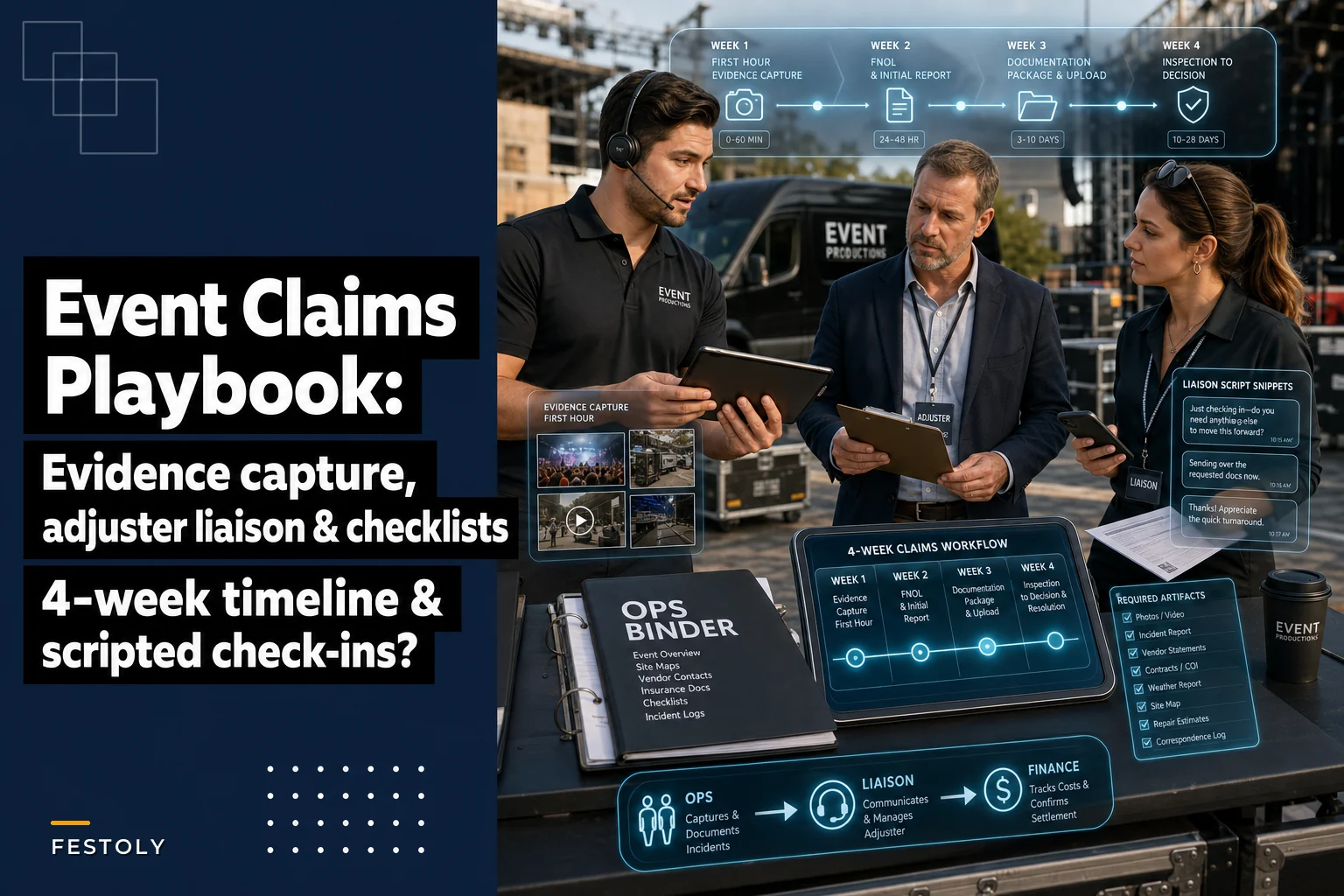
A realistic four-week timeline for common claims
Small-event claims that are documented well and reported promptly tend to resolve on a predictable arc. This is the pattern for straightforward property or cancellation claims — not complex liability disputes, which run much longer.
| Week | What should be happening | Who's driving it |
|---|---|---|
| Week 1 | First-hour capture complete; FNOL filed within 24–72 hrs; claim number and adjuster assigned; venue incident report requested in writing | Ops lead + designated liaison |
| Week 2 | Full documentation package assembled and submitted in one organized file; cost breakdown finalized separating incident costs from normal spend; first adjuster call completed | Liaison + finance person |
| Week 3 | Adjuster review; respond to any supplemental requests within 24 hrs; possible site inspection if damage-related; keep check-in cadence | Liaison |
| Week 4 | Coverage decision; settlement figure proposed; negotiate if the number ignores documented costs; confirm payment timing in writing | Liaison + whoever owns the budget |
A few honest caveats. Weather-cancellation claims under a dedicated event cancellation policy can move faster if the trigger is clear — a named storm, a government closure order. Property damage claims involving both a venue's insurer and yours can stretch past four weeks because of subrogation, the carriers sorting out who's ultimately liable. And if your documentation is thin, every week above slides right, sometimes by months.
The timeline is mainly useful for managing expectations internally — with clients, your own team, and your cash flow. If you know a legitimate claim takes roughly a month, you can plan around the gap instead of scrambling. This ties directly into how you handle live budget forecasting and spend controls: a pending claim is a receivable with a fuzzy date, and treating it that way keeps your month-of numbers honest.
A real scenario: the burst-pipe breakout rooms
A mid-size trade association ran a two-day conference for around 450 attendees in a hotel's meeting block. Midway through day one, a water line above two breakout rooms failed, flooding both and knocking out four afternoon sessions. No injuries, but a real loss: refunds owed to a chunk of attendees, a scramble to relocate two sessions into an undersized ballroom, and overtime for AV to re-rig in the new space.
The organizer's instinct was to firefight — and they did, competently. But the ops lead also ran the capture protocol: narrated video with spoken timestamps, wide and close photos before the hotel's crew brought in fans, screenshots of the hotel's notification, and a witness list including two venue engineers. FNOL went out that evening.
The initial settlement offer came back low — the adjuster had lumped the relocated sessions' AV overtime into "costs you'd have paid anyway." Because the organizer had a clean but-for cost breakdown and the timestamped record showing the overtime was triggered after the flood, they pushed back with a two-paragraph email and the supporting invoices. The revised offer came in roughly $9k higher than the first, and the whole thing closed inside about five weeks.
The lesson isn't that they were lucky. The capture packet from day one gave them something to negotiate with. Organizers who have nothing to push back with take the first offer because they can't substantiate a better one.
When a formal claims workflow actually matters — and when it doesn't
Not every mishap is worth a claim. Running this full workflow for a $600 damaged pop-up banner is a waste of everyone's time, and frequent small claims can affect your renewal pricing.
Run the full workflow when:
-
The loss is clearly above your deductible with meaningful room to spare
-
A session, day, or the whole event was canceled or materially disrupted
-
Property damage, injury exposure, or a vendor failure created real downstream costs
-
The incident could generate attendee refund liability
Skip the formal claim (but still document) when:
-
The cost is at or near your deductible
-
It's a minor, self-absorbable expense
-
The incident is the kind that, claimed repeatedly, will spike your premium
Even when you skip the claim, do the capture. A ten-minute evidence packet costs almost nothing and protects you if a "minor" incident turns out to have a long tail — an attendee who slipped on that water showing up three weeks later, for instance.
Building this into your event operation
The reason small events fumble claims isn't lack of coverage — it's that nobody owns the first hour. The fix is to make evidence capture a named role in your incident response, the same way you'd assign a show-caller or a medical lead. Put the capture template in the ops binder. Pre-load the FNOL and liaison email templates so they're copy-paste ready at 9 PM on a bad day. Decide in advance who the single adjuster contact is.
This belongs inside your broader event risk and resilience framework, not as a separate afterthought. The same triggers that tell you to activate a contingency plan should also trigger the capture protocol — the incident that forces a schedule change is usually the same incident that will become a claim.
Pin this workflow in your ops binder so the person on scene doesn't have to improvise instructions.
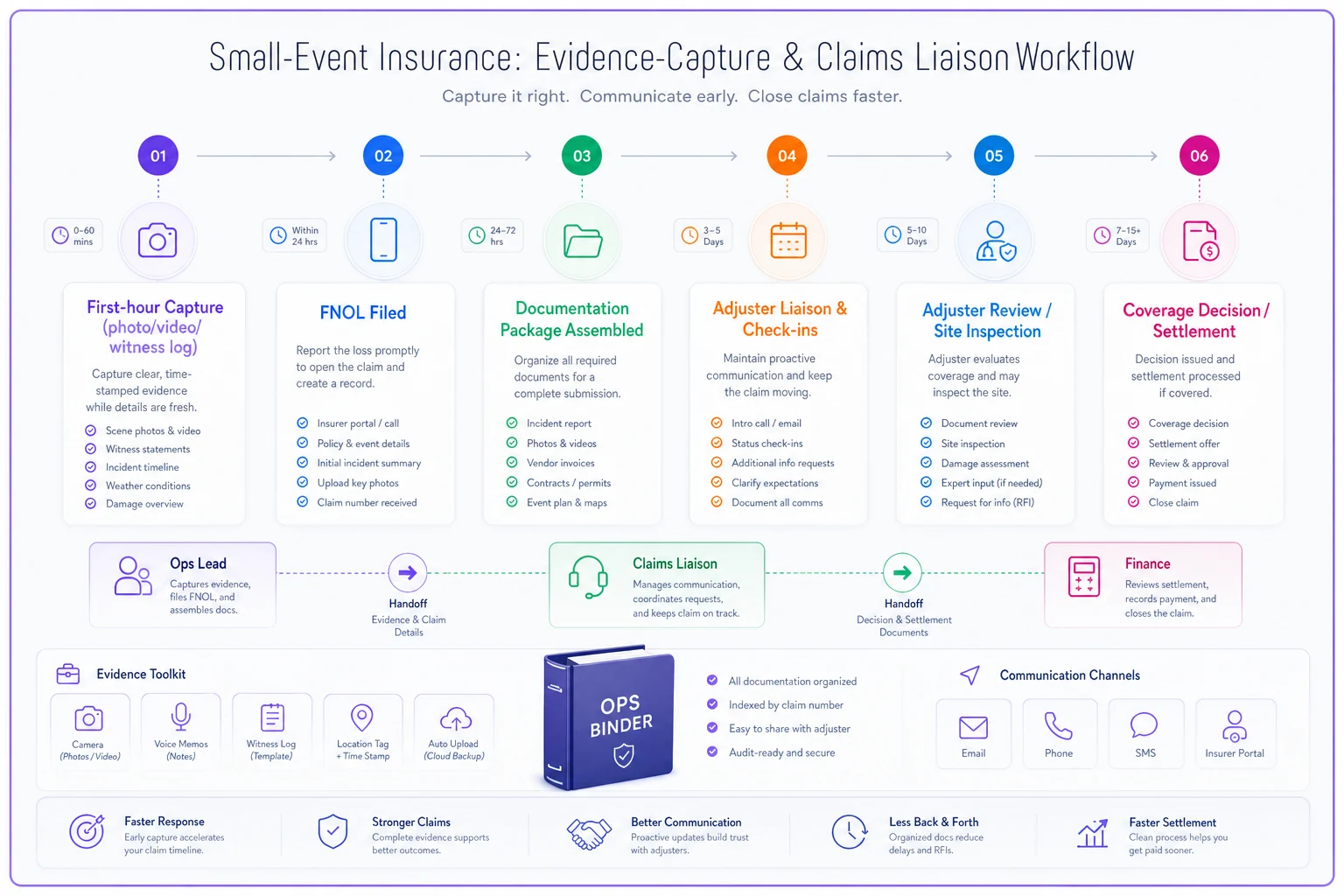
Pre-load FNOL subject lines and your liaison contact info in the ops binder for quick copy-paste at first notice.
The same triggers that tell you to activate a contingency plan should also trigger the capture protocol — the incident that forces a schedule change is usually the same incident that will become a claim.
Organizers who get paid treat the claim as something that starts during the crisis, not after it. Everyone else is reconstructing the story weeks later from memory and partial receipts, hoping an adjuster takes their word for it. They rarely do.
Ready to elevate your event management?
Join 5,000+ event organizers using Festoly to save time, improve coordination, and deliver memorable experiences.