

The fastest way to run out of saline gauze at a 12,000-person outdoor festival is to stock every medical point the same way. One central aid station and three satellite tents, all carrying identical kits, looks tidy on a spreadsheet. Then the main stage crowd crushes against barricades during a headliner, one satellite tent burns through its entire bandage and cold-pack supply in forty minutes, and the other two sit barely touched near the quiet craft vendors.
That mismatch — same stock everywhere, wildly different demand — is the core problem with event medical caching. It's not usually a budget problem. Most organizers buy enough supplies in total. They just put the wrong amounts in the wrong places, with no rule for when to move them.
This article is narrow on purpose. It covers medical supply caching for events: how to build minimum-cache templates per site based on who actually shows up at each location, how to set resupply thresholds and SLAs that trigger before you're empty, and how to keep a clean chain-of-custody log for controlled meds that will get you in regulatory trouble if they go missing.
Why identical kits across sites quietly fail
Attendance isn't evenly distributed, and neither are injuries. A medical tent near the main stage deals with heat, crowd-crush bruising, intoxication, and panic. A tent near a family/kids zone deals with scraped knees, minor allergic reactions, and lost-child distress. A tent at the entrance plaza handles fainting from long queues in the sun and a steady trickle of blister and dehydration cases.
These aren't the same consumption curves. In practice, the main-stage cache burns through cold packs, trauma dressings, and electrolyte supplies two to four times faster than the family-zone cache. If you stocked both with 50 cold packs, one runs dry mid-afternoon and the other still has 45 at teardown.
The second failure is timing. Even when total stock is adequate, nobody notices a cache is running low until a medic radios "we're out." At that point you're not resupplying — you're scrambling. A runner has to find the central store, pull supplies, and carry them across a packed festival ground, which can easily take 25–40 minutes during peak crowd density. For a bleeding control item or an EpiPen, that gap is unacceptable.
So the real work isn't buying more. It's three things: sizing each cache to its site's demand profile, triggering resupply early enough to beat the stockout, and tracking controlled items tightly enough to survive an audit.
Step 1: Build an attendance profile for each medical point
Before you can set a minimum-cache template, you have to describe what each site actually does. Skip the generic "first aid station" label and profile the location.
Eliminate event chaos with Festoly.
Manage every aspect of your event seamlessly — from planning to execution.
- Centralized event scheduling
- Real-time attendee tracking
- Vendor & resource coordination
No credit card required
-
Expected crowd exposure — how many attendees pass through or cluster within ~50 meters during peak hours
-
Dominant incident types — heat, trauma, intoxication, pediatric, allergic, minor wounds
-
Crowd character — age mix, alcohol presence, physical activity level
-
Access difficulty — how long a resupply runner realistically needs to reach it during peak
A useful way to classify sites is by load tier. Here's a profile table that works well as a starting template for mid-size outdoor events:
| Site Type | Peak Exposure | Dominant Incidents | Resupply Access | Cache Tier |
|---|---|---|---|---|
| Main stage aid tent | High (crowd crush zone) | Heat, trauma, intoxication, panic | Slow (15–40 min on foot) | Heavy |
| Entrance/queue station | Medium-High | Fainting, dehydration, blisters | Fast (near service road) | Medium-Heavy |
| Family/kids zone | Medium | Pediatric scrapes, allergic, lost-child | Medium | Medium |
| Vendor/craft area | Low-Medium | Minor wounds, fatigue | Fast | Light |
| Central aid HQ | — (resupply hub) | All + overflow | — | Master store |
The cache tier drives stocking quantities. A "Heavy" site doesn't just get more of everything — it gets disproportionately more of the fast-burn items (cold packs, trauma dressings, electrolyte sachets) and roughly the same baseline of rarely-touched items.
One thing worth flagging: access difficulty matters as much as demand. A medium-demand site that's a 35-minute walk from the central store should be stocked more like a heavy site, because you can't get supplies there quickly when it counts. Distance is effectively a demand multiplier.
Step 2: Set minimum-cache templates per tier
A minimum-cache template is the floor — the amount that must be present at a site at the start of each operational window (opening, mid-day, post-peak reset). It's not the total you'll use; it's the buffer that keeps the site functional until resupply arrives.
The logic we recommend:
Minimum cache = (peak hourly burn rate × resupply lead time in hours) × safety factor
Say your main-stage tent burns roughly 18 cold packs per hour at peak, and resupply realistically takes about 40 minutes (0.67 hours) during a crowd surge. That's around 12 cold packs consumed during a resupply cycle. Apply a safety factor of 1.5 for the unpredictability of surges, and your minimum cache floor for cold packs at that site lands around 18.
Run that same math per item, per site. You'll end up with templates that look nothing like each other — which is the point.
A simplified example of a Heavy-tier minimum template versus a Light-tier one:
| Item | Heavy Tier (main stage) | Light Tier (vendor area) |
|---|---|---|
| Trauma dressings | 20 | 6 |
| Cold packs | 18 | 6 |
| Electrolyte sachets | 60 | 15 |
| Adhesive bandages (box) | 4 | 4 |
| Burn gel packets | 10 | 6 |
| Nitrile gloves (pairs) | 150 | 60 |
| Saline flush | 25 | 10 |
Notice the baseline items (bandages, burn gel) barely move between tiers, while the surge items scale sharply. That's the usual shape. Overstocking baseline items everywhere is where a lot of medical budgets quietly leak — you buy 40 boxes of bandages for sites that will use four.
When this detailed approach makes sense: events over roughly 3,000–4,000 attendees, multi-site medical coverage, or anything running across multiple days. Below that threshold, a single well-stocked station with one small satellite is usually enough, and per-tier templating is overkill.
When it's a bad idea: a 500-person indoor conference with one medical room. Don't build a five-tier cache system for that. You'll spend more time on the spreadsheet than you'll ever save.
Step 3: Resupply threshold rules and SLAs
The minimum cache is the floor. The resupply threshold is the trigger — the level at which someone must request a restock before hitting the floor.
The mistake almost everyone makes: treating "we're out" as the trigger. By then you're already understocked and in reaction mode. The threshold has to fire with enough buffer to cover the resupply lead time plus whatever gets consumed during it.
-
Set the reorder point above the floor. Reorder point = minimum cache floor + (burn rate × resupply lead time). When on-hand count drops to this number, the request fires automatically.
-
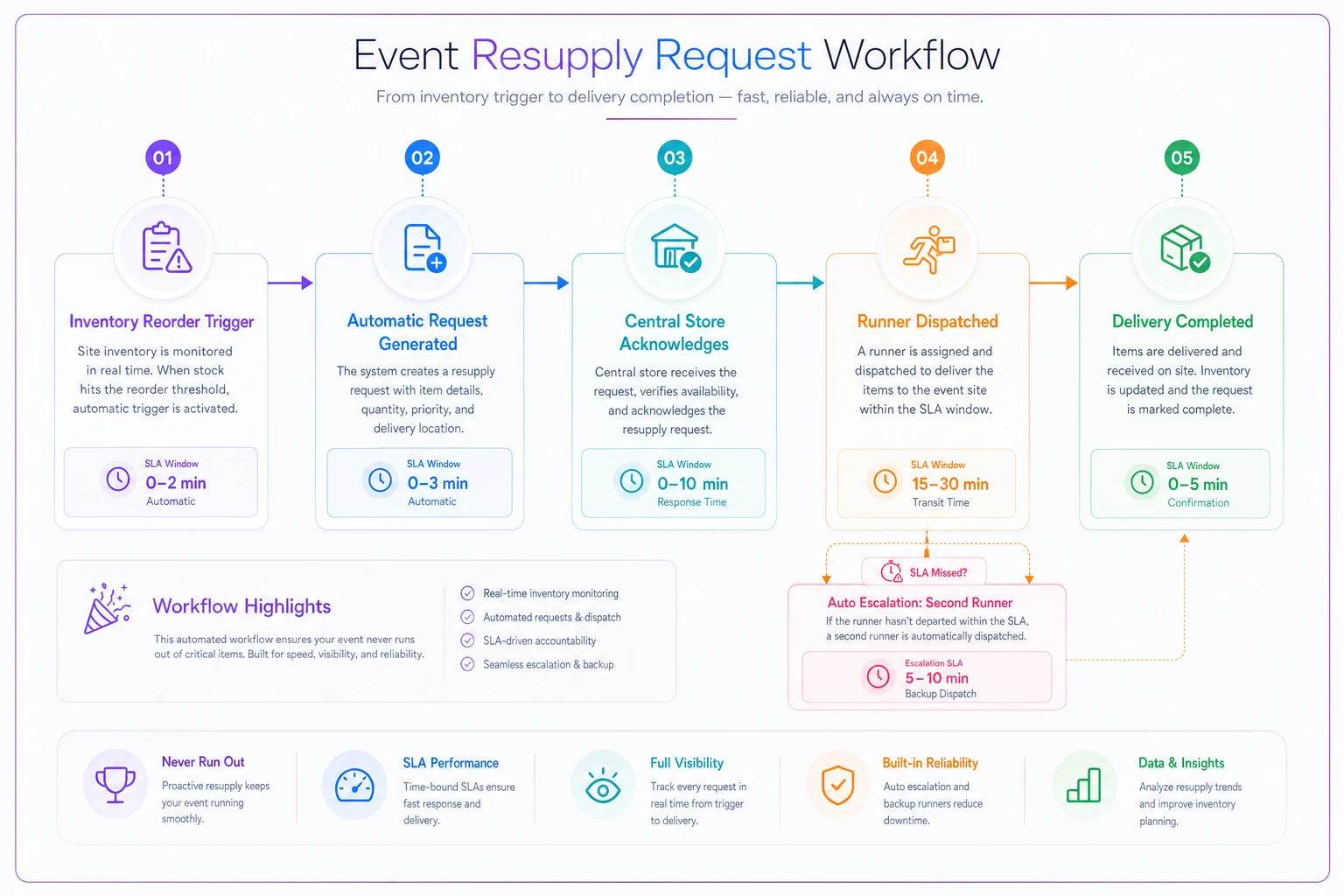
Assign a resupply SLA per tier. Heavy/slow-access sites get the tightest SLA because they can't afford delay. For example: Heavy-tier resupply must arrive within 30 minutes of request; Light-tier within 60.
-
Define who acknowledges and who delivers. A request with no named owner dies in the radio chatter. One person at central store acknowledges; one named runner delivers.
-
Log the request time and the delivery time. If your SLA is 30 minutes and you're consistently hitting 50, that's a staffing or routing problem you need to see in the data, not discover at teardown.
Here's a resupply SLA table you can adapt:
| Cache Tier | Reorder Trigger | Target SLA | Escalation if Missed |
|---|---|---|---|
| Heavy | At 150% of floor | 30 min | Notify medical lead + dispatch second runner |
| Medium-Heavy | At 140% of floor | 40 min | Notify medical lead |
| Medium | At 130% of floor | 45 min | Log + flag at next window |
| Light | At 120% of floor | 60 min | Log |
The escalation column matters more than people expect. A missed resupply on a Heavy site isn't just a late delivery — it's a site that may hit its floor before the next runner arrives. You want a second runner moving automatically, not a debate on the radio about whether it's urgent enough.
This resupply structure fits naturally into the broader operational triggers approach covered in the Event Risk & Resilience Framework — resupply thresholds are just another operational trigger with a defined owner and response time.
The diagram shows the resupply request, acknowledgment, escalation, and delivery workflow.
This resupply structure fits naturally into the broader operational triggers approach covered in the Event Risk & Resilience Framework — resupply thresholds are just another operational trigger with a defined owner and response time.
Step 4: Chain-of-custody logging for controlled meds
Everything above is inventory management. Controlled medications are a different animal, because the consequence of a loose process isn't an empty shelf — it's missing scheduled drugs, a regulatory problem, and potentially a licensing issue for your medical provider.
Controlled items (depending on jurisdiction and your medical director's protocols) need an unbroken record of who had them, when, and what happened to each unit. "We think we used them" is not a record.
-
Item name and dosage
-
Unique identifier (lot/serial where applicable)
-
Starting count at shift open, signed by the issuing authority
-
Every transfer between custodians, with both names and a timestamp
-
Every administration, tied to an incident/patient record
-
Any wastage, witnessed and co-signed
-
Ending count at shift close, reconciled against start count
The core principle: counts must reconcile at every handoff. Start count minus administered minus wasted must equal ending count. If it doesn't, you investigate immediately — not at the end of the event.
A simple chain-of-custody log row looks like:
| Time | Item | Action | Qty | From → To | Incident Ref | Witness | Running Count |
|---|---|---|---|---|---|---|---|
| 09:00 | [controlled item] | Issue | 10 | Store → Medic A | — | Lead | 10 |
| 13:20 | [controlled item] | Administer | 1 | Medic A | INC-0042 | Medic B | 9 |
| 16:45 | [controlled item] | Waste | 1 | Medic A | — | Medic B | 8 |
| 20:00 | [controlled item] | Return | 8 | Medic A → Store | — | Lead | 8 |
Two spots where custody logs break down in real events:
Shift handoffs. The morning medic hands off to the evening medic, both are tired, the count gets written down as "about right," and nobody co-signs. If anything's missing, you now can't say which shift it happened on. Every handoff needs a physical count and two signatures, no exceptions.
Wastage. A partially-used vial or a dropped unit gets tossed without a witness, the count comes up short later, and there's no explanation on record. Wastage must be witnessed and co-signed in the moment, or it becomes a discrepancy you can't close.
This controlled-med discipline should slot into your wider medical operations — the role assignments and incident documentation in the Event Medical & Emergency Playbook are where these custody logs actually get used, since every administration ties back to an incident record.
A real scenario: the two-tent music festival
A mid-size regional music festival, roughly 8,000 attendees across two days, ran two medical tents plus a central store. In year one, both tents were stocked identically — the "to be safe" approach.
What happened: the main-stage tent ran out of cold packs and trauma dressings by mid-afternoon on day one during a hot set with heavy crowd pressure. A runner spent close to 35 minutes getting resupply across the grounds. The quieter second tent ended day one with over 40 unused cold packs. Total supply was fine. Distribution and timing weren't.
For year two, they rebuilt caches by tier. The main-stage tent got a Heavy template with roughly triple the surge items and a 30-minute resupply SLA with automatic second-runner escalation. The second tent dropped to a Medium template. They also added a reorder-point trigger instead of waiting for "we're out."
The results weren't dramatic on paper, but they were the right kind of boring: no stockouts on either day, resupply runs triggered with enough buffer that no site hit its floor, and total supplies purchased actually dropped slightly because they stopped over-stocking the quiet tent. The medical lead's summary was that the event finally "ran on the plan instead of on luck."
That's the honest outcome of good caching — not a flashy metric, just fewer emergencies that were really just logistics failures in disguise.
Keeping the logs usable during a live event
Paper logs work fine right up until it's 90 degrees, the tent is slammed, and someone's trying to count vials while two patients wait. That's when counts get skipped and handoffs go unsigned.
The practical fix is making counting and threshold-tracking easier than skipping it. Some teams run per-site counts on a shared tracker that flags when a cache hits its reorder point, so the resupply request fires from the number rather than from someone remembering to radio in. The same approach helps with controlled-med reconciliation — a running count that requires a witness field on every wastage or handoff entry closes most of the gaps that paper logs leave open.
The goal isn't fancy software. It's removing the moments where a tired medic has to choose between patient care and paperwork, because paperwork always loses that fight. Whether you're using paper, a spreadsheet, or an AI-assisted operations platform that centralizes tracking and automates threshold alerts, the test is the same: can you reconcile every controlled item at any moment, and does every cache know its own reorder point without someone eyeballing it?
Quick pre-event checklist
Before doors open, confirm:
-
- [ ] Each medical point has a documented attendance profile and cache tier
-
- [ ] Minimum-cache floors are calculated per item, per site (not copied across sites)
-
- [ ] Reorder points are set above floors with the resupply lead time built in
-
- [ ] Resupply SLAs are assigned per tier with named acknowledgers and runners
-
- [ ] Escalation rules (second runner) are defined for Heavy/slow-access sites
-
- [ ] Controlled-med start counts are signed at shift open
-
- [ ] Handoff procedure requires physical count + two signatures
-
- [ ] Wastage procedure requires a witness co-signature
-
- [ ] End-of-shift reconciliation is scheduled, not optional
End-of-shift reconciliation is scheduled, not optional
The takeaway
Event medical caching goes wrong in predictable ways: identical stock across sites with very different demand, resupply that only triggers after a stockout, and controlled-med logs that fall apart at handoffs. None of those are supply budget problems. They're distribution, timing, and documentation problems.
Build cache templates around what each site actually does. Trigger resupply before you hit the floor, with SLAs that account for how far the runner has to walk. Treat controlled-med custody as something you can reconcile at any moment, not something you piece together at teardown.
Do those three things and your medical operation stops running on luck — which, at a crowded event, is exactly what you want.
Ready to elevate your event management?
Join 5,000+ event organizers using Festoly to save time, improve coordination, and deliver memorable experiences.