

Most emergency plans die in a binder. They're written to satisfy a venue's insurance requirement, printed once, and never opened again until an inspector asks for them. Then something actually happens — a guest goes down with chest pains near the food trucks, or a section of grandstand seating starts swaying — and nobody on the floor knows who's supposed to call 911, who clears the path, or who keeps 800 curious people from crowding the scene.
The gap isn't knowledge. Your team knows how to dial 911. The gap is choreography under pressure. When adrenaline hits, people freeze or they all move toward the same thing at once. A real event emergency response playbook fixes that by pre-assigning every task so nobody has to think, only execute.
This is the tactical version. Roles, scripts you can read word-for-word over the radio, drills that take fifteen minutes, and the two forms that will save you during the insurance and liability fallout afterward.
Start with the collapse scenario, because it's the most common one
Forget active shooters and bomb threats for a second. The overwhelming majority of emergencies at events are medical: heat exhaustion, cardiac events, seizures, allergic reactions, alcohol-related incidents, and falls. A mid-size outdoor festival with 5,000–8,000 attendees will typically log somewhere between 15 and 40 medical contacts across a weekend, and one or two of those will be serious enough to need an ambulance.
Here's how a medical emergency actually falls apart in real operations. A guest goes down. The nearest staffer — usually a 19-year-old volunteer running a wristband station — notices. They panic-radio "someone's hurt near the beer garden" with no location detail, no severity, no clear ask. Three managers respond at once and converge, leaving their own posts uncovered. Nobody's actually calling EMS because everyone assumes someone else did. The ambulance arrives at the wrong gate because no one was assigned to meet it.
Every one of those failures is a role problem, not a training problem. So let's assign the roles.
The five roles that cover 90% of incidents
You don't need a huge emergency org chart. For most events, five clearly named roles handle nearly everything. The trick is that these are hats, not necessarily five separate people — at a small event one person may wear two, but each hat has one owner at all times.
Eliminate event chaos with Festoly.
Manage every aspect of your event seamlessly — from planning to execution.
- Centralized event scheduling
- Real-time attendee tracking
- Vendor & resource coordination
No credit card required
| Role | Primary job in an incident | Who typically wears it |
|---|---|---|
| Incident Commander (IC) | Makes the call, owns the decision, does NOT do hands-on tasks | Event director or ops lead |
| First Responder | Reaches the person, provides immediate care, stays with them | Trained medical staff or nearest trained staffer |
| Comms Lead | Runs the radio, calls 911, relays clean info both directions | Ops coordinator at the command post |
| Access Guide | Meets EMS at the gate and walks them straight to the scene | Security or gate staff nearest the entrance |
| Crowd Buffer | Creates space, redirects onlookers, protects privacy | Nearest 2–3 staff/volunteers |
The single most important line here: the Incident Commander does not touch the patient and does not run for supplies. The moment your decision-maker is kneeling on the ground doing CPR, nobody is managing the event. This is the mistake experienced planners make repeatedly — the senior person's instinct is to rush in and help, which is exactly the wrong move because their job is to see the whole board.
Communication scripts you can actually read out loud
Under stress, people ramble. A good script forces structure. The format that works on a radio is Location → Severity → Resource → Confirm. Print these on the back of every staff credential.
Reporting an incident (any staffer to Comms Lead): > "Command, this is [name]. Medical at [specific landmark — 'Gate C, inside the wristband tent']. [One adult, conscious but chest pain / unconscious, not breathing / minor, ankle]. Requesting [First Responder / ambulance]. Do you copy?"
Comms Lead confirming and dispatching: > "Copy, [name]. First Responder en route to Gate C wristband tent. All other units hold your posts. Access Guide, stand by to receive EMS at the main gate. Acknowledge."
Calling 911 (Comms Lead — script it so you don't fumble the address): > "I need an ambulance at [full venue address]. The patient is at [landmark]. We'll have someone in a [hi-vis vest] meeting you at [specific gate]. Adult, [description of condition]. My callback number is [number]."
Two details that get missed constantly: the callback number (dispatchers call back and if you gave them the main office line, nobody answers) and the meeting point. Ambulances at large venues routinely lose 4–8 minutes circling a perimeter because nobody flagged them down. That's not a rounding error when someone's in cardiac arrest.
The "hold your posts" line is deliberate. It's the single instruction that stops the convergence problem — everyone piling onto one incident. Say it every time.
Rehearsal drills that take fifteen minutes, not a training day
Nobody's going to run a full-day tabletop for a Saturday craft fair. The realistic constraint is that you get maybe 15 minutes at the pre-event staff huddle. So design drills that fit inside that window.
During the staff briefing, pick a random spot and announce: "There's a person down right here. Go." Then watch what happens without correcting anyone for the first 30 seconds. You'll immediately see who moves toward it, who freezes, and whether anyone actually starts a comms call. The point isn't perfection — it's exposing the reflexes.
-
The location callout drill. Have each staffer, one at a time, radio in a fake incident from wherever they're standing, using the Location → Severity → Resource format. This trains precise location language before it matters.
-
The "who calls 911" drill. Point at two staffers and say "he collapsed." Watch to see if they both assume the other is calling. Then reinforce: the Comms Lead calls, always, so field staff never hesitate.
-
The gate-meet drill. Time how long it takes your Access Guide to get from their post to the main gate and back. If it's over 2 minutes, you need a closer person assigned or a second gate contact.
Teams who run even one of these drills tend to cut their time-to-first-responder roughly in half compared to teams working off a binder they've never opened. It's not magic — it's just that people have physically done the thing once.
Here's a simple workflow to visualize the drill and response choreography.
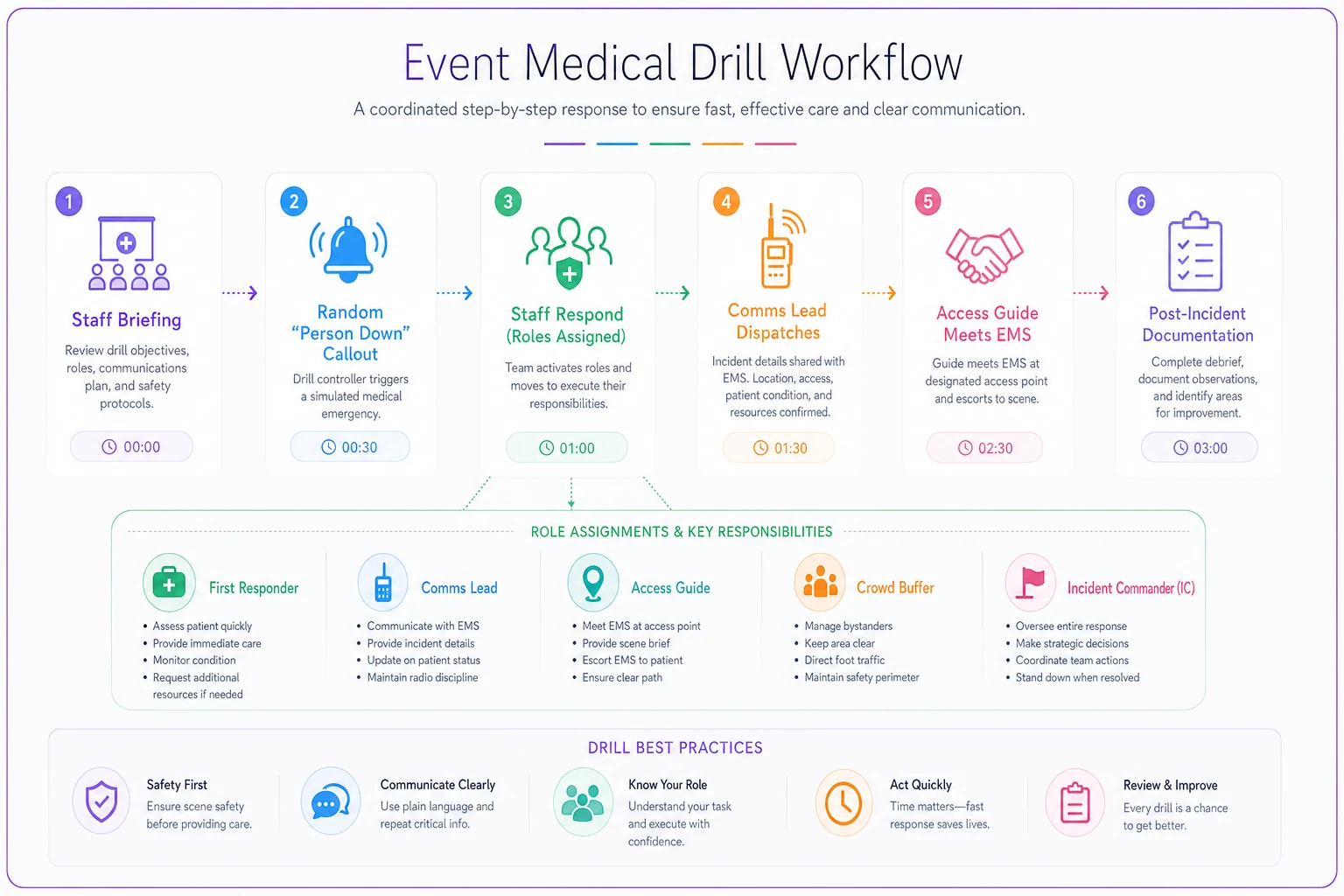
Run these micro-drills across your pre-event window.
The two forms that matter after the dust settles
The care happens in minutes. The liability lives for years. If a guest is injured and later files a claim, your documentation is the entire case. Vague notes scribbled on a napkin won't hold up, and "we think it happened around 3ish" is how events lose lawsuits.
You need two forms, and they need to be fillable at the scene — on a phone, ideally, so timestamps are automatic.
Incident Report Form — capture these fields, no exceptions:
-
Date, exact time reported, exact time resolved
-
Precise location (the same landmark language from your scripts)
-
Person involved
name, contact, age range if known
-
What happened, in plain factual language — no speculation, no opinions on fault
-
What actions were taken and by whom (with times)
-
Whether EMS was called, arrival time, transport decision
-
Witnesses
names and contact info
-
Staff on scene and their roles
-
Photos of the location/conditions (not the patient)
The "no speculation" rule is worth dwelling on. The most damaging thing a staffer can write is a guess about cause — "the floor was probably wet" or "she seemed drunk." Record what you observed, not what you concluded. That distinction has flipped the outcome of more insurance disputes than almost anything else.
The second form is the Post-Incident Review, filled out within 48 hours while memory is fresh:
-
What went right in the response
-
Where did seconds get lost, and why
-
Did the right roles get filled, or did people improvise
-
One concrete change for next time
Keep the review blameless. The goal is a faster response next time, not a scapegoat. The second you turn reviews into blame sessions, staff stop reporting near-misses, and near-misses are your best early warning system.
A real scenario: the 3,000-person food festival
A regional food festival — roughly 3,000 attendees across a single Saturday, about 40 staff and volunteers — had a plan that existed entirely as a laminated sheet in the organizer's truck. Their previous year's near-miss: a guest with a severe nut allergy started reacting, and it took almost eleven minutes between "someone's not feeling well" and the first trained person reaching her, because the radio call was garbled and two managers ran the wrong direction.
For the next year they did three things. Assigned the five roles by name at the morning huddle. Printed the Location → Severity → Resource script on every lanyard. Ran the "person down, go" drill twice before gates opened.
Mid-afternoon, a heat-related collapse happened near the main stage. The staffer radioed a clean location call, the Comms Lead dispatched the First Responder and told everyone else to hold, and the Access Guide had EMS at the patient in under four minutes. The organizer's estimate was that they'd cut their response time by more than half — and just as importantly, the incident report was complete and timestamped before the ambulance even left. When the guest's family called two weeks later asking questions, they had a clear factual record instead of a fuzzy memory.
Nothing here cost money. It cost fifteen minutes of preparation and the discipline to assign roles out loud.
When a full playbook makes sense — and when it's overkill
This level of structure makes sense when: you're running anything over roughly 500 attendees, serving alcohol, hosting in extreme weather, using temporary structures, or expecting an older or higher-risk crowd. Also any multi-day event, where fatigue erodes response quality by day three.
It's overkill when: you've got a 40-person workshop in a building with staff and a defibrillator on the wall and 911 down the street. In that case, "know where the AED is and who's calling 911" is genuinely enough. Don't build a five-role command structure for a book club.
Who should NOT half-do this: anyone hosting a large public event with volunteer-heavy staffing. Volunteers rotate, they're often young, and they've never faced an emergency. A vague plan plus inexperienced staff is the worst combination — that's precisely the setup where eleven minutes pass before anyone reaches a collapsing guest. If you're volunteer-heavy, the role assignments and lanyard scripts aren't optional; they're the whole thing.
Where software quietly helps — and where it doesn't
Most of this is human choreography, and no tool replaces a staffer who knows to say "hold your posts." But a few operational pieces get genuinely easier with the right platform behind them.
Role assignments drift constantly as staff swap shifts. Having your five roles tied to live staff assignments — rather than a static sheet from Monday — means the person wearing the Comms Lead hat at 4 PM is actually the person on shift, not someone who left at noon. Digital incident forms with automatic timestamps and location tagging also remove the biggest weakness of paper reports: fuzzy times and missing fields. When a report gets filed, routing it automatically to the right people for the post-incident review means it doesn't sit forgotten in a folder.
That's the kind of coordination work operational platforms handle well — keeping the right information in front of the right person at the moment it matters. But the drills, the scripts, the calm voice on the radio? That's still on you.
The bottom of it
An emergency plan that lives in a binder isn't a plan — it's a liability shield that doesn't actually shield anyone. What protects your guests, and your event, is the fifteen minutes you spend before gates open assigning five roles by name, handing out lanyards with a script on the back, and running one quick "go" drill so people's hands know what to do before their brains catch up.
The events that handle emergencies well aren't the ones with the thickest binders. They're the ones where a nervous 19-year-old volunteer can look at a collapsed guest, key the radio, and say the right seven words without having to think about it. Build for that, and everything else follows.
An emergency plan that lives in a binder isn't a plan — it's a liability shield that doesn't actually shield anyone. What protects your guests, and your event, is the fifteen minutes you spend before gates open assigning five roles by name, handing out lanyards with a script on the back, and running one quick "go" drill so people's hands know what to do before their brains catch up.
Ready to elevate your event management?
Join 5,000+ event organizers using Festoly to save time, improve coordination, and deliver memorable experiences.