



Most inclusion efforts on events fall apart at the same place: the gap between intention and documentation. A planner sets a goal to bring in more diverse suppliers, speakers, and vendors. Six months later, a sponsor or board member asks for the numbers. And now someone is digging through email threads, invoices, and half-updated spreadsheets trying to reconstruct what actually happened.
That reconstruction problem is the whole ballgame. If your inclusion targets can't survive an audit, they aren't targets — they're hopes. And the reason this keeps happening isn't that organizers don't care. It's that inclusion usually lives outside the operating model instead of inside it. It's treated as a value, not a workflow.
This piece is about wiring inclusion directly into how the event gets built: procurement gates that actually stop a purchase, supplier diversity targets that map to real spend, audit rules baked into your programming decisions, and documentation templates that generate proof as a byproduct of normal work. Not a separate initiative. Part of the machine.
Why inclusion breaks the moment you try to measure it
An organization commits to something like "30% of vendor spend goes to diverse-owned businesses." Everyone nods. The number goes into a deck. Then actual procurement happens the way it always has — the AV company you've used for years, the caterer the venue recommends, the printer down the street. Nobody checks the target until it's too late to influence anything.
The failure isn't ill will. It's sequencing. Inclusion targets get set at the strategy layer and then never touch the transaction layer where decisions actually get made. Purchasing happens fast, under deadline, by whoever has the corporate card and a vendor relationship. There's no checkpoint that forces the question "does this choice move us toward or away from our target?" at the moment money moves.
The second problem is definitional. What counts as a "diverse supplier"? Self-attested? Third-party certified? Woman-owned, minority-owned, veteran-owned, disability-owned, LGBTQ-owned? If three people on your team each carry a different definition in their heads, your final report is noise. You can't audit a number when the underlying category is fuzzy.
The third issue — the one that quietly kills most programs — is that the proof lives in too many places. Certification PDFs in one inbox. Spend in the accounting system. Speaker demographics in a survey nobody finished. Contract terms in a shared drive. When it's time to verify anything, the labor of assembling it is so painful that people just estimate. And estimates don't survive scrutiny.
What actually breaks as the event scales
A single 200-person conference can get away with a messy inclusion process. Someone knows, roughly off the top of their head, who the vendors were. That informal knowledge collapses somewhere between three and ten events a year.
Eliminate event chaos with Festoly.
Manage every aspect of your event seamlessly — from planning to execution.
- Centralized event scheduling
- Real-time attendee tracking
- Vendor & resource coordination
No credit card required
At scale, three specific things break:
Attribution gets muddy. When you're running a portfolio of events, a single supplier might serve four of them. Do you count their diversity status once or per-event? Is their spend allocated correctly across programs? Without a clean rule, your aggregate numbers drift, and different reports show different figures depending on who pulled them.
Certifications expire and nobody notices. A minority-owned business certification is usually valid for a defined period, then requires renewal. If you certified a supplier as diverse in January and their status lapsed in August, but your report in December still counts them — that's an audit finding waiting to happen. At one or two suppliers, you'd catch it. At forty, you won't, not manually.
The programming side drifts from the procurement side. Supplier diversity and speaker/content diversity are usually managed by completely different people, with completely different systems, and no shared scorecard. You end up over-reporting on the side someone happened to track and going silent on the side nobody owned.
This is fundamentally a coordination and documentation problem, which is why it connects directly to how you handle event data governance and metric ownership. If nobody owns the inclusion metric with a defined SLA for when and how it gets updated, it will rot the same way every unowned metric rots.
The operating model: gates, targets, rules, templates
An inclusive programming operating model has four moving parts. They only work together. Skip one and the whole thing degrades into good intentions.
| Component | What it does | Where it lives | What breaks without it |
|---|---|---|---|
| Procurement gates | Forces an inclusion check before a purchase is approved | The approval workflow | Spend happens, then you find out you missed target |
| Supplier diversity targets | Defines the goal in measurable, categorized terms | The strategy + budget layer | Vague goals nobody can verify |
| Programming audit rules | Encodes what counts, how it's counted, and when it's checked | The definitions layer | Fuzzy categories, disputed numbers |
| Documentation templates | Captures proof as a byproduct of normal work | The transaction layer | Nothing survives an audit |
Each one needs to come down to the level where it actually changes behavior.
Procurement gates that can actually stop a purchase
A gate is only real if it can say no. Most "gates" in inclusion programs are advisory — a line on a form that everyone skips. A real gate sits in the approval path and blocks progress until a condition is met or explicitly waived by someone with authority.
The practical version looks like a tiered rule based on purchase size. Below a small threshold — anything under a few hundred dollars — no gate, because the overhead isn't worth it. In the middle band, the buyer records the supplier's diversity status and whether at least one diverse-owned alternative was solicited. Above a larger threshold, you require documented evidence that a diverse supplier was invited to quote, even if they didn't win.
Notice what that last rule does. It doesn't force you to pick the diverse supplier. It forces you to include them in the process, which is both more defensible and more honest. You're measuring effort and access, not rigging outcomes. That distinction matters enormously when an auditor or skeptical board member starts poking.
The mistake most people make is setting the gate too aggressively at first. If every $50 purchase suddenly requires three quotes and a certification check, your team will route around the system entirely, and you'll end up with less visibility than before. Start with the high-dollar band, prove the workflow, then push the threshold down.
Supplier diversity targets that map to real spend
A target like "30% diverse suppliers" is ambiguous on purpose — nobody has to commit to a denominator. Thirty percent of what? Number of suppliers? Total spend? Addressable spend?
That last term is the one that keeps you honest. Some spend genuinely has no diverse-owned option available in your market — a specific proprietary platform, a venue you're contractually locked into. Carving out addressable spend (the portion where you actually have a choice) makes the target both fairer and more credible. Claiming 30% of total spend when half of it is non-addressable is the kind of thing that unravels under questioning.
A typical example: an events team runs about $1.2M in annual vendor spend across a season. After removing locked-in venue costs and one proprietary registration platform, maybe $700k–$800k is genuinely addressable. Setting a diverse-spend target against that addressable base — and reporting both numbers — is what makes the figure survive a review. You're not hiding the non-addressable portion; you're contextualizing it.
Targets also need to be broken out by category, not lumped together. "Diverse-owned" as a single bucket lets you quietly over-index on one category while ignoring others. Track the categories separately, even if you report a combined headline number.
Programming audit rules: the boring part that saves you
This is the part everyone wants to skip, and the part that determines whether any of it holds up. Audit rules are the written answers to the questions that cause disputes later:
-
What counts as diverse? Certified only, or self-attested with documentation? By which certifying bodies?
-
As of when? Certification must be valid as of the contract signing date, or as of the event date?
-
How is spend attributed when a supplier serves multiple events?
-
What's the evidence standard — a certificate on file, a quote in the record, both?
-
Who can waive a gate, and how is the waiver documented?
Write these once, get them approved by whoever owns compliance, and stop re-litigating them mid-season. The value isn't in the rules being perfect — it's in them being stable and written down, so two people pulling the same report get the same answer.
On the programming side — speakers, panelists, performers, content — the same discipline applies but the data is more sensitive. You're often dealing with self-reported demographic information, which means consent and aggregation rules matter. The clean approach: collect at the individual level with explicit consent, report only in aggregate, and never let a single-panel breakdown become identifiable. Your audit rule here is as much about privacy as it is about counting.
Documentation templates that generate proof automatically
The whole system lives or dies on whether documentation is a byproduct or a chore. If capturing proof is a separate task someone does after the fact, it won't happen. If it's embedded in the step people already have to complete, it happens for free.
That means your intake and approval forms are your documentation. The vendor onboarding form captures certification status and uploads the certificate. The purchase approval captures the gate decision and any waiver reason. The speaker confirmation captures consented demographic data. By the time the event is over, the audit file has assembled itself out of steps that had to happen anyway.
The failure mode is the "we'll tag it later" spreadsheet. Anything deferred to a cleanup pass at the end is guessing. Standardized templates that force the field at the moment of the transaction are the only version that produces defensible numbers.
A workflow that ties it together
Here's how the pieces move in sequence across a single event cycle:
-
Set the addressable target. At budget time, categorize spend into addressable and non-addressable, and set diverse-spend targets against the addressable base, broken out by category.
-
Onboard suppliers through a standard intake. Every new vendor's diversity status and certification — with expiry date and uploaded proof — is captured before they can be issued a purchase order.
-
Trigger the gate at approval. When a purchase crosses the threshold, the approval workflow requires the inclusion check and records whether diverse suppliers were solicited.
-
Log waivers explicitly. If a gate is overridden, the reason and the approver are recorded — no silent skips.
-
Track programming inclusion in parallel using consented, aggregate demographic capture for speakers and content.
-
Reconcile mid-season, not just at the end. Pull the running numbers against target while there's still time to influence remaining purchases.
-
Generate the report from the captured data, not from memory or reconstruction.
The reconciliation step in the middle is the one most teams miss, and it's the highest-leverage one. Checking your numbers with three events left in the season means you can still act. Checking after the last event means you're writing an explanation, not hitting a target.
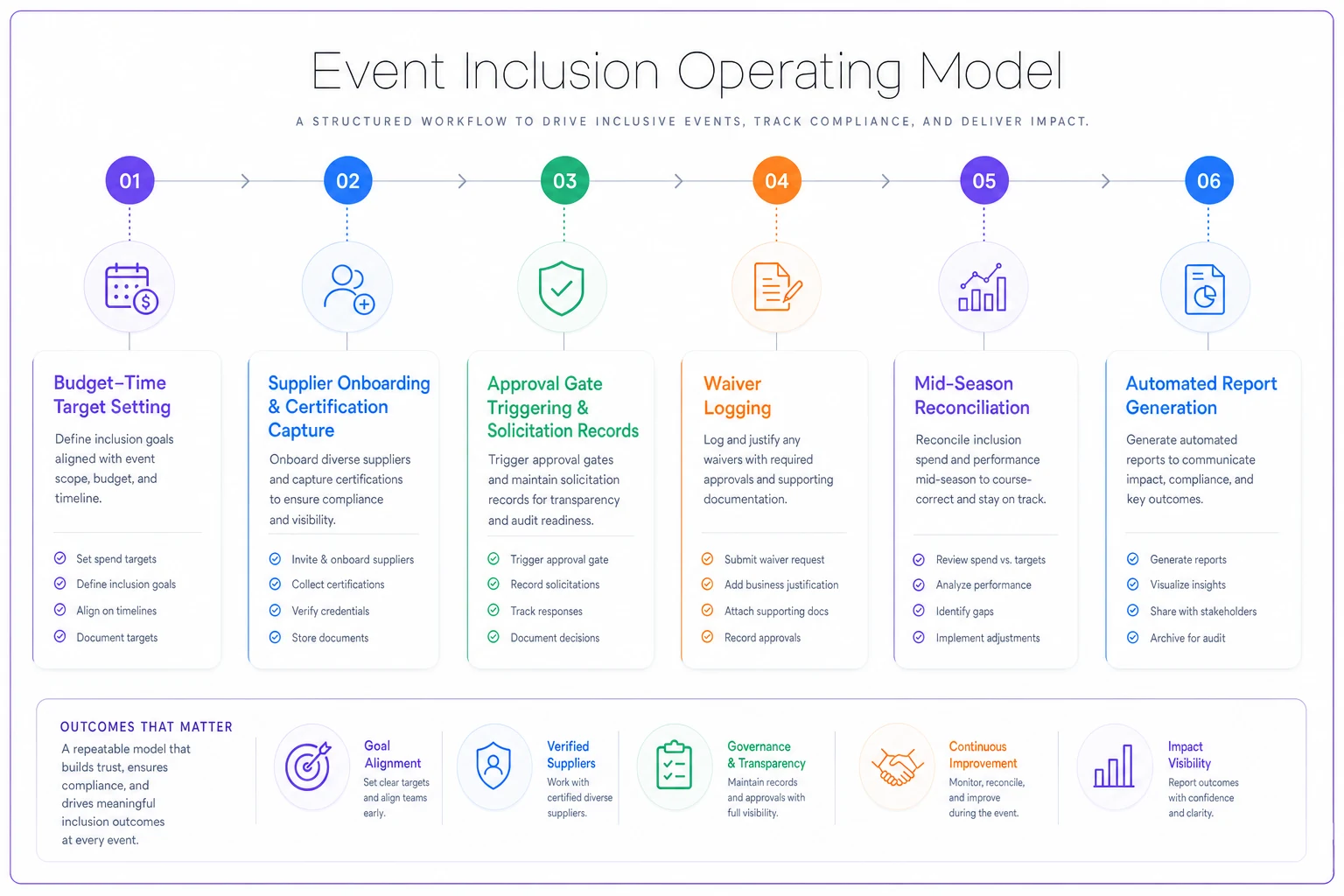
This diagram maps the sequence of gates, onboarding, approvals, reconciliation, and report generation so you can see how each step feeds the next.
This sequencing matters because each step feeds the next. Onboarding without gates means clean data but no enforcement. Gates without prior onboarding means approvals get held up while someone scrambles to find a certificate. When the steps are in order, the system mostly runs itself.
A real scenario
A regional association running about eight events a year — a mix of conferences and smaller workshops — committed to a supplier diversity target after a board push. First year, they reported a number pulled together in the final two weeks: roughly 18% diverse spend, assembled from invoices and best guesses. When a board member asked how many of those suppliers were currently certified, nobody could answer, and two turned out to have lapsed certifications. The number quietly got walked back.
The next cycle they rebuilt around the model above. They split spend into addressable (around $540k of a total near $900k), set a category-broken target against the addressable base, put a gate on purchases over about $2,500, and moved certification capture into vendor onboarding.
The headline number the following year wasn't dramatically higher — they landed somewhere around 24–26% of addressable spend. But they could stand behind it. Every supplier in the count had a valid certificate on file with an expiry date. Every high-dollar purchase had a documented solicitation record. When the board asked the hard question this time, the answer took about an hour to produce instead of two weeks, and nothing got walked back. The verifiability was worth more than a few extra points would have been.
When this makes sense — and when it doesn't
When it makes sense: You're running a portfolio of events, you have external stakeholders (sponsors, boards, public funders) who will ask for numbers, or you've already made a public inclusion commitment you now have to back up. The moment inclusion becomes something you report, it needs to become something you can audit.
When it's overkill: A one-off event, a tiny budget, or an internal team gathering where nobody will ever request verification. Bolting a full gate-and-audit apparatus onto a single 80-person workshop is process for its own sake. Track it lightly, move on.
Who should not do this yet: Teams that haven't nailed down basic vendor and spend data. If you can't reliably pull total vendor spend by event, you're not ready for a diversity overlay on top of it — you'll be measuring inclusion against a denominator you don't trust. Get the underlying spend data clean first, then layer this on.
Where the contracts fit in
Inclusion targets have a habit of dying at the contract stage, because the terms that would make a supplier's diversity status enforceable simply aren't there. If a supplier represents themselves as diverse-owned and that status matters to your reporting, that representation belongs in the contract — along with the right to see current certification and a notice obligation if their status changes.
This is the same discipline that comes up when you're avoiding vendor contract traps through clause-level language. The clauses that protect you operationally and the clauses that protect your inclusion reporting come from the same habit: writing down what you're relying on instead of assuming it. A verbal "yeah, we're minority-owned" that never made it into a document is exactly the kind of thing that collapses the first time someone checks.
The mindset shift that makes it stick
The teams that get this right stop treating inclusion as a moral overlay and start treating it as an operational spec — the same category of thing as a safety requirement or a budget control. Nobody debates whether the fire exits are "authentic." They're a requirement, they're checked, they're documented. Inclusion targets get durable at the exact moment they get that same unglamorous treatment.
The proof-generation piece is what most people underestimate. When documentation is a byproduct of normal work rather than a separate reporting sprint, the whole thing stops being fragile. You're not reconstructing what happened — you're reading what the system already recorded.
Set the gates so they can actually say no. Define the target against a denominator you can defend. Write the audit rules once and stop re-arguing them. Let the templates do the remembering. Do that, and inclusion stops being a claim you make and becomes a number you can hand to anyone who asks.
Ready to elevate your event management?
Join 5,000+ event organizers using Festoly to save time, improve coordination, and deliver memorable experiences.