


Rain forecasts give you a number. They don't tell you that the northeast corner of your site drains through a single clogged grate, or that your main vendor alley sits four inches below the access road and turns into a shallow lake the moment runoff starts moving. By the time water is pooling, the planning window is gone. What you have left is whatever gear is already on site and whatever your crew has actually rehearsed.
This is a tight, operational walkthrough of the physical side of flooding: where you build barriers, how you stage pumps, and the one thing most teams get wrong — reopening a flooded zone on gut feeling instead of a hard, binary checklist tied to drain function and a named safety sign-off. If you want the broader decision logic around weather calls, the decision trees for common event disruptions covers the trigger side. This post is about what your hands do once the trigger fires.
Start by mapping water, not the forecast
Most flood problems on event sites aren't about total rainfall. They're about where water goes once it lands. A site can absorb a surprising amount of rain and stay dry if flow paths lead away from occupied zones. The same site floods with half the rain if one low point sits under a tent full of power distribution.
Walk your site before anything is built and mark three things:
-
Low points — anywhere water will naturally collect. Vendor alleys between two raised walkways, the base of a slope, loading areas that were graded for trucks, not drainage.
-
Flow paths — the lines water travels along. Curbs, road edges, the seam where asphalt meets grass, cable trenches.
-
Drains and their actual capacity — not just where grates exist, but which ones are already half-clogged with leaves, gravel, or construction debris.
The pattern you see repeatedly: teams assume the installed drainage works. On temporary sites, it often doesn't. Grates get covered by flooring, trenches get crushed by forklifts, and inlets that were fine during the venue walkthrough are blocked by the time load-in finishes. A drain you haven't physically tested is a drain you can't count on.
Before you plan a single berm, assign someone to clear and test every grate in or near an occupied zone. Pour a few gallons, watch it drain, note the slow ones. That map — not the weather app — is what your flood tactics get built around. For how this fits into a wider risk picture, the event risk and resilience framework is worth reading alongside this.
Channeling: send water somewhere on purpose
The cheapest flood tactic is also the most overlooked. Before you try to block water, try to redirect it. Channeling means giving runoff a defined path toward a drain or safe runoff area so it never reaches the zone you care about.
Eliminate event chaos with Festoly.
Manage every aspect of your event seamlessly — from planning to execution.
- Centralized event scheduling
- Real-time attendee tracking
- Vendor & resource coordination
No credit card required
On a hard surface, this is usually just a line of sandbags or water-filled barriers set at a slight angle — not a wall, a guide. You're nudging flow a few feet to the left so it runs along the road edge into a storm drain instead of sheeting across your vendor alley. Done early, a 30-foot channel built from maybe 40–60 sandbags can keep an entire zone dry that would otherwise need pumping all night.
A few things that go wrong with channeling:
-
People build it perpendicular to the flow instead of along it. That turns a channel into a dam, which backs water up somewhere worse.
-
They forget the exit. A channel that funnels water toward a grate that's already clogged just concentrates the problem. Clear the destination drain first.
-
They build it too late. Once water is already moving across the zone, channeling fights established flow. It works best when it's in place before the rain, shaping the first runoff.
Channeling won't save you in a genuine flash flood. But for the far more common scenario — steady rain, slow pooling, marginal drainage — it's often the tactic that keeps your crew from spending the whole night running pumps.
Temporary berms: where blocking actually works
When redirecting isn't enough, you block. A temporary berm is a low barrier built to hold water out of a protected zone. The two realistic options for most events:
| Barrier type | Best for | Setup speed | Watch out for |
|---|---|---|---|
| Sandbags | Uneven ground, small gaps, building around obstacles | Slow, labor-heavy | Gaps between bags leak; needs overlap and a plastic liner to seal |
| Water-filled barriers (bladder dams) | Long straight runs on flat hard surfaces | Fast once water source is near | Useless on uneven ground; can shift if not anchored |
The mistake that sinks most berm efforts isn't the barrier material — it's height and continuity. A berm is only as good as its lowest point and its weakest seam. A six-inch berm with one four-inch dip lets water in at the dip, and the whole thing was wasted labor. Build to a consistent height across the full run, then add a few inches of margin, because water finds every shortfall.
The second common failure: no plan for water that gets behind the berm anyway. Rain falls inside your protected zone too. If you build a perfect wall with no pump inside it, you've built a bathtub. Every berm needs a designated low point inside it and a pump assigned to that point.
Pump staging: position before you need it
Pumps fail you in two ways — they're not where the water is, or they are where the water is but can't discharge it anywhere useful. Both are staging problems, and both are solvable before the first drop.
-
Where will water collect inside this zone? That's your intake point. Stage the pump there, not at the zone's center or entrance.
-
Where does the discharge hose go? A pump that dumps water ten feet away onto a surface that drains right back into your zone is a loop. Run the discharge to an actual drain, a lower runoff area, or far enough downhill that it leaves for good.
-
What powers it, and what's the backup? Electric pumps die when power does, and power often dies in the same storm that's flooding you. Gas-powered pumps need fuel staged nearby and ventilation if they're anywhere near enclosed space.
A workable staging pattern for a mid-size site: one primary pump per protected low zone, plus one spare staged centrally that any zone can grab. Fuel for gas units in a marked, ventilated spot with enough for several hours of continuous run. Discharge hoses pre-run and pre-secured, because nobody wants to be laying 50 feet of hose in a downpour.
Run each pump for two minutes during setup and watch where the water actually goes.
The detail crews skip: testing discharge routing in dry conditions. Run each pump for two minutes during setup and watch where the water actually goes. You'll find the "downhill" discharge point is subtly uphill, or the hose kinks at a corner — while it's still easy to fix.
A real scenario
A two-day outdoor food and music event on a converted parking lot — roughly 6,000 attendees a day — had a vendor row sitting in the lot's natural low spot. The venue's drainage was two storm grates, both partially blocked by temporary flooring laid over them during load-in.
Day one brought steady afternoon rain. Within about 40 minutes, water was pooling ankle-deep across the vendor row, under food trucks pulling 30-plus amps each. The crew had two pumps on site but hadn't staged them — both were still boxed in a storage container 200 feet away. By the time they were running and the flooring was pulled back off the grates, three vendors had shut down and the ops team had cut power to that row as a precaution. Call it two hours of lost vendor sales, plus the refund conversations afterward.
For day two, the team changed almost nothing about their equipment and everything about their staging. They cleared and tested both grates that morning, laid a short sandbag channel to steer road runoff away from the row, pre-positioned both pumps at the two lowest points with discharge hoses run to a drain at the lot edge, and staged fuel nearby. Rain came again that afternoon, heavier. The row stayed open the whole time. Same gear, same site, same weather — the difference was entirely in preparation and positioning.
Inspection checklist: what to verify before rain, not during
Flood readiness is a setup-phase job. Run this during load-in while there's still daylight and slack in the schedule:
-
[ ] Every grate in or near an occupied zone cleared and water-tested
-
[ ] Flooring and cable runs checked so they aren't covering drain inlets
-
[ ] Low points in each occupied zone identified and marked on the ops map
-
[ ] Channeling material staged near zones that need runoff redirected
-
[ ] Berm material at each zone that needs blocking, with height target set
-
[ ] One pump staged per protected low zone, plus a central spare
-
[ ] Discharge hoses pre-run and routed to a confirmed drain or runoff point
-
[ ] Each pump test-run for two minutes; discharge path confirmed to flow away
-
[ ] Fuel for gas pumps staged in a marked, ventilated location
-
[ ] Power source and backup confirmed for electric pumps
-
[ ] One person per zone assigned as flood lead, named on the duty sheet
Every item on this list is easy during setup and genuinely hard once it's raining. A grate takes two minutes to clear in daylight and a frustrating twenty minutes in the dark with water already on top of it.
The binary reopen checklist: the part teams get wrong
Water recedes, a zone looks dry, pressure builds to reopen because vendors are losing money and attendees are asking. So someone makes a call based on how it looks. That's how a zone reopens with a hidden live electrical hazard, or with a grate still backed up so the next shower refloods it in ten minutes.
The fix is to strip judgment out of the reopen decision entirely. Reopening a flooded zone should be binary — every item is a yes/no, and a single "no" keeps the zone closed. No partial reopens, no "probably fine."
-
Standing water fully cleared from the walking and operating surface — not "mostly," fully.
-
Drains confirmed actively flowing, not just uncovered. Someone watched water move through the grate.
-
No active inflow — the source of flooding has stopped, or channeling and berms are holding it back.
-
Electrical inspected and cleared by a qualified person. Any distribution, cable, or equipment that sat in water stays off until it's checked. Non-negotiable.
-
Walking surfaces checked for slip and trip hazards — mud, silt, displaced flooring, loose cables.
-
Named safety sign-off logged — a specific person, at a specific time, who confirms items 1 through 5 and owns the decision.
That last item matters more than it looks. A reopen decision with no name attached is a decision nobody owns, which means nobody actually verified it. Logging who signed off and when forces someone to physically walk the zone, and gives you a clear record if anything goes wrong later. If you're handling an insurance angle on top of everything else, that timestamped sign-off becomes part of your evidence trail.
The binary structure is the whole point. The moment you allow "good enough," pressure from vendors and the schedule will push zones open before drains are actually working. A yes/no gate gives your onsite lead something concrete to point to when someone pushes back: the checklist isn't complete, so the zone stays closed. That's a much easier conversation than defending a judgment call after the fact.
When these tactics make sense — and when they don't
Channeling and berms make sense when you're dealing with the common case: steady or heavy rain, marginal drainage, slow pooling. Most event flooding is this, not a wall of water. Redirecting and blocking buys you the time you need, and pumps handle the rest.
They're the wrong plan when the real risk is flash flooding or rising water from an outside source — a nearby river, storm surge, upstream runoff. No temporary berm built during load-in holds back serious moving water. If your site sits in a genuine flood zone, the right answer is evacuation and closure triggers, not sandbags. Know which situation you're actually in before you commit a crew to holding a line that can't be held.
Who should skip the heavy pump staging: small indoor events, or sites with genuinely good, tested drainage and no low points in occupied zones. If water has somewhere to go on its own, you don't need to stage three pumps. Match the effort to what your site map actually shows you — not to a generic worst case.
Keeping it coordinated when it's actually happening
The hardest part of flood response isn't the tactics — it's keeping track of everything live. Which zones are closed, who's the flood lead for each, whether the reopen checklist is done, which pumps are running and on what fuel. That's a lot to hold in your head during a storm when radios are busy and everyone's wet and dealing with something else.
Teams that handle this well keep the flood map, zone status, and reopen checklists in one shared operational view instead of scattered across radio calls and someone's clipboard. When zone status and sign-offs live somewhere the whole ops team can see, you stop getting the situation where one lead thinks a zone reopened and another thinks it's still closed. That visibility matters most during the chaotic middle of an incident, when verbal updates get lost and decisions stop getting recorded. The tools are less important than the discipline of having one source of truth — but having zone states, assigned leads, and checklist completion visible to everyone at once removes a whole category of coordination mistakes that otherwise show up exactly when you can least afford them.
This visual ties together who owns each zone, the checklist state, and pump/discharge status so everyone sees the same picture.
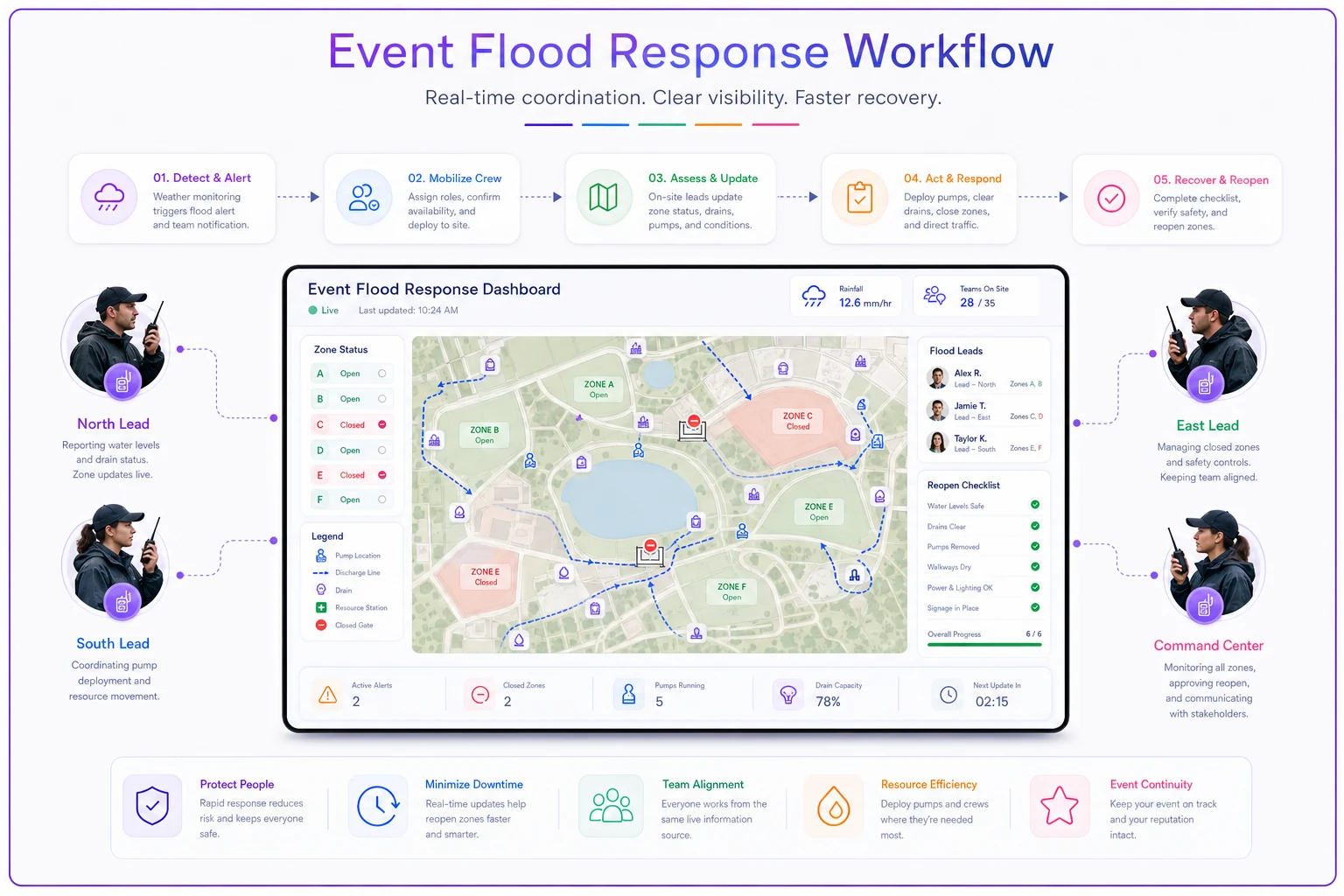
The graphic shows a single source of truth for zone states, assigned leads, and checklist completion so teams avoid conflicting verbal updates during a storm.
The bottom line on reopening
The tactical side of flood mitigation — channeling, berms, pump staging — rewards preparation. Almost everything that matters happens during load-in, in daylight, when it's easy. The response side, when water's already moving, is just executing the staging you already set up.
The reopen decision is where discipline pays off most. A flooded zone that reopens too early because it looked dry is how a weather inconvenience becomes a safety incident. Tie that decision to drain function and a named safety sign-off, make it strictly yes/no, and you take the single most dangerous judgment call of the whole event and turn it into a checklist anyone can verify. That's the difference between a site that handled the rain and one that just got lucky.
Ready to elevate your event management?
Join 5,000+ event organizers using Festoly to save time, improve coordination, and deliver memorable experiences.