


Event organizers obsess over ROI, but they're usually measuring the wrong things at the wrong time. There's this disconnect where executives want hard numbers while marketing teams scramble to justify budgets with spreadsheets nobody trusts.
The measurement trap that kills most event programs before they start
Most event programs use broken measurement frameworks. They track registration numbers religiously while missing pipeline influence. They measure booth traffic as deals slip through untracked. They count social media impressions while real revenue attribution vanishes into some "marketing influenced" percentage that makes finance teams groan.
The problem isn't just picking better metrics. Teams collect tons of data but can't connect it to actual business outcomes. A developer conference launching a new product needs different success metrics than a customer appreciation dinner. But teams keep using that same tired playbook—count attendees, survey satisfaction, declare victory, repeat.
Why standard event metrics create operational blindness
The typical event measurement approach looks reasonable on paper. Track registrations versus attendance. Survey participants. Count leads. Calculate cost per acquisition. Generate a report showing positive trends. Plan the next event.
Eliminate event chaos with Festoly.
Manage every aspect of your event seamlessly — from planning to execution.
- Centralized event scheduling
- Real-time attendee tracking
- Vendor & resource coordination
No credit card required
This breaks down when events get complex. Consider what happens when a mid-size B2B company runs a hybrid user conference. Marketing wants brand awareness metrics. Sales wants qualified pipeline. Customer success wants retention signals. Product wants feature feedback. Finance wants hard ROI within 90 days. Each team pulls in different directions, measuring different things, creating reports that tell completely different stories about success.
The measurement chaos gets worse when you factor in attribution complexity. That enterprise deal that closed six months after your conference—did the event influence it? Product says their demo drove the decision. Sales claims their follow-up sealed it. Marketing points to the executive dinner. Customer success notes the implementation workshop. Everyone's right, everyone's wrong, and nobody can prove anything definitively.
Traditional event management platforms make this worse by focusing on logistics metrics rather than business outcomes. They'll tell you exactly how many people checked in before 9am but can't connect those attendees to revenue opportunities. They track session attendance perfectly but miss the hallway conversation that becomes a seven-figure partnership.
Building measurement frameworks that match real business objectives
Effective event measurement starts with accepting uncomfortable truths about what events can and can't deliver. Not every event drives immediate revenue. Not every attendee becomes a lead. Not every interaction needs tracking. The framework needs to match reality, not wishful thinking.
Start by mapping event types to primary objectives and realistic attribution windows. A thought leadership summit might take 18 months to show revenue impact but generates immediate brand lift. A sales kickoff should show pipeline velocity changes within 60 days. A customer conference might not generate new revenue but reducing churn by 2% delivers more value than acquiring 50 new accounts.
The framework needs three layers working together. First, define success metrics tied to actual business goals, not event industry benchmarks. Second, establish data collection methods that capture both quantitative outcomes and qualitative signals. Third, create attribution models that acknowledge uncertainty while still providing directional guidance.
Most teams want perfect attribution but operate with messy data. They want real-time insights but use disconnected systems. They want predictive analytics but can't even agree on historical performance.
Primary objectives and their measurement profiles
Different event objectives require fundamentally different measurement approaches. Pipeline acceleration events need tight sales integration and short attribution windows. Brand building events need sentiment tracking and long-term lift studies. Product launches need adoption metrics and feature engagement data.
Pipeline & Revenue Events
These events live and die by their ability to move deals forward. Success means tracking every interaction from first touch to closed won. The measurement profile focuses on deal velocity, stage progression, and influenced revenue within defined windows.
Key metrics include meetings booked versus held, opportunities created versus progressed, deal size changes, and time-to-close acceleration. Attribution typically runs 30-90 days for transactional sales, 6-12 months for enterprise deals. Data collection relies heavily on CRM integration and sales team input.
Brand & Awareness Events
These events play a longer game, building market presence and thought leadership over time. Success means tracking perception changes, content amplification, and market positioning shifts.
Key metrics include share of voice changes, sentiment analysis, content engagement rates, and executive relationship mapping. Attribution windows stretch 12-24 months with quarterly measurement checkpoints. Data collection combines social listening tools, survey platforms, and media monitoring services.
Customer Success Events
These events focus on retention, expansion, and advocacy rather than new acquisition. Success means tracking account health improvements and expansion revenue opportunities.
Key metrics include renewal rates, upsell velocity, NPS changes, and product adoption increases. Attribution typically runs through full renewal cycles. Data collection requires tight integration with customer success platforms and usage analytics.
Attribution tradeoffs and practical compromises
Perfect attribution doesn't exist. Every model makes tradeoffs between accuracy and practicality. Single-touch attribution is clean but wrong. Multi-touch attribution is complex but still incomplete. Influence models sound sophisticated but often become black boxes that nobody trusts.
The practical approach acknowledges these limitations upfront. Instead of chasing perfect attribution, focus on directional accuracy and consistent methodology. Pick an attribution model that matches your sales cycle and stick with it long enough to establish baselines.
For in-person events with clear attendance records, lean toward first-touch or last-touch attribution depending on the event's role in the buyer journey. Early-stage awareness events get first-touch credit. Late-stage acceleration events get last-touch credit. Mid-funnel events share credit through simple multi-touch models.
Hybrid events complicate attribution further. Virtual attendees engage differently than in-person participants. They might watch recordings weeks later or only attend specific sessions. Weight in-person attendance higher for relationship-building metrics. Weight virtual attendance higher for content consumption metrics.
The biggest attribution challenge comes from indirect value creation. That partner who attended your event and later referred three deals—how do you track that? The analyst who mentioned your product in a report after seeing your keynote—where's that value captured? The customer who became an advocate after attending your user conference—how does that factor into ROI?
Smart teams build attribution models that capture direct value precisely while estimating indirect value consistently. They use conservative multipliers for word-of-mouth impact. They track leading indicators like executive relationships and partner engagement. They accept that 20-30% of event value remains unmeasured but ensure the measured portion justifies investment.
Data collection templates that actually work
Most event data collection fails because teams try to track everything instead of tracking what matters. They create 50-question surveys that nobody completes. They build complex tracking systems that break under real-world pressure.
Effective data collection starts with ruthless prioritization. Pick 5-7 metrics that directly connect to business objectives. Design collection methods that minimize friction. Build redundancy for critical data points.
Pre-Event Collection Template
| Data Point | Collection Method | Timing | Priority |
|---|---|---|---|
| Registration source | UTM tracking | Real-time | Critical |
| Company profile | Registration form | Upon signup | Critical |
| Buying stage | Progressive profiling | Pre-event survey | High |
| Strategic account flag | CRM integration | Automatic | High |
| Intended outcomes | Registration preferences | Upon signup | Medium |
Track registration source, company profile, and buying stage. Capture intended outcomes through simple preference selections, not essay questions. Map attendees to existing CRM records immediately, not after the event. Flag VIP attendees and strategic accounts for special handling.
The registration form should take under 90 seconds to complete. Every additional field reduces completion rates. That optional "dietary restrictions" field might seem helpful, but if it pushes your form over two minutes, you'll lose more registrants than you'll gain in operational efficiency.
The registration form should take under 90 seconds to complete.
During-Event Collection Template
-
Session check-ins through mobile apps or RFID badges
-
Booth engagement through lead scanners or QR codes
-
Content interaction through download tracking
-
Meeting completion through appointment systems
-
Networking activity through app analytics
-
Demo requests through registration systems
-
Social engagement through hashtag monitoring
Most of this data lives in different systems that don't talk to each other. The registration platform doesn't connect to the mobile app. The lead scanner doesn't sync with the appointment system. The session tracking doesn't flow to the CRM. Manual data consolidation becomes a multi-week project that delays follow-up.
Post-Event Collection Template
Send surveys within 48 hours while memories remain fresh. Keep them under 8 questions. Focus on outcomes and intentions, not satisfaction scores. Include one open-ended question for qualitative feedback. Track response rates by segment to identify collection gaps.
Follow-up data collection should happen at 30, 60, and 90-day intervals for pipeline events. Check deal progression, meeting completion, and next steps. For brand events, run quarterly perception studies and annual impact assessments. For customer events, track product usage changes and renewal outcomes.
Measurement cadence for different event formats
In-person events follow predictable measurement rhythms. Pre-event metrics focus on registration velocity and audience quality. During-event metrics track engagement and interaction density. Post-event metrics measure follow-through and business impact.
Virtual events need different measurement cadences because engagement patterns vary wildly. Live attendance might be 40% of registrations, but on-demand views could triple that number over the next month. Track live participation immediately, on-demand consumption weekly for the first month, and total reach quarterly.
Hybrid events require parallel measurement tracks. In-person attendees get measured like traditional events. Virtual attendees need extended tracking windows. The complexity comes from understanding how these audiences interact—did virtual attendees influence in-person participants through chat? Did in-person content drive virtual engagement?
Measurement frequency also depends on organizational metabolism. Fast-moving startups might review metrics weekly. Enterprise organizations might run monthly cycles. Match measurement cadence to decision-making cycles, not arbitrary schedules.
System integration and data flow architecture
The biggest measurement challenge isn't choosing metrics—it's connecting systems to capture them automatically. Most organizations run events across 8-12 different platforms that barely integrate. Registration lives in one system, content in another, engagement tracking in a third, CRM data in a fourth.
[Event ROI Data Flow Workflow - GRAPH placeholder]
This diagram shows how registration, engagement, CRM, and analytics systems should link together.
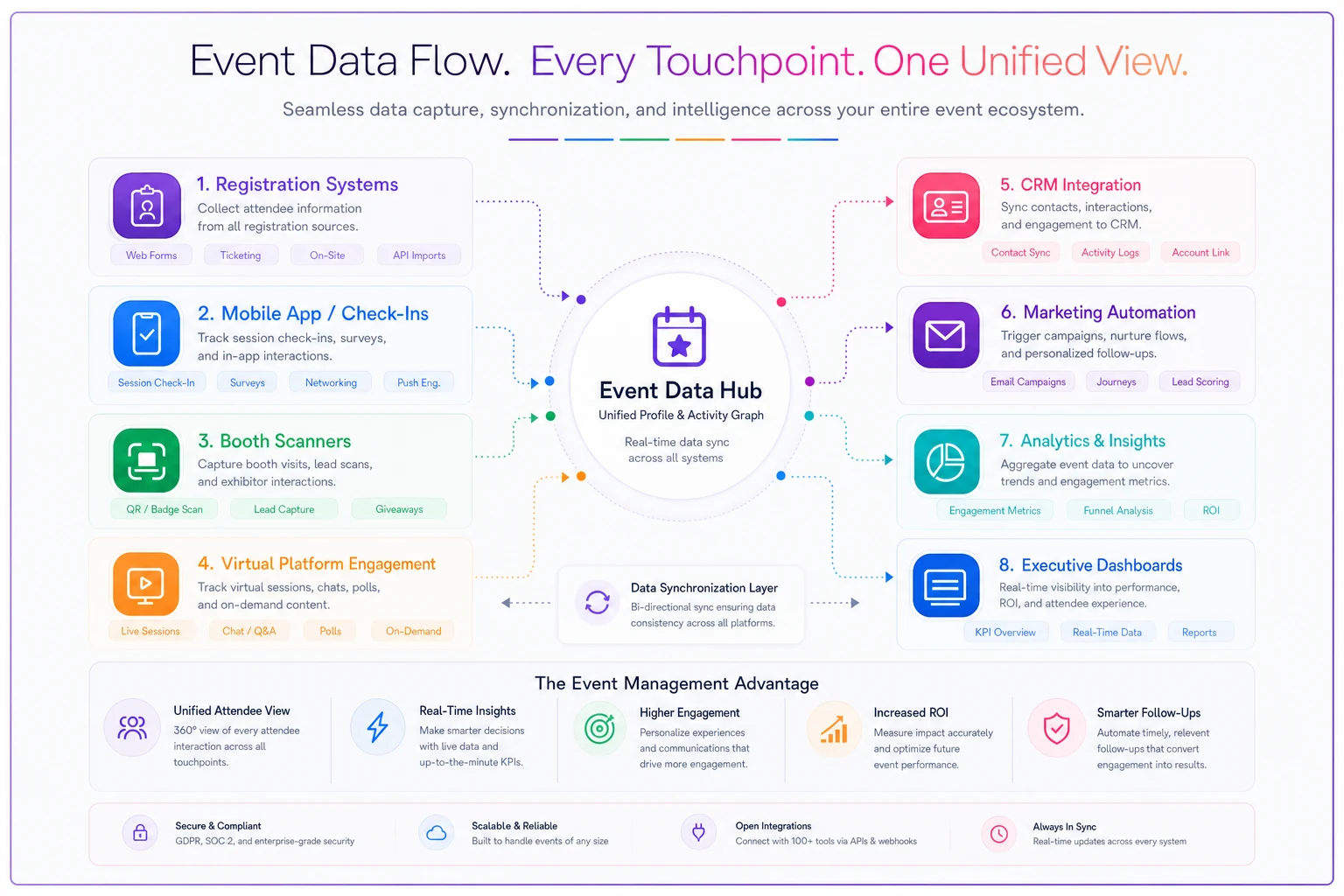
Manual data consolidation becomes a massive operational burden. Teams spend days copying attendee lists between systems. They build elaborate spreadsheets trying to match email addresses across platforms. They lose attribution data in the gaps between systems.
Modern event operations need unified data architecture. This doesn't mean buying an all-in-one platform that does everything poorly. It means building integration layers that connect specialized tools effectively. Registration data should flow automatically to CRM systems. Engagement metrics should update lead scores in real-time.
The integration challenge becomes especially complex for hybrid events running parallel tech stacks. Virtual platform data needs to merge with in-person check-in systems. Mobile app analytics need to combine with booth scanner data. Each integration point becomes a potential failure point where data gets lost or corrupted.
AI-powered operational platforms help here by identifying and matching records automatically across systems. Instead of manually mapping data between platforms, smart systems can infer connections from partial data. Rather than building complex integration workflows, automation reduces the operational burden from weeks to hours.
ROI calculation models and executive reporting
Every event organizer claims to calculate ROI, but most use different formulas that produce wildly different results. Some only count direct revenue. Others include pipeline influence. Some factor in cost avoidance and efficiency gains. The lack of standardization makes comparison impossible.
The practical approach uses three ROI models simultaneously. Conservative ROI only counts closed-won revenue directly attributed to the event. Moderate ROI includes influenced pipeline with probability weighting. Aggressive ROI factors in brand value, relationship building, and indirect benefits.
Conservative Model Calculation:
(Directly Attributed Closed Revenue - Total Event Cost) / Total Event Cost
This model only counts deals where the event was the primary touch point. It ignores influenced revenue, pipeline creation, and brand value. Most events show negative or barely positive ROI under this model, especially in the first year.
Moderate Model Calculation:
((Attributed Revenue + (Influenced Pipeline × Win Rate)) - Total Event Cost) / Total Event Cost
This model includes pipeline creation and acceleration, weighted by historical win rates. It provides a more complete picture while remaining grounded in measurable outcomes. Most successful B2B events show 200-400% ROI under this model within 12 months.
Aggressive Model Calculation:
((All Revenue + Pipeline + Brand Value + Cost Savings) - Total Event Cost) / Total Event Cost
This model attempts to capture total value creation including hard-to-measure benefits. It requires assumptions about brand impact, relationship value, and efficiency gains. While less precise, it often better reflects the true business impact of major events.
Executive reporting needs to tell a story beyond just ROI calculations. Start with business impact—deals closed, pipeline created, customers retained. Add operational metrics—cost per outcome, efficiency improvements, scale achievements. Include strategic value—relationships built, market position, competitive advantages.
Most executives want simple dashboards, not complex attribution models. They care more about trend direction than precise percentages. Show them whether events are getting more or less effective over time, not whether the exact ROI was 247% or 263%.
Warning signs your measurement framework is broken
Watch for these signals that your event measurement system needs overhaul. Reports take weeks to generate after events end. Different departments show conflicting success metrics. Attribution arguments dominate post-event reviews. The same metrics get tracked but never acted upon.
The most dangerous sign is when teams start gaming metrics rather than improving outcomes. They optimize for registration numbers by reducing qualification standards. They boost satisfaction scores by surveying only happy attendees. They inflate pipeline numbers by counting every conversation as an opportunity.
Another clear signal is when operational teams spend more time on measurement than improvement. If data collection and reporting consume 30% of your event team's capacity, the framework is too complex. If generating executive reports requires dedicated analysts and multiple systems, the architecture is broken.
Teams also struggle when measurement becomes defensive rather than instructive. Instead of using data to improve future events, they use it to justify past decisions. This happens when measurement systems punish honest assessment or when success metrics become political rather than practical.
Building sustainable measurement operations
The best event ROI framework is one that actually gets used consistently. This means balancing comprehensiveness with practicality. It means choosing good-enough attribution over perfect tracking. It means automating data collection rather than relying on manual processes.
Start with clear objective hierarchy. Every event should have one primary goal, two to three secondary goals, and no more. Map metrics directly to these goals. Ignore everything else, no matter how interesting it might seem.
-
Startup Stage
Track registration, attendance, and basic satisfaction
-
Growth Stage
Add pipeline attribution and content engagement metrics
-
Scale Stage
Incorporate lifetime value and multi-touch attribution
-
Mature Stage
Include brand impact and competitive positioning metrics
Don't try to jump straight to advanced measurement. Build your operational muscle with simple metrics first, then layer on complexity as your systems and processes can handle it.
Build measurement into operational workflows rather than treating it as a separate process. Registration forms should capture attribution data automatically. Session check-ins should update engagement scores immediately. Follow-up sequences should track response rates natively.
Invest in integration before sophistication. A simple framework with automated data flow beats a complex model requiring manual updates. Focus on connecting your core systems—registration, CRM, marketing automation, and analytics. Once data flows smoothly, you can add sophistication through AI-powered analysis and predictive modeling.
Making measurement decisions that matter
Event ROI frameworks fail when they promise precision that doesn't exist or demand effort that isn't sustainable. The path to credible measurement isn't through perfect attribution or complete data capture. It's through consistent methodology, realistic expectations, and clear connection to business value.
Teams that succeed with event measurement share common traits. They pick a methodology and stick with it long enough to establish baselines. They automate data collection rather than relying on manual effort. They present multiple perspectives on ROI rather than defending a single calculation.
Most importantly, they recognize that measurement serves decision-making, not justification. The goal isn't to prove that every event succeeded. It's to understand what drives value and what doesn't, then adjust accordingly. Sometimes that means killing beloved events that don't deliver ROI. Sometimes it means investing more in formats that work.
Most event programs run on momentum and tradition rather than data-driven decisions. They repeat what they've always done because nobody can definitively prove what works better. Breaking this cycle requires commitment to measurement discipline, even when it's imperfect.
The framework and templates provided here offer a starting point, not a final answer. Every organization needs to adapt them to their specific context and constraints. But the principles remain constant—align metrics with objectives, build sustainable collection processes, accept attribution tradeoffs, and focus on actionable insights over perfect data.
Ready to elevate your event management?
Join 5,000+ event organizers using Festoly to save time, improve coordination, and deliver memorable experiences.