

Most planners treat vendors as a series of disconnected transactions. You run an RFP, pick someone, sign a contract, hope they show up, and then forget about them until next year when you start the whole thing over. The vendor who melted down at last year's gala somehow ends up back on your shortlist because nobody wrote down what happened, and the one who quietly saved your load-in never gets rewarded for it.
That gap — between how vendors actually perform and how you select them next time — is where the real money leaks. The event vendor performance lifecycle is the connective tissue that closes that loop. It links what you ask for in procurement, what you measure during the event, and what you do with that information afterward, so your vendor pool gets more reliable every cycle instead of resetting to zero.
This isn't about adding paperwork. It's about building a system where last year's reality informs next year's decisions, and where your best suppliers get locked in as preferred vendors before your competitors poach them.
Why the Lifecycle Breaks (And It Usually Breaks in the Same Places)
The failure almost never happens at the contract stage. Contracts get negotiated carefully — people worry about liability, payment terms, and cancellation clauses. The breakdown happens in the handoffs between stages, because each stage is owned by a different person who doesn't talk to the next one.
-
Procurement is run by someone focused on price and availability. They score RFPs on cost and a gut sense of whether the vendor seems competent.
-
On-site operations is run by a completely different crew who inherits whatever procurement signed, with no visibility into what was promised.
-
Post-event wrap-up gets rushed, because everyone's exhausted and the next event is already looming. Performance notes, if they exist at all, live in someone's memory or a Slack thread that gets buried.
So the data that should flow backward into the next RFP never makes the trip. The on-site team knows the AV vendor showed up two hours late and sent a crew that didn't match the quote. Procurement never hears about it. Twelve months later, that same vendor wins the bid again because their number was lowest and nobody flagged them.
When you're running one or two events a year, this is annoying but survivable. You remember the big disasters. The problem compounds fast once you're running eight, twelve, twenty events a year with overlapping vendor pools — institutional memory stops working. You physically cannot remember which caterer underdelivered in which city. That's when a real lifecycle system stops being optional.
Stage One: RFPs That Actually Predict Performance
Most RFPs are written to compare prices. That's the original sin. If your scoring heavily weights cost, you're optimizing for the vendor most willing to underbid — which is frequently the vendor most likely to cut corners on-site.
Eliminate event chaos with Festoly.
Manage every aspect of your event seamlessly — from planning to execution.
- Centralized event scheduling
- Real-time attendee tracking
- Vendor & resource coordination
No credit card required
A performance-oriented RFP asks vendors to commit to specific, measurable things before they're hired, and those commitments become the baseline you measure against later. The questions shift from "what's your price" to "what will you guarantee, and what happens when you miss."
A few things worth building into the RFP itself:
-
Staffing specifics, named where possible. Not "experienced crew" but "crew of 6, lead with 3+ years, on-site by a defined call time." Vague staffing promises are the number one source of on-site disputes.
-
Response-time commitments during the event. How fast will they fix a problem? Fifteen minutes? An hour? Get it in writing.
-
A reference check that asks the right question. Don't ask references "were they good." Ask "did they deliver exactly what was quoted, and what went wrong." The second half of that question is where you learn something.
-
Their own performance data. Serious vendors who run tight operations can tell you their on-time rate. Ones who can't are telling you something too.
The RFP stage is also where clause-level language matters enormously, because the commitments here feed directly into your SLA scorecard later. If you're fuzzy on what counts as a breach now, you'll have no leverage during a dispute. It's worth reviewing the specific contract traps and negotiation moves that medium events routinely fall into — the language you lock in during procurement is what you'll be enforcing at 6am on load-in day.
A common mistake at this stage
Planners load the RFP with requirements but never define how those requirements will be measured. A vendor promises "prompt setup." Prompt according to whom? Without a defined metric, every promise is unenforceable. The RFP should map, item by item, to a scorecard line. If it can't be scored, it shouldn't be a promise — it should be a conversation.
Stage Two: Onboarding That Transfers Knowledge Forward
Onboarding is the most skipped stage, and skipping it is why on-site teams keep getting blindsided. The vendor signed a contract with procurement, but the people actually running the floor have never seen that contract and don't know what was promised.
Good onboarding is really just a controlled handoff of expectations. Before the event, the vendor should receive — and acknowledge — the specific KPIs they'll be measured against. No surprises on either side. The on-site team should receive the same document, so everyone is scoring against the same standard.
In practice, onboarding should produce three artifacts that travel together:
-
A scorecard the vendor has seen and agreed to, so there's no "nobody told me" when they underperform.
-
An on-site contact map — who the vendor escalates to, and who on your side owns that relationship.
-
A baseline record of what was quoted, so on-site changes can be flagged as deviations instead of arguments.
This is where vendor operations and exhibitor operations start to rhyme. The discipline of linking what was contracted to what happens on the floor is the same muscle covered in the exhibitor operations framework — milestones, on-site rules, and settlement all have to reference the same source of truth. Vendors are no different. If the floor team can't see the contract, the contract may as well not exist.
Stage Three: SLA Scorecards and On‑Site KPIs
This is the heart of the lifecycle, and where most of the measurable value lives. An SLA scorecard turns vague impressions ("they were fine, I guess") into data you can actually act on.
The trick is keeping it small enough that someone will fill it out during a live event. A 40-line scorecard sounds thorough and gets ignored. A 6-to-8-line scorecard that an ops lead can complete in two minutes between fires actually gets done.
Here's a practical breakdown of what belongs where:
| Metric | What It Measures | Captured When | Owner |
|---|---|---|---|
| On-time arrival | Vendor on-site by call time | Load-in | Dock/gate lead |
| Staffing match | Crew size & roles vs. contract | Setup | On-site ops |
| Setup completion | Ready by deadline | Pre-doors | Ops lead |
| Response time | Speed resolving issues | Live | Zone manager |
| Spec compliance | Delivered = quoted | Live / teardown | Ops lead |
| Teardown & cleanup | Left in agreed condition | Load-out | Dock/gate lead |
| Communication | Reachable, proactive | Throughout | Vendor liaison |
Each line gets a simple score — a 1-to-5, or even just pass/flag/fail. What matters is that it's captured in the moment, not reconstructed from memory a week later. Memory is the enemy here. By the time you sit down to do a post-mortem, the small failures have blurred together and the vendor who was 90 minutes late becomes "a little behind."
Keep the scorecard to 6–8 lines so an ops lead can complete it in two minutes during the event.
The KPI most planners forget to track
Everyone tracks whether the vendor delivered. Almost nobody tracks how much your team had to intervene to make them deliver. A vendor who hits every deliverable but requires three of your staff babysitting them all day is far more expensive than their invoice suggests. Add a "touch count" or "intervention level" to your scorecard. It surfaces the vendors who look fine on paper but quietly burn your labor budget.
A regional conference series running roughly a dozen events a year moved from informal vendor impressions to a 7-line scorecard captured on-site. Within two cycles they noticed their "cheapest" AV vendor scored well on deliverables but had the highest intervention count across every event — their crew was understaffed, so the planner's own techs kept filling gaps. The invoice looked like a bargain; the true cost, once you priced in the borrowed labor, was somewhere in the range of 20–25% higher than the next bid. That vendor dropped off the preferred list the following year. The replacement cost slightly more up front and saved real staff hours.
Stage Four: Performance Reviews That Close the Loop
A scorecard that nobody reviews is just a form. The review is where scattered on-site observations get consolidated into a vendor-level verdict that feeds the next RFP.
The review should happen within a week or two of the event, while it's still fresh, and it should produce a single rolling record per vendor — not a new document every time. That rolling record is the whole point. It's what lets you see that a caterer was great in March, shaky in July, and had a staffing collapse in October. One bad event might be an anomaly. A trend is a decision.
A workable review workflow:
-
On-site scores get collected into the vendor's rolling record immediately after the event.
-
The vendor liaison adds context — not just numbers, but why. "Late because of a traffic incident, communicated proactively" is a very different note than "late, unreachable for 40 minutes."
-
The vendor gets a short summary of how they scored. This matters more than people expect — vendors who know they're being measured perform differently.
-
The record flags the vendor as preferred, conditional, or do-not-rebook, and that flag is visible to whoever runs the next procurement.
This visual outlines how scores move from event capture into the rolling vendor record and then into a rebook/no-rebook decision.
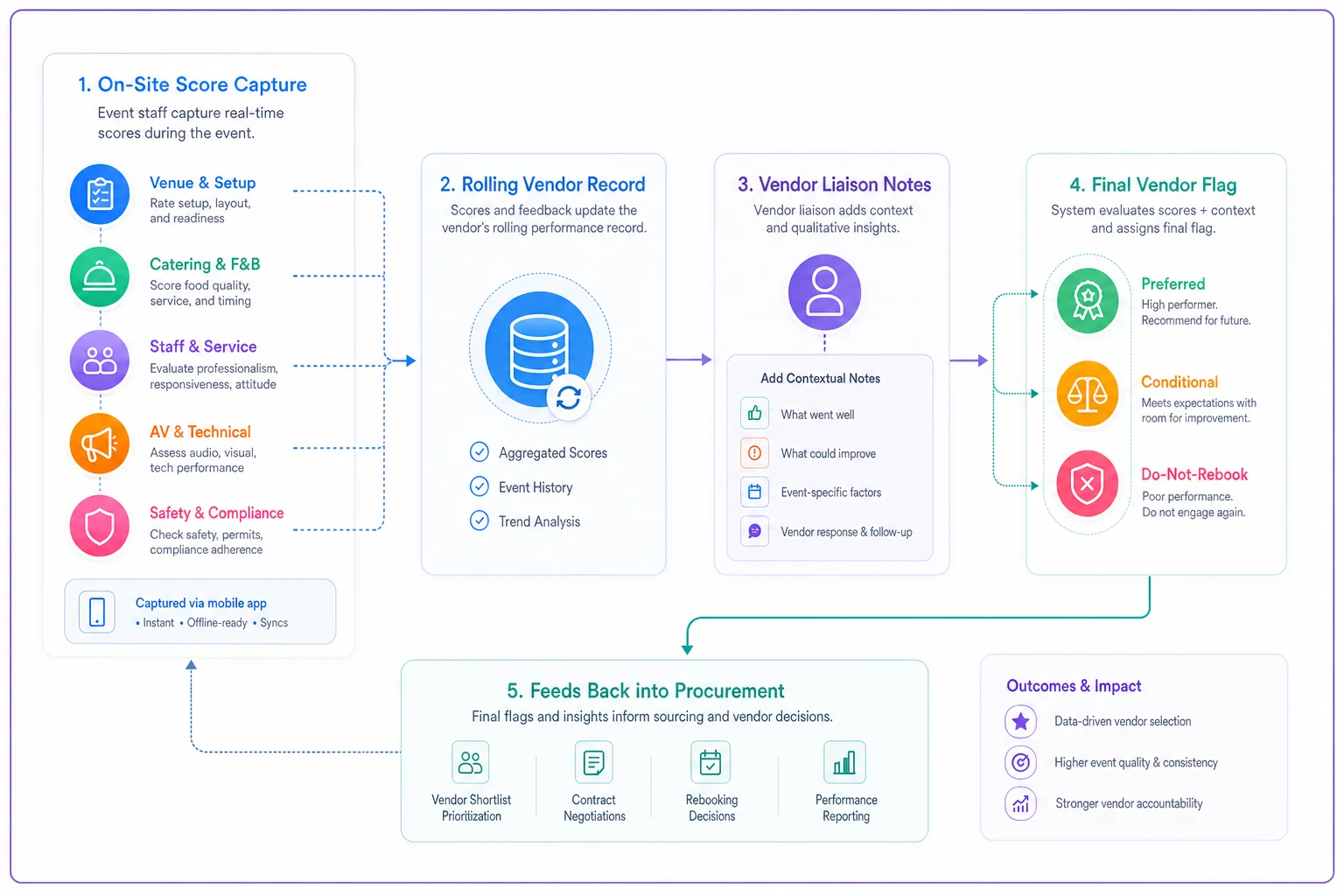
That final flag is the mechanism that actually prevents the "why is this disaster vendor back on our shortlist" problem. Small thing, fixes a recurring and expensive failure.
Stage Five: Dispute Workflows That Don't Poison the Relationship
Disputes are inevitable. The question is whether your process resolves them in a way that preserves good vendors and penalizes bad ones — or just creates grudges and lost suppliers.
The biggest mistake is handling disputes emotionally and in the moment, on the floor, during the event. That's the worst possible time: everyone's stressed, nobody has the full picture, and decisions made at 11pm during teardown tend to be wrong.
A better approach separates the on-site flag from the resolution:
-
On-site, the ops team logs the issue factually against the scorecard. No negotiation, no penalty decisions. Just evidence: what was promised, what happened, timestamped.
-
Post-event, the dispute moves to a defined workflow with the vendor liaison, where penalties, credits, or corrective commitments get decided against the contract language.
This is where your RFP and onboarding discipline pays off. If the scorecard maps cleanly to contracted commitments, disputes become almost mechanical — "you committed to a crew of six, three showed, here's the agreed remedy." If your commitments were vague, every dispute becomes a shouting match about interpretation.
Who should NOT run disputes this way
If you run a single small event a year with two or three vendors you've worked with for a decade, a formal dispute workflow is overkill. A phone call fixes it. This system earns its keep when you have vendor turnover, multiple events, or vendors you don't personally know. At that scale, informal handling is exactly what lets bad vendors slide back in.
Preferred-Vendor Programs: Where the Whole Lifecycle Pays Off
Everything above feeds one outcome: a preferred-vendor program. Once you have reliable performance data flowing from procurement through on-site KPIs into reviews, you can formally designate vendors who've earned it — and give them something in return.
Preferred vendors get first look at upcoming RFPs, faster onboarding (they already know your standards), and sometimes longer payment terms or multi-event commitments. In exchange, you get vendors who treat your events as a priority because they're protecting a relationship that reliably sends them work.
The economics are pretty straightforward. A vendor who knows they'll be rebooked across six events a year has every incentive to overperform. A vendor fighting for a one-off job is optimizing for winning the bid, not for your load-out running smoothly. The preferred-vendor program converts transactional relationships into something closer to a partnership — but only because the performance data gives you an honest basis for who deserves to be in it.
When a preferred-vendor program is a bad idea
If you're locking vendors in based on relationships instead of data, you're not running a preferred program — you're running favoritism with a nicer name. A vendor who's "always been our guy" but scores poorly on-site is costing you more than the newcomer you won't take a chance on. The program only works if the preferred list is earned through the scorecard, not inherited through habit. The moment it becomes political, it stops reducing risk and starts hiding it.
A Quick Checklist to Pressure-Test Your Current Setup
Run through this honestly:
-
[ ] Do your RFP requirements map directly to measurable scorecard lines?
-
[ ] Does your on-site team see the contract commitments before the event?
-
[ ] Is vendor performance captured during the event, not reconstructed afterward?
-
[ ] Do you track how much your own staff had to intervene, not just whether deliverables were met?
-
[ ] Is there one rolling record per vendor, not a new file each time?
-
[ ] Does a bad performance review actually block that vendor from the next shortlist?
-
[ ] Are disputes logged on-site but resolved post-event against contract language?
-
[ ] Is your preferred-vendor list based on scores, or on who you like?
If you're missing more than two or three of these, your lifecycle has a broken handoff somewhere — and it's almost certainly costing you in repeat problems you've stopped noticing.
Where Software Fits (And Where It Doesn't)
None of this requires sophisticated tooling to start. The rolling vendor record can live in a shared sheet; the on-site scorecard can be a form on someone's phone. The discipline matters far more than the platform.
That said, the lifecycle gets genuinely hard to run manually once you're past a handful of events and a dozen vendors. The failure point is almost always the handoff — data captured on-site that never makes it back into procurement. Workflow and vendor management platforms earn their place here by keeping that loop closed automatically: on-site scores flow into the rolling record, the record surfaces during the next RFP, and preferred-vendor flags travel with the vendor instead of living in one person's head. Automating those connections removes the single most common reason the lifecycle breaks — a human forgetting to carry information from one stage to the next. But the system has to exist first. Software only accelerates a loop you've already designed.
Bringing It Together
The reason vendor quality feels random to so many planners is that there's no system connecting what you promised, what you measured, and what you decided to do next time. Each event starts fresh, memory does the heavy lifting, and bad vendors survive on short attention spans.
The event vendor performance lifecycle fixes that by treating procurement, on-site KPIs, reviews, and disputes as one continuous loop rather than four isolated events. Build the scorecard so it maps to the contract. Capture performance in the moment. Let the data decide who gets preferred status. Do that consistently, and your vendor pool stops resetting every year and starts compounding — reliable suppliers get locked in, weak ones get filtered out, and your events get quietly, measurably easier to run.
Ready to elevate your event management?
Join 5,000+ event organizers using Festoly to save time, improve coordination, and deliver memorable experiences.