

Most event tech stacks don't fail because a single vendor is bad. They fail at the seams — the moment your ticketing platform hands off to access control, your cashless provider tries to reconcile against your CRM, your mobile app expects data the badge printer hasn't written yet. Each vendor works fine in a demo. It's the integration that breaks at 9:47am on show day when 4,000 people hit the gates and the Wi-Fi is already half-dead.
The uncomfortable part is that you, the organizer, own the architecture whether you designed it or not. Vendors own their boxes. Nobody owns the wiring between the boxes unless you decide to. This post is about that wiring — the sync patterns, data contracts, conflict rules, and offline fallbacks that determine whether your event runs smoothly or spends its first two hours in radio-silence chaos while three vendors blame each other on WhatsApp.
We'll work through prioritized sync patterns, how to write data contracts that vendors actually honor, conflict-resolution rules for when two systems disagree, and offline-first fallbacks that keep gates moving when connectivity dies. With worked examples for the vendor combinations you're most likely to actually run.
Why the seams break: it's a coordination problem, not a software problem
Here's the pattern that shows up across almost every mid-to-large event stack. You buy a ticketing platform because it's great at ticketing. An access control system because it's great at scanning. A cashless provider because it handles payments and reconciliation well. Each is a strong product. But each one assumes it's the source of truth for the attendee.
When three systems each think they own the attendee record, you get drift. Ticketing says the ticket was upgraded to VIP at 8pm last night. Access control synced at 6pm and never got the update. The attendee shows up, gets scanned, gate flashes "General Admission" while they're waving a confirmation email that says otherwise. Now you've got a supervisor override, a queue backing up, and a data conflict nobody defined a rule for.
This is why event technology architecture is fundamentally a coordination discipline. The individual tools are rarely the bottleneck. The bottleneck is the undefined handoff — who writes what, when, in what shape, and who wins when two systems disagree. In practice, this usually happens because the integration was scoped as "we'll connect them via API" without anyone specifying the direction of authority, the timing of syncs, or the behavior when the network goes down.
The teams who avoid show-day chaos aren't the ones with the fanciest tools. They're the ones who wrote down, before load-in, exactly which system owns which field and what happens when connectivity drops.
Prioritizing your sync patterns: not everything needs to be real-time
The most expensive mistake in event tech is treating every data flow like it needs instant, two-way, real-time sync. Real-time sync is expensive, fragile, and the first thing to collapse under load. Most of your data doesn't need it.
Eliminate event chaos with Festoly.
Manage every aspect of your event seamlessly — from planning to execution.
- Centralized event scheduling
- Real-time attendee tracking
- Vendor & resource coordination
No credit card required
Sort every integration into one of three tiers based on how quickly stale data causes a real operational problem.
| Sync Tier | Max Acceptable Staleness | Pattern | Typical Flows |
|---|---|---|---|
| Tier 1 — Critical | Seconds | Real-time push (webhook) with local cache fallback | Access control scans, cashless balance, capacity counts |
| Tier 2 — Operational | 1–5 minutes | Polling or micro-batch | Ticket upgrades, name changes, comp additions, session check-ins |
| Tier 3 — Analytical | Hours / post-event | Nightly batch or end-of-day export | CRM enrichment, revenue reconciliation, marketing attribution |
The discipline here is refusing to promote things to Tier 1 that don't belong there. A common example: someone insists CRM tags must update in real time so the concierge team sees VIP flags instantly. But if you look at the actual workflow, a 3-minute polling sync is completely fine — the concierge isn't reacting in sub-second windows. Promoting that flow to real-time just adds one more fragile connection that can fail on show day.
The inverse mistake is worse. Capacity counts for a zone with a hard fire-code limit cannot be a 5-minute batch. If your indoor stage caps at 2,500 and your counter is running five minutes behind, you can be 200 people over before the system knows. That's a safety issue, not a data-quality issue.
A useful rule: the sync tier should match the cost of being wrong for that specific field, not the importance of the system it lives in. An important system can carry Tier 3 fields. A boring system can carry a Tier 1 field.
Data contracts: the thing vendors will honor if you write it down
A data contract is just an explicit agreement about the shape and meaning of data moving between two systems. Not the API docs — those describe what's possible. The contract describes what your event actually sends and expects, plus what happens when data is malformed or missing.
-
Field-level ownership — which system is authoritative for each field (ticketing owns
tickettype, access control ownslastscan_timestamp, cashless ownsbalance) -
Required vs optional fields, and the explicit default for each optional field
-
Enumerated values — the exact allowed set for things like
access_level, so nobody invents a new tier mid-event -
Identity keys — the shared attendee ID every system keys against, and how it's generated
-
Malformed-data behavior — reject, quarantine, or accept-with-default, decided per field
-
Timestamp and timezone standard — everything in UTC, or you will have a check-in that appears to happen before the ticket was issued
The reason this matters: vendor APIs are generous. They'll accept a null where you meant zero, a string where you meant an enum, a missing field where you assumed a default. Everything looks fine in testing with clean data. Then a comp ticket gets created through a side door without a ticket_type, access control defaults it to null, null maps to "deny," and your sponsor's CEO gets turned away at the gate.
That identity key deserves its own emphasis. The single most common root cause of cross-system chaos is ticketing keying attendees by email, access control keying by badge serial, and cashless keying by wristband UID — with nothing reliably tying the three together. When you can't join records, every downstream conflict becomes unresolvable by machine and gets handled by a human at a help desk. Pick one canonical attendee ID early, propagate it to every system, and make it a required field in every contract.
Good data contracts also make your post-event analytics survivable. When the same attendee ID and the same enumerated values flow through every system, reporting isn't a reconciliation nightmare. This connects directly to how you handle metric ownership and analytics SLAs — the contract is where governance actually gets enforced, at the field level, before bad data ever reaches a dashboard.
Conflict resolution: deciding who wins before the fight happens
Two systems will eventually disagree about the same attendee. The question isn't whether — it's whether you decided the rule in advance or you're improvising it at the gate.
-
Source-of-truth wins. One system is authoritative, full stop. If ticketing and access control disagree on
ticket_type, ticketing wins because ticketing owns it. Simple, predictable, and correct for most identity and entitlement fields. -
Last-write-wins (with reliable timestamps). Whichever update has the newer timestamp prevails. This works for fields that genuinely change over time and can be updated from multiple places — a phone number, a dietary flag. It only works if your timestamps are trustworthy and in a single timezone, which loops right back to your data contract.
-
Merge / additive. Some fields should never overwrite — they should accumulate. Cashless top-ups are the classic case. If two nodes both recorded a top-up while offline, you don't pick a winner; you sum them. Getting this wrong means either double-crediting or making someone's money disappear.
There's an operational subtlety most teams miss: the default conflict behavior of most integration middleware is last-write-wins, because it's the easiest to implement. That's exactly wrong for entitlement fields. If access control re-syncs stale data after ticketing made a change, last-write-wins can silently revert a legitimate upgrade. You have to override the default deliberately for anything where authority matters more than recency.
A practical example: an attendee upgrades to VIP online at 8:15pm. Access control's last full sync was 6:00pm. At 6:30am the next morning, access control does a startup sync and — under naive last-write-wins keyed on its clock — could reassert the old access level. Under source-of-truth-wins, ticketing's VIP flag always prevails regardless of sync order. Same data, completely different gate experience, decided entirely by which rule you wrote down weeks earlier.
Offline-first: the fallback that determines whether your event survives a dead network
Every honest event architecture assumes the network will fail at the worst possible moment. Not "might." Will. Backhaul saturates, a cell tower gets overloaded by 5,000 attendees, someone unplugs the wrong switch during load-in. Your architecture's real quality is measured by what happens in those minutes.
-
What can each node decide alone? A scanner should validate a ticket against a locally cached allowlist without phoning home for every scan. If it can't, one network blip stops every gate simultaneously.
-
What's the failure-mode default? When a scanner can't verify a ticket at all, does it fail open (let people in, reconcile later) or fail closed (deny)? This is a risk decision, not a technical one, and it differs by event. A free community festival might fail open to keep gates moving. A paid conference with strict capacity might fail closed. Decide it, write it down, and make sure staff know which mode they're in.
-
How do queued writes reconcile? When the network returns and 40 terminals dump their offline transactions at once, your reconciliation logic has to handle duplicates, ordering, and the additive-merge cases from the conflict section. This is where cashless especially lives or dies.
A quick visual of an offline-first scanner syncing workflow:
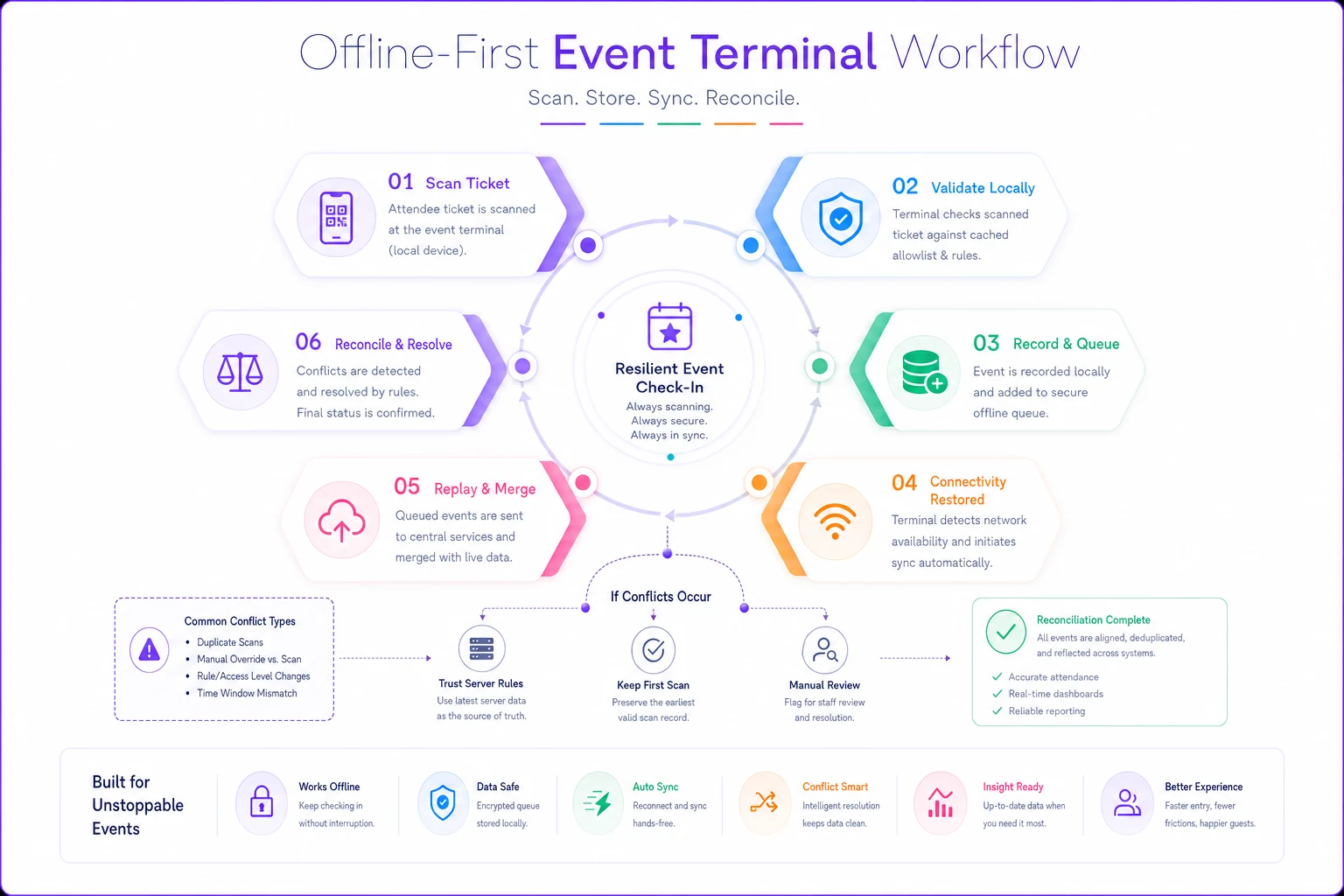
A worked offline scenario: your access control runs a locally cached allowlist refreshed every few minutes when online. Network dies for 18 minutes during peak arrivals. Because each scanner holds the allowlist locally, gates keep moving — attendees get scanned, entries get logged to local storage. When connectivity returns, each scanner replays its queued entry events. Capacity counts, which were drifting across independent nodes during the outage, reconcile up to the true total. The one thing you can't do offline is enforce a hard capacity cap in real time across nodes, so for capped zones you either pre-allocate per-gate limits or accept a reconciliation gap and manage overflow physically. Knowing that limitation in advance is the whole point.
Worked examples for common vendor combinations
Ticketing → Access Control (the most common pairing).
Ticketing is source-of-truth for identity and entitlement. Access control owns scan events and holds a cached allowlist. Sync pattern: Tier 1 for the allowlist push (webhook on every ticket change, plus a full refresh every few minutes as a safety net), Tier 2 for scan events flowing back. Conflict rule: source-of-truth-wins on tickettype and accesslevel; access control never overrides ticketing on entitlement. Offline fallback: cached allowlist, fail-open or fail-closed per your risk call, queued scan replay on reconnect.
Cashless → CRM / Ticketing.
Cashless owns balance and transaction history — never let another system overwrite a balance. Sync pattern: Tier 1 for balance at the terminal (with local caching so a terminal keeps taking payments offline), Tier 3 for the CRM enrichment that ties spend back to the attendee profile. Conflict rule: additive-merge on transactions; you sum, you never pick a winner. Offline fallback: terminals operate against cached balances and queue transactions; reconciliation on reconnect sums offline top-ups and spends, flags anything that pushes a balance negative for manual review. This is the combination where a sloppy conflict rule literally loses attendees' money, so it deserves the most rigorous contract.
Ticketing / Access Control → Analytics & CRM. Almost entirely Tier 3 — nightly or post-event batch. Nothing operational depends on it during show hours, so don't waste real-time connections here. The contract's job is consistency: same attendee ID, same enumerated values, same timezone, so your post-event numbers actually tie out. Getting this layer right is what makes the difference between clean outcome-to-metric attribution and a week of manual spreadsheet reconciliation after the event.
Mobile app → everything. The app is usually a reader, not a writer, and treating it that way avoids enormous pain. It displays ticket status, cashless balance, schedule — it should read from caches and tolerate staleness gracefully. Showing a "last updated" timestamp beats showing wrong data confidently. When the app does write (session check-in, favoriting), those are Tier 2 at most, and last-write-wins is fine because nothing critical hangs on them.
A pre-event integration checklist
Before load-in, walk your stack against this.
-
[ ] Every attendee is keyed by one canonical ID that propagates to every system
-
[ ] Every shared field has exactly one owning system documented
-
[ ] Every integration is assigned a sync tier (1/2/3) with a max-staleness number
-
[ ] Every multi-writer field has an explicit conflict rule (source / last-write / merge)
-
[ ] Middleware's default last-write-wins has been overridden for all entitlement fields
-
[ ] Every critical node has a defined offline fallback and a fail-open/fail-closed decision
-
[ ] Cashless reconciliation logic handles duplicate and additive offline transactions
-
[ ] All timestamps are standardized to one timezone (UTC recommended)
-
[ ] Malformed-data behavior is defined per field (reject / quarantine / default)
-
[ ] Someone owns the seams — not just the vendors, the wiring between them
If you can't answer one of these, that's your next failure point.
A real scenario: a regional conference that stopped blaming vendors
A roughly 6,000-attendee regional professional conference ran three vendors — a ticketing platform, a separate access control provider, and a cashless system — connected through a middleware layer set up "to save time." First year, their morning peak was a mess: badge upgrades from the night before didn't reflect at the gates, help-desk lines ran 20-plus minutes deep for the first hour, and a mid-morning connectivity dip stopped scanning entirely for around 15 minutes because every scan was hitting the server live.
Nothing about the vendors changed for year two. What changed was the architecture discipline. They picked a single canonical attendee ID and forced it through all three systems. Wrote a one-page data contract per integration with field ownership and defaults. Demoted the CRM tag sync from real-time to a few-minute poll, and promoted the allowlist to a proper cached-with-webhook pattern so scanners could validate locally. Set access control to source-of-truth-wins on entitlement, overriding the middleware default. Configured scanners to run offline against a cached allowlist with a documented fail-open rule for general admission.
The second-year morning peak wasn't perfect, but it was a different event. Gate overrides for entitlement mismatches dropped to a handful across the whole morning. Help-desk waits at open settled into the single-digit minutes. When connectivity wobbled again mid-morning — because it always does — the gates kept moving on cached data and reconciled cleanly afterward instead of freezing. No new software. Just someone finally owning the seams.
Where this leaves you
Event technology architecture doesn't reward the biggest budget or the trendiest vendor. It rewards the organizer who treats the connections between systems as a first-class thing to design, not an afterthought to wire up later. The tools will mostly do their jobs. The failures live in the handoffs — the undefined ownership, the wrong sync tier, the middleware default nobody overrode, the offline mode nobody decided.
Sit down before load-in and answer, for each pair of connected systems: who owns each field, how fast does it sync, who wins in a conflict, and what happens when the network dies. Those four questions, written down and agreed by every vendor, prevent most of the show-day fires that people wrongly blame on bad software. The architecture is yours whether you claim it or not — you may as well design it on purpose.
Sit down before load-in and answer, for each pair of connected systems: who owns each field, how fast does it sync, who wins in a conflict, and what happens when the network dies. Those four questions, written down and agreed by every vendor, prevent most of the show-day fires that people wrongly blame on bad software. The architecture is yours whether you claim it or not — you may as well design it on purpose.
Ready to elevate your event management?
Join 5,000+ event organizers using Festoly to save time, improve coordination, and deliver memorable experiences.