

The worst version of a crisis isn't the crisis itself. It's the second one you create when your social media coordinator tweets "we're evacuating due to a gas leak," your stage MC tells the crowd "please remain calm, this is precautionary," and your text-alert system fires a message that says nothing at all because nobody had the login. Three channels, three stories, one event. Attendees pull out their phones, compare notes, and now you're not managing a disruption — you're managing confusion on top of a disruption.
Most event teams have decent emergency operations. They've drilled the evacuation routes. They know where the medical tent is. What they almost never have is a governance layer that controls who says what, on which channel, with whose sign-off, during the forty-five minutes when everything is on fire and the person who normally approves messaging is stuck in a loading dock with no signal.
Crisis communications governance isn't about writing better statements. It's about building a system where the right message leaves the right channel at the right time — even when half your leadership is unreachable and the other half is panicking.
Why cross-channel messaging falls apart under pressure
The failure is almost never a lack of good intentions. It's structural. During normal operations, your channels are owned by different people who rarely need to coordinate in real time. Your email list is run by marketing. Your on-site PA is run by production. Your X/Instagram accounts live with a comms person who may not even be on-site. Your SMS alert tool is owned by whoever set it up eighteen months ago.
In calm conditions, distributed ownership works fine. Each channel does its job. But a crisis collapses the timeline. Suddenly all of these channels need to say the same thing within minutes of each other, and the people who control them have never practiced moving as a single unit.
A few patterns show up repeatedly:
-
Nobody knows who has final sign-off. The person who "owns" communications assumes someone senior will approve the statement. The senior person assumes comms is already handling it. Twenty minutes pass.
-
Channel access is siloed. The one person with the SMS login is off-shift or on a plane. There's no shared credential and no documented failover.
-
Messaging drifts by channel. The tone someone uses on Instagram doesn't match the official email, which doesn't match what stewards are telling people face to face.
-
Speed pressure beats accuracy. Someone posts "all clear" before it's confirmed, then has to walk it back — which destroys trust faster than silence ever would.
What breaks isn't talent. It's the absence of a rehearsed chain. People default to improvisation, and improvisation across five channels under stress produces contradiction almost every single time.
The three layers of a governance model that actually holds
Layer 1: Channel ownership with named backups
Eliminate event chaos with Festoly.
Manage every aspect of your event seamlessly — from planning to execution.
- Centralized event scheduling
- Real-time attendee tracking
- Vendor & resource coordination
No credit card required
Every outbound channel needs one primary owner and at least one named backup who has tested access. "Tested" is the operative word — a backup who's never actually logged in is not a backup, it's a hope.
A simple ownership grid that works for most medium events:
| Channel | Primary Owner | Backup Owner | Approval Required Before Send |
|---|---|---|---|
| On-site PA / stage announcements | Production Lead | Stage Manager | Incident Commander (verbal OK) |
| SMS / push alerts | Comms Lead | Ops Duty Manager | Incident Commander |
| Social (X, Instagram, FB) | Social Coordinator | Comms Lead | Comms Lead + IC for anything safety-related |
| Email broadcast | Marketing Lead | Comms Lead | Incident Commander |
| Staff/volunteer radio & internal chat | Ops Duty Manager | Production Lead | None for internal coordination |
| Press / media line | Senior Spokesperson | Event Director | Event Director only |
Notice that internal coordination channels have no approval gate. That's deliberate. You never want your radio traffic or internal chat bottlenecked by a sign-off — those channels are how the team figures out what to say in the first place. The gates only apply to outbound, public-facing messaging.
Layer 2: Escalation and approval gates
This is where most teams either over-engineer or under-engineer. Too many gates and you can't move fast enough. Too few and someone fires off an unapproved message that becomes the story.
-
Tier 1 — Routine operational updates (gate change, schedule slip, weather delay with no safety risk). Channel owner can send directly using a pre-approved template. No additional sign-off.
-
Tier 2 — Elevated disruption (significant delay, partial area closure, vendor failure affecting attendees). Requires Comms Lead approval before any public send.
-
Tier 3 — Safety and reputational events (evacuation, medical emergency affecting crowd, security incident, anything likely to attract media). Requires Incident Commander sign-off. No channel sends until that single approval is given — and when it is, all channels send the coordinated version within an agreed window.
The critical rule for Tier 3: one approval unlocks all channels simultaneously. You don't approve the email, then separately approve the tweet, then separately approve the PA script. The IC approves the core message, and each channel owner adapts it to their format and sends within, say, five minutes. That's how you get coherence.
Your escalation logic should connect directly to the operational triggers you've already defined elsewhere. If you've built out a proper risk and resilience framework, your comms tiers should map onto the same severity thresholds — a Tier 3 comms event should correspond to a specific operational trigger, not a gut feeling that "this seems bad."
Layer 3: Pre-approved templates and holding statements
The single highest-leverage thing you can prepare is a set of holding statements written and legally cleared before the event. A holding statement buys you time. It acknowledges a situation, signals that you're responding, and commits to a follow-up — without speculating on cause, blame, or outcome.
A good holding statement does three things and nothing else:
-
Confirms you're aware and responding
-
Tells people what to do right now (or that no action is needed)
-
Says when they'll hear more
> "We're aware of [situation] in [location/area]. Our team is responding and [specific action, e.g., 'stewards are directing attendees to the east exits']. For your safety, please [clear instruction]. We'll share an update by [specific time]."
Notice what's missing: no cause, no reassurance you can't back up, no "everything is fine." You fill in the brackets in real time, but the skeleton is already locked. This is what lets a stressed channel owner produce an accurate message in ninety seconds instead of freezing over a blank screen.
Your disruption templates should already exist in draft form if you've done the work on decision trees for common disruptions. The governance model simply adds the approval and channel-ownership wrapper around those templates so they can't be sent incoherently.
The holding-statement workflow, start to finish
Below is how this actually moves during a live incident — because the layers only matter if they connect into a sequence people can execute under pressure.
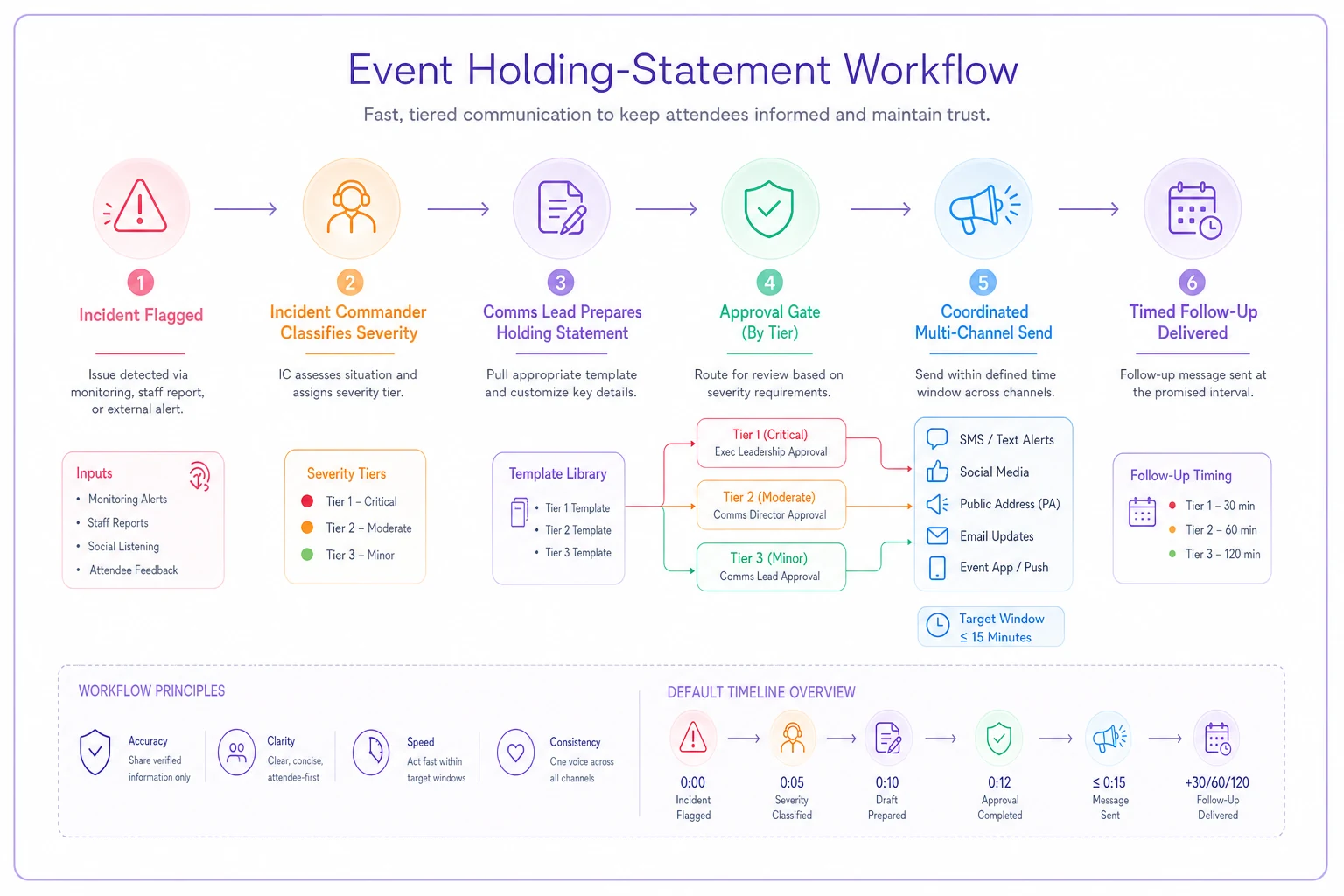
This illustrates the sequence people should run under pressure so approvals and sends stay coordinated.
Something happens: a sudden storm cell forces a main-stage hold. The Ops Duty Manager flags it on the internal channel. The Incident Commander classifies it as Tier 2 — elevated disruption, not yet a safety evacuation.
The Comms Lead pulls the relevant holding template — the "weather hold" variant — and fills in the specifics: which stage, what attendees should do (move to covered areas, no need to leave the site), and when the next update will come (fifteen minutes). Tier 2 lives at the Comms Lead level, so they approve it and the coordinated send begins. The SMS owner pushes the alert. The social coordinator adapts the same core message to platform format. The production lead hands the stage manager a matching script for the PA. All three go out inside a five-minute window, carrying the same information in the same tone with the same next-update time.
Fifteen minutes later, the follow-up lands exactly when promised — even if the only update is "still holding, next update in fifteen." Promising an update and delivering it, even an empty one, is what keeps a crowd patient. Silence between promised updates is where rumors breed.
If that storm had escalated to a full evacuation, the only thing that changes is the approval gate jumps to Tier 3 and the Incident Commander owns the sign-off. The workflow itself — core message, coordinated multi-channel send, timed follow-up — stays identical. That consistency is the point. Your team runs the same play regardless of severity; only the approver changes.
What breaks as events scale
A 500-person conference and a 20,000-person festival have the same governance shape, but the failure points move.
At small scale, the problem is usually that one person wears every hat. The event director approves messaging, writes it, and posts it. That works until that person is physically dealing with the incident and can't also be drafting statements. The fix is less about structure and more about pre-writing templates so a less-senior person can execute with confidence.
At medium scale, the problem becomes handoff gaps between shifts and channels. The person who approved the morning's messaging has gone home; the evening team doesn't know what's already been communicated or what tone was set. Governance has to include a running communications log — a simple timestamped record of every public message sent, on which channel, approved by whom.
At large scale, the problem is coordination latency. You've got multiple comms people, multiple stages, possibly multiple incident commanders across zones — and the risk is that two zones send contradictory messages about the same site-wide situation. You need a single source of truth: one person or role that owns the master message for any site-wide event, with zone teams adapting rather than originating.
The through-line across all three: as you grow, more of your governance effort shifts from writing messages to coordinating the people who write messages. The content gets easier to pre-build. The coordination gets harder.
Rehearsals: the part everyone skips
A governance model that's never been rehearsed is a document, not a capability. Teams build careful escalation matrices and then test them for the first time during an actual emergency. It happens more than you'd think.
You don't need elaborate drills. A fifteen-minute tabletop during your production meeting covers most of it. Throw a scenario at the team — "stage collapse, east arena, roughly 3,000 people in the immediate area" — and make them physically run the sequence: who classifies it, who approves, who sends on which channel, what the holding statement actually says. You'll find the broken links fast.
A practical rehearsal checklist:
-
[ ] Every channel owner can log into their channel from their own phone, right now, without asking anyone for credentials
-
[ ] Every channel has a named backup who has personally tested access in the last 30 days
-
[ ] The Incident Commander and backup IC both know they hold Tier 3 sign-off
-
[ ] Holding-statement templates are saved somewhere accessible offline (printed copies in the ops binder count)
-
[ ] The team has run at least one tabletop scenario end-to-end within two weeks of the event
-
[ ] Legal/leadership has pre-cleared the template language so nobody's waiting on approval mid-crisis
-
[ ] There's a defined "next update" cadence and someone owns delivering it even when there's nothing new
-
[ ] The communications log is set up and someone owns maintaining it in real time
Test backups' logins during the tabletop so you discover access issues on a Tuesday, not during an evacuation.
The most valuable output of a rehearsal isn't confidence — it's discovering that your SMS backup person was never actually added to the account. You want to find that on a Tuesday, not during an evacuation.
A real scenario
A regional two-day music festival, around 12,000 attendees, had a decent emergency plan but no comms governance layer. During year one, a power failure hit the second stage mid-set. What followed was the textbook mess: the social coordinator posted "technical difficulties, back soon" within two minutes, the stage MC told the crowd it'd be "just a few minutes" (it wasn't), and the official SMS alert never went out because the one person with access was on a dinner break and didn't see the radio call. Attendees near the stage got three different stories and started drifting toward other areas, creating density issues the crowd team hadn't planned for.
For year two, the team built a governance model: tiered approvals, named channel backups, six pre-written holding templates, and a single tabletop drill the morning of day one. When a similar outage hit the main stage on day two, the sequence ran clean. The IC classified it Tier 2 in under a minute, the Comms Lead approved the holding template, and SMS, social, and PA all carried the same message — "main stage is paused due to a technical issue, the show will resume shortly, next update in 10 minutes" — within about four minutes of each other. The follow-up landed on time. No contradictory messaging, no crowd drift, no social-media speculation thread. The debrief noted the incident barely registered with attendees as a problem at all.
The difference between the two years wasn't better technology or a bigger team. It was a rehearsed chain of ownership, approval, and pre-written content.
When this level of governance makes sense — and when it's overkill
It makes sense when you're running events where multiple people control multiple outbound channels, where an incident could plausibly attract media attention, or where crowd size means a messaging mistake has real safety consequences. Basically: anything above a few thousand people, or anything with sponsors, press, or meaningful reputational exposure.
It's probably overkill for a 150-person workshop where the organizer is the only one communicating with attendees and can simply stand up and tell everyone what's happening. Building a six-channel approval matrix for that is bureaucracy for its own sake. Keep two holding templates in your back pocket and move on.
One thing worth calling out: teams that confuse governance with paperwork tend to over-build this. The goal is faster, more coherent communication under pressure — not a thicker binder. If your approval gates are so layered that nobody can get a message out in under twenty minutes, you've built the wrong thing. Good governance makes the right message move faster, not slower, because people aren't improvising from scratch.
Keeping the system coherent without the overhead
Where this gets genuinely hard is maintenance. Channel ownership changes as staff turn over. Templates need updating as your event evolves. The communications log needs to actually get filled in during the chaos, which is exactly when people forget to do it.
This is where operational platforms earn their place — not by generating messages for you, but by keeping the governance structure visible and enforced. A workflow system that stores your approved templates, maps each channel to its current owner and backup, routes a Tier 3 message to the right approver automatically, and timestamps every send into a single log removes the manual coordination that tends to collapse under stress. AI-assisted workflows can also flag when a message is about to go out on one channel without the matching sends queued on the others — the kind of coherence check a human easily misses at 11pm during an incident.
The software isn't the governance. The governance is the thinking you do beforehand: who owns what, who approves what, and what you'll say before you know you need to say it. A good operational platform just makes that thinking harder to skip and easier to execute when it counts.
The bottom line
Crisis communications don't fail because teams are careless. They fail because distributed channel ownership, missing approval gates, and blank-page panic all show up at the exact same moment. The fix isn't heroics — it's deciding, in advance, who speaks, who approves, and what gets said, then rehearsing it until the chain holds under pressure.
Build the three layers, write the holding statements before you need them, test your channel access on a quiet Tuesday, and run one tabletop drill. When something actually goes wrong, you'll be managing one problem instead of two.
When something actually goes wrong, you'll be managing one problem instead of two.
Ready to elevate your event management?
Join 5,000+ event organizers using Festoly to save time, improve coordination, and deliver memorable experiences.