

Most comms plans look bulletproof on paper. Then doors open, 8,000 phones hit the same cell tower, someone keys up on the wrong channel during a medical call, and the "backup" radio nobody charged is sitting dead in a Pelican case backstage. The plan didn't fail — the plan was never tested against real load, real terrain, and real human behavior.
This is a practical walk through the parts of event communications resilience that actually break under pressure, and the specific routines that keep your net usable when everyone needs it at once.
Start with a signal audit, not a channel map
Almost everyone buys or rents radios first, then figures out coverage later. It's backwards. Concrete stairwells, metal-clad loading docks, underground green rooms, and elevator shafts eat UHF signal. If you didn't walk those spots before show day, you'll find the dead zones during an incident.
A real signal audit is boring and physical. Two radios, one person parks at the command post, the other walks every operational corner of the venue keying up every 20–30 seconds. You log it plainly:
-
Location
-
Clear / scratchy / dead
-
Which channel
-
Time of day (RF environment shifts when the building fills with bodies and other transmitters)
The worst dead zones are almost never the open floor. They're the transition spaces — the ramp between the loading dock and the concourse, the stairwell to the AV catwalk, the far corner of a parking structure where your traffic team lives. Those are exactly the spots where a comms failure hurts most, because that's where load-in, security, and transport all overlap.
A quick audit-log format that works:
| Zone | Channel tested | Result | Fix |
|---|---|---|---|
| Dock ramp to concourse | Ops 1 (UHF) | Scratchy after 30ft | Add repeater or reassign zone to Ops 2 |
| AV catwalk stairwell | Ops 1 | Dead | Runner-relay protocol or hardwired intercom |
| North parking structure L2 | Traffic | Clear near ramp, dead at back wall | Position lead near ramp, no back-wall solo posts |
| Underground green room | Talent | Dead | Wired phone + designated relay person |
The audit output isn't a pretty map. It's a list of decisions: where you need a repeater, where you accept dead zones and plan a human relay instead, and where you forbid solo posts because someone could go silent and nobody would know.
Channel and frequency allocation: separate by function, not by department
The second common failure is dumping everyone on one or two channels because "it keeps everyone in the loop." It does the opposite. When production, security, catering, and volunteers all share a channel, the medical team can't get a word in during the exact 90 seconds they need it.
Eliminate event chaos with Festoly.
Manage every aspect of your event seamlessly — from planning to execution.
- Centralized event scheduling
- Real-time attendee tracking
- Vendor & resource coordination
No credit card required
Allocate by traffic type and urgency, not by org chart. A workable structure for a mid-size event:
-
Ops 1 (Command) — leads only. Low chatter, high authority. This channel stays quiet on purpose.
-
Ops 2 (Production/Stage) — show calling, AV, stage transitions.
-
Security — access, crowd, incident.
-
Medical/Safety — kept nearly silent so it's instantly usable in an emergency.
-
Logistics — catering, load-in/out, runners, vendors.
-
Volunteers — high-chatter channel, isolated so it never clogs command.
Your medical and command channels should feel underused on a normal day. If your emergency channel has casual traffic on it, it's not an emergency channel anymore — it's just another crowded net. Empty airtime is a feature, not waste.
Empty airtime is a feature, not waste.
On frequency coordination — if you're renting radios, get your frequencies coordinated and licensed properly, and confirm nobody else at a shared venue is stepping on your assigned frequencies. Multi-hall convention centers are notorious for this. Two events on the same floor can end up hearing each other's traffic if the rental vendor got lazy with coordination. Ask the venue for a list of what's already licensed and in use that week.
Frequency planning ties directly into your risk taxonomy
Comms isn't a standalone system — it's the nervous system that every other contingency depends on. If your channel plan doesn't line up with how you've mapped operational triggers, you'll have a beautifully organized net that doesn't match the incidents you actually planned for. It's worth cross-checking your channel structure against your broader event risk and resilience framework so each escalation path has a clear, uncontested channel to live on.
Credentialed-device lists: who gets a radio, and who is accountable for it
Radios walk. Every event loses a few. But the deeper problem isn't loss — it's not knowing who had which device on which channel. When something goes sideways and you need to know who was on the dock at 2pm, "one of the logistics radios" is not an answer.
A credentialed-device list is exactly what it sounds like: every radio, earpiece, and PTT device tied to a named person, a role, an assigned channel, and a return time. It's the comms equivalent of access control layers. If you already run tiered badge access, this should feel familiar — the same discipline that governs your layered credentialing workflow should govern who gets a transmitting device.
A device-issuance record should capture:
-
Device ID (physical label, not just serial)
-
Assigned person + phone number
-
Role and zone
-
Default channel + backup channel
-
Issued time / due-back time
-
Battery pack ID and charge cycle
-
Signature at pickup and return
Why the battery pack ID matters: the single most common "radio failure" isn't a broken radio. It's a battery that got issued at 60% and died four hours into a twelve-hour shift. Tracking packs separately and swapping at fixed intervals kills most mid-show dropouts before they happen.
The crews who lose the fewest radios aren't the strictest — they're the ones who make return frictionless. One clearly marked return table, one person checking devices back in against the list, done. When return is a hassle, radios end up in someone's backpack "for safekeeping" and vanish.
PTT routines: discipline is what keeps the channel usable
Push-to-talk is only as good as the habits of the people using it. Undisciplined PTT is how a six-channel plan collapses into noise. The fixes are small and almost entirely behavioral.
The routines that matter most:
-
Wait a full second after keying up before speaking. The first syllable gets clipped otherwise, and half your transmissions become "…on the north gate, copy?" with nobody knowing what the first half was.
-
Name the recipient first, then yourself. "Security lead, this is Gate 3." Not the other way around. The listener needs to know instantly whether the message is for them.
-
Keep transmissions under about 10 seconds. If it's longer, it's a phone call or a face-to-face, not a radio message.
-
Confirm with "copy" — actually confirm. Silence is not acknowledgment. An unconfirmed instruction is an instruction that didn't happen.
-
Use plain language, not ten-codes, unless your whole team drilled them. Half-learned codes cause more confusion than they prevent.
The most underrated habit: teaching people not to key up. A huge share of channel congestion is status updates nobody asked for. If the info doesn't require action or affect a decision, it stays off the net. Command channels especially should default to silence.
One practical PTT trap worth knowing: earpiece users often can't tell their radio battery is dying because the audio just gets quieter gradually. They think the venue's loud. Build a "radio check" call into your routine — every hour, on the half-hour, leads call for a round-robin check. Anyone who doesn't answer gets a runner sent and a battery swap.
Backhaul triage: when your data and voice links start dropping
Backhaul is the connection carrying your data — check-in scanners, payment terminals, ticketing, sometimes VoIP-based comms — back to where it needs to go. When the venue Wi-Fi buckles under crowd load, or the cell network saturates at peak arrival, your scanners hang and lines back up fast.
The core resilience principle: layer independent paths. Don't let voice, data, and payments all ride the same pipe. A workable layering looks like:
-
Primary hardwired venue network for fixed positions (check-in, box office, command).
-
Secondary dedicated event Wi-Fi on separate APs from the public/attendee network.
-
Tertiary cellular failover (bonded or multi-carrier if budget allows).
-
Voice fallback analog radio that doesn't touch any of the above.
The mistake here is assuming redundancy exists when it's actually the same wire wearing two hats. "We have Wi-Fi and cellular" means nothing if the cellular is just a hotspot plugged into the same congested tower everyone's phone is fighting over. True redundancy means genuinely separate infrastructure.
The 30-minute triage play
When comms or backhaul starts degrading, you don't want people improvising. You want a timed sequence with named owners. Here's a triage play scoped to the first 30 minutes of a degradation event, with owner scripts baked in.
Visualizing the 30-minute triage sequence makes roles and timing easier to remember.
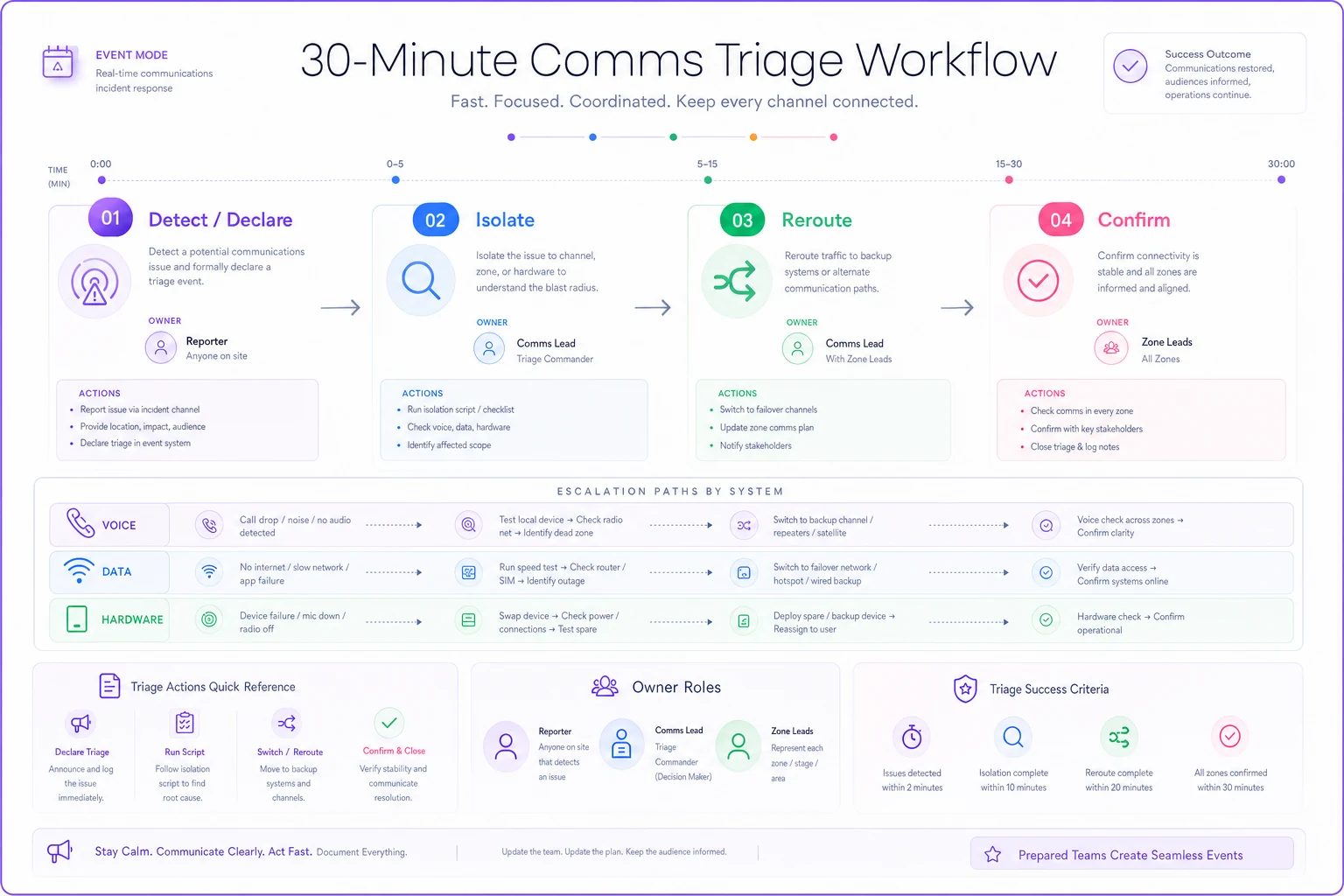
Minute 0–5: Detect and declare
-
Whoever notices calls it on Command
"Command, this is [name], we have degraded comms on [channel/system], requesting triage."
-
Comms lead declares the triage active. No debate, no diagnosing yet — just
"Copy, triage active, all leads acknowledge on Command."
Minute 5–10: Isolate the failure
-
Comms lead runs the isolation script
"Is this voice, data, or both? Which zones? Which channels?"
-
Each lead reports one line
"Logistics — data down at check-in, voice fine." Short, specific, no speculation.
Minute 10–20: Reroute
-
Data down → switch affected stations to cellular failover
"Check-in, switch scanners to failover network now, confirm when green."
-
Voice down in a zone → activate the human relay from your signal audit
"North structure, no signal — runner relay active, [name] is your relay to Command."
-
Payments affected → trigger offline/manual mode per your box office protocol.
Minute 20–30: Confirm and stabilize
-
Round-robin confirmation on Command
every affected zone reports restored or still-degraded.
-
If still degraded, comms lead escalates to venue IT / rental vendor with a specific ask, not a vague complaint: "Ops 1 dead in the AV stairwell since 2:10, need a repeater or we hold that post on relay for the night."
Log the incident time, cause, and fix while it's fresh.
The reason for tight timing: without a clock, degradation triage sprawls into 45 minutes of everyone talking over each other trying to figure out whose fault it is. The owner scripts remove the hesitation. People know exactly what to say and who says it.
A short real scenario
A regional two-day food-and-music festival, roughly 9,000 daily attendees, ran everything — comms, scanners, vendor payments — off the venue's public Wi-Fi and a single shared channel plan. Day one, gates opened at noon and the network saturated within about 20 minutes. Check-in scanners hung, lines backed up past the parking lot, and the one comms channel turned into overlapping traffic as every team tried to report the same problem simultaneously.
They lost close to 40 minutes of clean throughput at peak arrival and had a handful of near-misses on the safety side because medical couldn't reliably raise command through the chatter.
For day two, no new hardware — just process. They split into five channels by function, kept medical near-silent, moved check-in scanners onto a separate dedicated AP with cellular failover, issued radios against a credentialed-device list with hourly battery swaps, and ran the 30-minute triage play as a drill before doors. Day two opened without the meltdown. When one scanner cluster dropped mid-afternoon, the failover switch and reroute took a few minutes instead of derailing the whole gate. The difference wasn't gear. It was discipline and separation.
When heavy comms infrastructure makes sense — and when it doesn't
Not every event needs repeaters, bonded cellular, and a six-channel plan. Matching the setup to the event is part of the skill.
This level of infrastructure makes sense when:
-
Attendance runs into the thousands and arrival is compressed into a short window.
-
The venue has known dead zones or multiple disconnected areas (parking, underground, multi-hall).
-
Payments and access control depend on live connectivity.
-
You have safety-critical teams who cannot afford a dead channel.
This is overkill when:
-
You're running a few hundred people in a single open room with strong existing connectivity.
-
Everyone can reasonably reach each other by phone or line-of-sight.
-
There's no safety-critical or payment dependency on the network.
Who should not try to build this from scratch on show week: a first-time organizer with no signal audit done and no rental vendor relationship. If that's the situation, the honest move is to hire a comms coordinator or lean on the venue's in-house team rather than improvise a plan you've never tested. An untested comms plan gives false confidence, which is worse than knowing you're thin and planning around it.
Bringing it together
The events that stay coordinated under pressure aren't the ones with the fanciest radios. They're the ones that walked the building, separated their channels by function, tracked every device to a named person, drilled their PTT habits, and rehearsed a timed triage play before doors opened. Every one of those is a decision you make before the crowd arrives — because during the crowd is exactly when you have no time to make them.
Start with the signal audit. Everything else — channel allocation, device lists, triage timing — flows from knowing where your net actually works and where it doesn't. Get that right and most of the day-of chaos never gets the chance to compound.
The events that stay coordinated under pressure aren't the ones with the fanciest radios. They're the ones that walked the building, separated their channels by function, tracked every device to a named person, drilled their PTT habits, and rehearsed a timed triage play before doors opened. Every one of those is a decision you make before the crowd arrives — because during the crowd is exactly when you have no time to make them.
Start with the signal audit. Everything else — channel allocation, device lists, triage timing — flows from knowing where your net actually works and where it doesn't. Get that right and most of the day-of chaos never gets the chance to compound.
Ready to elevate your event management?
Join 5,000+ event organizers using Festoly to save time, improve coordination, and deliver memorable experiences.