

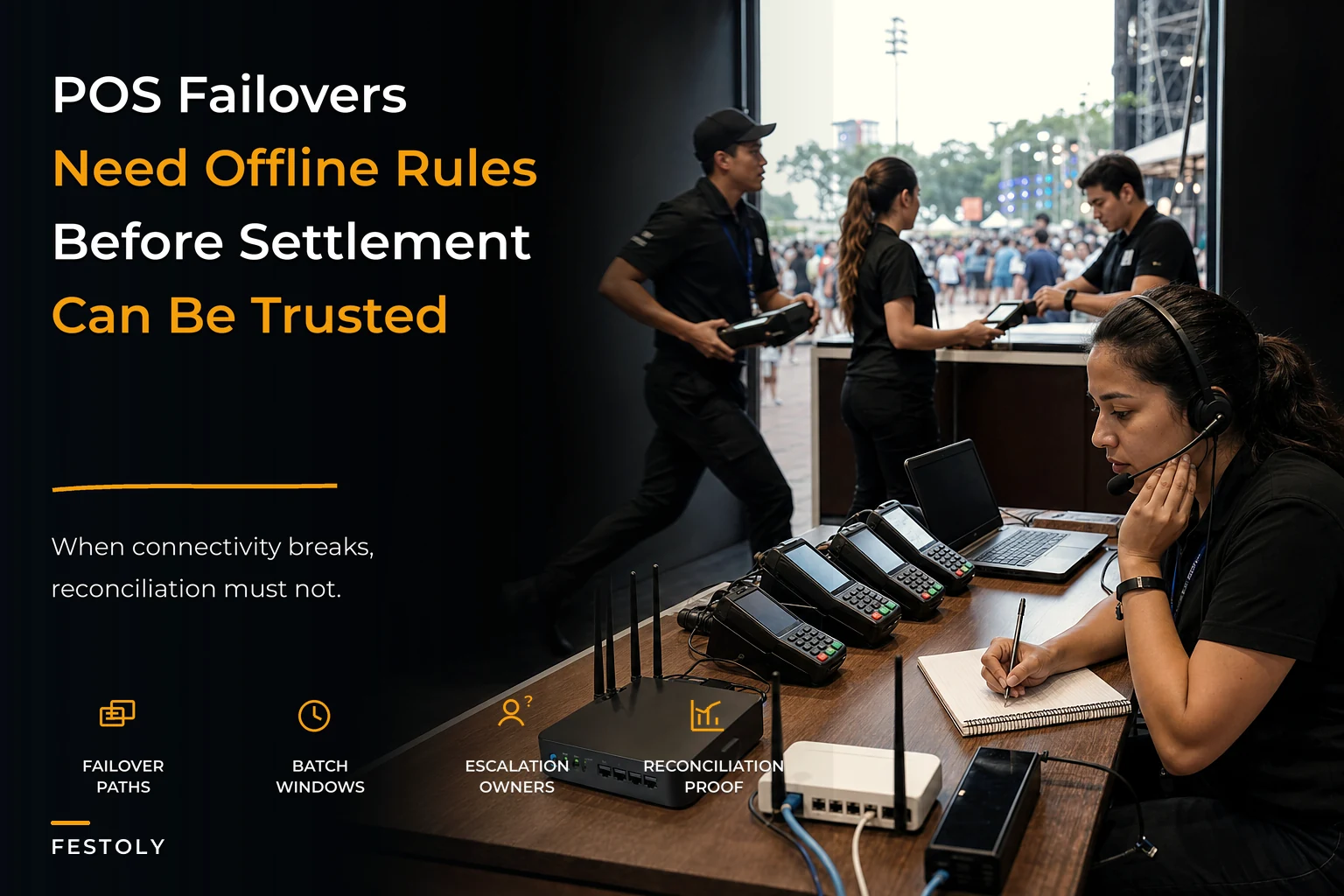

Most payment problems at events don't show up on the payment side. They show up three days later when the numbers don't tie out — when a bar reports $41k in sales but the processor settled $37k, and nobody can explain the gap because half the transactions ran offline during a network drop and the terminal logs got wiped when someone recharged the units overnight.
That's the actual shape of the problem. Cashless payment at an event isn't a single system — it's four or five loosely connected systems pretending to be one. Ticketing runs its own rails. The bar POS runs another. Merch might be on Square while food vendors run their own machines and remit a cut. Sponsors sometimes have activation booths taking payment through yet another provider. When it all works, nobody notices. When one piece drops offline for eleven minutes during peak, you inherit a reconciliation nightmare that eats your finance lead's entire week after the show.
This is a spec for how the whole thing should fit together — offline handling, failover order, settlement timing, and the reconciliation templates that make the money actually add up.
Why payment breaks at events specifically
Retail stores don't have this problem at the same scale because their conditions are stable. Fixed power, fixed internet, fixed terminal count, predictable transaction volume across the day. Events invert every one of those.
You're standing up a temporary payment network on a site that had no infrastructure a week ago. Connectivity is shared across ticketing scanners, staff radios over LTE, attendee phones saturating the same towers, and your POS fleet. During the 30–45 minute window when doors open or a headliner ends and everyone hits the bar at once, you get simultaneous peak transaction volume and peak network congestion. Those two curves peaking together is what causes the damage.
-
Terminal count is sized for average, not peak. Ten bars with two terminals each handle the day fine and completely choke during the two 40-minute surges that actually generate half the revenue.
-
Nobody owns the offline decision. When the network drops, individual bartenders decide whether to keep serving. Some go offline, some stop, some take cash "just for now" without a float or a log.
-
Settlement is treated as automatic. Organizers assume the processor "just settles" and don't realize batches have to close, cutoff windows exist, and un-batched offline transactions can silently expire.
The financial exposure isn't theoretical. At a mid-size festival doing somewhere around $600k–$900k in on-site spend across a weekend, even a 2–3% unreconciled gap is real money that walks out the door — and you usually can't tell whether it's fraud, comped drinks, offline decline losses, or just bad data.
The offline transaction decision, and why it needs a rule before the event
Most planners get this wrong: offline mode isn't free money. When a terminal accepts a card offline, it's storing the transaction locally and guessing the card is good. When it reconnects and batches, some of those transactions decline. The card was maxed, expired, or flagged. You already gave someone the drink. That's a straight loss.
Eliminate event chaos with Festoly.
Manage every aspect of your event seamlessly — from planning to execution.
- Centralized event scheduling
- Real-time attendee tracking
- Vendor & resource coordination
No credit card required
Offline handling is a risk-tolerance decision, and it has to be made by finance before the gates open — not by a bartender at 9:40pm.
The workable rule is a per-transaction offline ceiling. Small transactions ride offline because the decline risk on a $9 beer is tiny and the queue cost of refusing service is high. Large transactions — merch bundles, VIP upgrades, bottle service — get blocked when offline because a declined $340 transaction hurts. A typical spec looks like this:
| Channel | Offline behavior | Ceiling | Rationale |
|---|---|---|---|
| Bar / concessions | Allow offline | Up to ~$40/txn | High volume, low value, queue cost dominates |
| Merch | Allow offline, cap tight | Up to ~$60/txn | Higher decline losses, moderate volume |
| VIP / upgrades | Block offline | $0 | Large tickets, decline loss too high |
| Vendor booths | Vendor's own policy | Per contract | Not your settlement risk, but your reputation |
The ceiling matters less than the fact that someone decided it in advance and it's configured into the terminals, not left to judgment. Stored offline transactions should also have a hard cap on how long they can sit un-batched — most processors expire stored offline auths after a set window, and a terminal that goes offline and gets powered down overnight can lose everything in its queue. If your staff swaps or charges units between sessions, offline transactions must be force-batched first. That single overlooked step accounts for a huge share of "the money disappeared" postmortems.
POS failover: the order of operations when the network drops
Failover is where most event payment plans are vaguely worded and operationally useless. "We have a backup" isn't a plan. The plan is a specific, ordered sequence that a floor lead can execute in under two minutes without calling anyone.
Visual: the following workflow shows the ordered steps to follow during an outage.
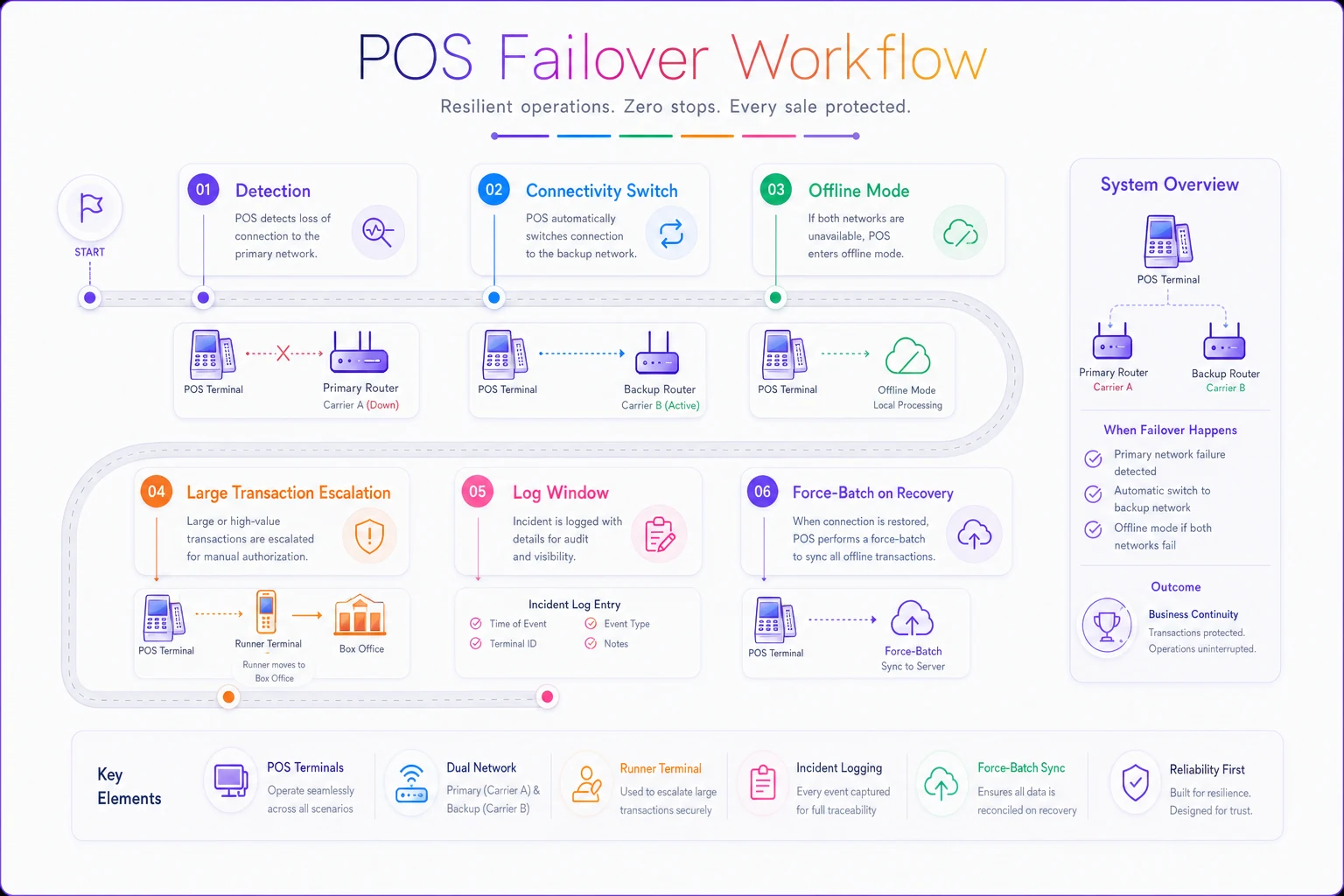
A clean failover sequence for a single bar or POS cluster:
-
Detect — terminals show connection loss, or a lead notices auth times climbing past ~8–10 seconds. Don't wait for total failure; slow auths are the failure starting.
-
Switch connectivity — move the cluster from primary (venue wifi or wired) to backup (a dedicated LTE/5G router on a different carrier). This should be a physical switch or a pre-configured second SSID, not a re-setup.
-
Go offline if backup also fails — if both paths are down, terminals drop to offline mode within their configured ceilings automatically. Bartenders keep serving small transactions.
-
Escalate large transactions — anything above the offline ceiling routes to a single "runner" terminal that a lead carries to wherever there's still a live connection (often the box office, which usually has the most robust link).
-
Log the window — note the start time of the outage on a shared incident sheet. This one habit saves the reconciliation team hours later because they can isolate exactly which transactions ran under degraded conditions.
-
Force-batch on recovery — when connectivity returns, batch immediately before doing anything else. Don't let offline queues sit.
The two carriers on separate networks point is worth emphasizing. If your primary and backup both ride the same tower, they fail together during congestion. A second router on a genuinely different carrier is one of the cheapest resilience upgrades available, and it gets skipped constantly.
Pro-tip: Put the backup router on a different carrier to avoid simultaneous congestion.
When aggressive offline mode is a bad idea
If your event skews high-value-per-transaction — a wine festival with $200 tasting packages, a trade show selling equipment on-site — wide-open offline mode is dangerous. Decline losses compound fast. These events should lean toward blocking offline and instead over-provisioning connectivity and terminals so they rarely need it. Offline is a queue-management tool for high-volume, low-ticket environments, not a universal safety net.
Settlement windows: the timing nobody plans
Settlement is where the money actually moves from "approved" to "in your account," and it runs on cutoff times that don't care about your event schedule.
Batch cutoffs. Most processors have a daily cutoff — often somewhere in the evening — after which transactions roll into the next settlement day. For a multi-day event, Friday-night bar sales might settle on a different day than you expect, and your day-by-day cash reporting won't match your day-by-day sales unless you're accounting for that cutoff. Decide upfront whether you're reporting on transaction date or settlement date and stay consistent, because mixing them creates phantom discrepancies.
Multi-party splits. When vendors take payment through your platform and you remit their cut, the settlement timing for their money and the fee timing for your processor rarely align. Vendors want paying out fast; your funds may not have cleared. Getting the sequencing wrong means you're floating vendor payouts out of your own cash. This connects directly to how you structure vendor and exhibitor terms — the same discipline covered in the exhibitor operations framework, where contract milestones and settlement workflows need to be defined before anyone's on-site, not negotiated after the money's collected.
A settlement spec should state, in plain language: when batches close each day, which date basis reporting uses, when vendor payouts release relative to fund availability, and who signs off before any money leaves.
The reconciliation template that actually ties out
Reconciliation fails when teams try to match one giant number — total sales — against one giant deposit. It never matches, and you can't find the gap. The fix is reconciling in layers, per channel, per day.
For each channel each day, you're matching four numbers:
-
POS reported sales (what the terminals say they sold)
-
Processor settled amount (what actually landed, net of fees)
-
Offline transactions attempted vs. cleared (and the delta = decline losses)
-
Comps, voids, and refunds (the deliberate reductions)
When those four reconcile per channel, the total takes care of itself. When they don't, you know exactly which channel and which day to investigate instead of staring at a spreadsheet of the whole weekend.
A practical reconciliation checklist to run the morning after each event day, while memory and logs are fresh:
-
[ ] Confirm every terminal successfully batched (no orphaned offline queues)
-
[ ] Pull POS sales report per channel, per day basis
-
[ ] Pull processor settlement report, note fee deductions separately
-
[ ] Match offline-attempted against offline-cleared; flag declines over a set threshold
-
[ ] Reconcile cash floats per bar against cash sales logged
-
[ ] Cross-check comps and voids against manager authorization logs
-
[ ] Note any outage windows from the incident sheet and flag transactions in those windows
-
[ ] Sign off per channel before rolling up to the daily total
Doing this nightly instead of after the whole event is the single biggest improvement most teams can make. A discrepancy found on Friday night is a fixable process error for Saturday. The same discrepancy found on Monday is an unsolvable mystery.
Where software actually helps — and where it doesn't
Modern event payment and management platforms handle a lot of this natively: configurable offline ceilings, automatic force-batching prompts, consolidated multi-channel settlement reporting, and reconciliation views that break out declines and fees per channel. If you're running more than a handful of terminals across multiple channels, doing this by hand is where errors creep in — manually stitching exports from three processors into one spreadsheet is exactly the kind of task that produces phantom gaps.
That said, software doesn't make the decisions for you. It won't set your offline ceiling, define your settlement date basis, or decide your failover order. Those are policy choices you make with finance. The tooling enforces the policy consistently and removes the manual data-stitching; it doesn't replace the spec. Teams that buy a platform expecting it to think for them still end up with reconciliation gaps — they've just automated the collection of bad decisions faster.
The reconciliation and settlement discipline here also feeds directly into on-site financial control during the event itself. The nightly per-channel tie-out is one of the strongest inputs to live budget forecasting and spend controls, because you can't manage burn or protect on-site revenue against real numbers if the payment data is 48 hours behind and untrustworthy.
A real scenario
A regional two-day food and music event, roughly 12,000 attendees, was running eight bar stations and a merch tent on venue wifi with a single backup router on the same carrier. On day one, the headliner ended and the entire crowd hit the bars inside about 20 minutes. Wifi saturated, the backup router — same tower — saturated with it. Terminals dropped to offline mode with no configured ceiling, so bartenders kept ringing everything, including a run of $180 bottle packages.
When they batched the next morning, around $6k–$7k in offline transactions declined, most of it concentrated in those large packages that never should've been accepted offline. On top of that, three terminals had been powered down overnight before batching and lost their offline queues entirely — an unknown amount, never recovered. The total unexplained gap that day was somewhere around 4–5% of bar revenue.
For day two they made three changes: a hard $40 offline ceiling on bars, a rented second router on a different carrier, and a strict "batch before you charge or swap any unit" rule enforced by the bar lead. Day two ran through the same post-headliner surge. The gap came in under 1%, and every dollar of it was accounted for as documented declines rather than mystery. Nothing exotic — just decisions made before the surge instead of during it.
The pattern underneath all of this
Event payment failures are almost never a technology failure. The terminals work. The processors work. What fails is the absence of a decision — nobody set the offline ceiling, nobody defined the failover order, nobody chose a settlement date basis, nobody built the per-channel reconciliation.
The whole architecture comes down to writing those decisions down before the gates open and configuring them into the system rather than leaving them to a bartender's judgment at peak. Get the offline rules, the failover sequence, the settlement timing, and the layered reconciliation defined in advance, and the money ties out. Leave any one of them to be figured out live, and you'll spend the week after your event trying to explain a gap you can never fully close.
The whole architecture comes down to writing those decisions down before the gates open and configuring them into the system rather than leaving them to a bartender's judgment at peak. Get the offline rules, the failover sequence, the settlement timing, and the layered reconciliation defined in advance, and the money ties out. Leave any one of them to be figured out live, and you'll spend the week after your event trying to explain a gap you can never fully close.
Ready to elevate your event management?
Join 5,000+ event organizers using Festoly to save time, improve coordination, and deliver memorable experiences.