

Most catering problems at events don't happen at the tasting or in the contract. They happen in the 90 minutes between plating and service, when the kitchen thinks one thing, the floor thinks another, and nobody has a shared timeline that survives contact with a real room full of guests.
The dietary side is worse. Allergen handling tends to work fine right up until the exact moment it doesn't — and when it fails, it fails fast, in front of people, sometimes with an ambulance involved. This piece is about that specific stretch of the operation: the kitchen-to-guest timeline, the paperwork that keeps dietary info accurate, how to physically separate allergen meals so they don't get cross-contaminated on a crowded pass, and a decision tree your on-site team can actually follow when something goes wrong.
This isn't a general catering guide. It's the operational spine for one meal service at one event.
The 8-checkpoint kitchen-to-guest timeline
The reason plated dinners run late or cold usually isn't the kitchen being slow. It's that there's no agreed sequence of checkpoints, so the banquet captain and the head chef are each working off a different mental clock. One is watching food temp, the other is watching the program run long, and the handoff point never got defined.
A working timeline has checkpoints, not just a start and end time. Each checkpoint has an owner and a go/no-go condition. Here's the structure that holds up across most seated events of 150–400 guests.
| Checkpoint | Trigger | Owner | Go condition |
|---|---|---|---|
| T-90: Final headcount lock | 90 min before service | Planner + Captain | Guaranteed count + dietary count confirmed |
| T-60: Plate-up begins | Kitchen ready | Head Chef | Hot line at temp, allergen plates staged separately |
| T-40: Allergen plates finished first | Before general plating | Allergen lead | Labeled, covered, seat numbers attached |
| T-25: Captain briefs floor | Plating underway | Captain | Every server knows their allergen seats |
| T-15: Program cue check | Before doors | Planner + Show-caller | Speaker/host aware food is coming |
| T-0: Service starts | Captain's call | Captain | Allergen tables served first or by dedicated runner |
| T+20: Mid-service sweep | Halfway | Captain | No stalled tables, refires flagged |
| T+40: Clear + dessert hold | Most tables done | Captain | Dessert allergen check repeated |
The checkpoint people skip most consistently is T-40, where allergen plates get made first. Everyone nods at it in planning and then abandons it under pressure because the kitchen wants to plate in one clean sweep. That's the mistake. When allergen meals go through the same rushed plating window as everything else, that's exactly when a garnish or a shared spoon ends up somewhere it shouldn't.
Here's a simple workflow image of those checkpoints to clarify handoffs and owners.
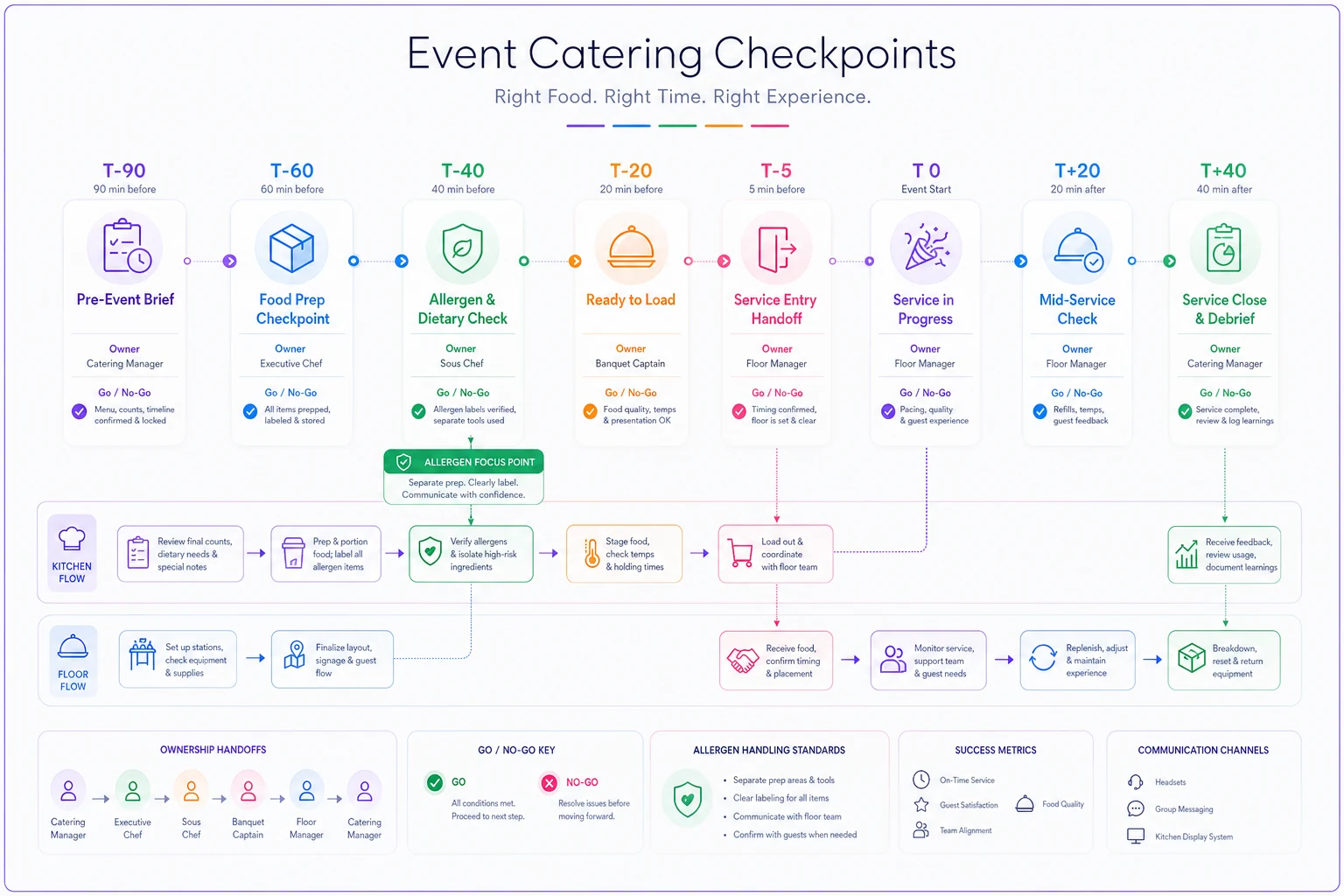
One pattern worth flagging: events that run the program and the meal off the same person almost always drift. The planner watching speaker timing cannot also be calling plate-up. Split those roles, even at smaller events. The same logic that applies to show-callers managing stage cues applies here — food service needs its own caller who isn't distracted by what's happening on stage.
The catering manifest and intake templates
The dietary information collected at registration is almost never the dietary information that reaches the kitchen intact. It degrades at every handoff — from the RSVP form, to a spreadsheet, to an email to the caterer, to a handwritten note on the pass. By the time it's on the floor, "severe shellfish allergy, table 12" has become "no seafood?" scrawled on a ticket.
Eliminate event chaos with Festoly.
Manage every aspect of your event seamlessly — from planning to execution.
- Centralized event scheduling
- Real-time attendee tracking
- Vendor & resource coordination
No credit card required
They should share the same fields so nothing gets translated or summarized between them.
Intake template (guest-facing)
-
Type Allergy / Intolerance / Preference / Religious or ethical
-
Substance dropdown of the major allergens plus "other"
-
Severity Anaphylaxis risk / Serious reaction / Discomfort / Preference only
-
Cross-contact sensitivity Yes / No (this is the one everyone forgets)
-
Seat or table (filled in later)
-
Guest name + contact for day-of clarification
The severity and cross-contact fields are what separate a real manifest from a vague one. A peanut preference and a peanut anaphylaxis risk require completely different handling, and if your form treats them the same, your kitchen will too.
The manifest (kitchen + floor-facing)
The manifest is the single sheet the caterer plates from. It should be sorted by table, then by severity, so a server reading it sees the whole table at once. A typical row looks something like:
> Table 12 · Seat 4 · ANAPHYLAXIS · Shellfish · cross-contact YES · Meal: chicken (allergen-safe prep) · Plate marker: red flag
The plate marker matters more than people expect. A color-coded flag, pick, or visually distinct plate means a server doesn't have to remember — they can see which plate is the allergen meal. When there's no visual marker, allergen plates get shuffled during the run and land at the wrong seat.
One recurring failure: the manifest gets finalized at T-90 headcount lock, but a guest with a severe allergy is a walk-in or swaps seats at the last minute. If your intake template lives in a shared system rather than a printed sheet, that update reaches the kitchen instead of dying in someone's inbox. This is one place where AI-powered operational software genuinely earns its keep — not because it's clever, but because a last-minute dietary change on a linked manifest updates everywhere at once instead of requiring three phone calls during service. The value isn't automation for its own sake; it's that the single source of truth doesn't fracture the moment things get busy.
Allergen segregation rules for the pass
Cross-contact is a physical problem, not a paperwork one. You can have a perfect manifest and still poison someone because two plates touched on the pass. Segregation rules exist to make physical handling foolproof under pressure.
-
Allergen meals plated first, on a separate section of the pass, before the general plate-up rush starts.
-
Dedicated utensils and gloves for allergen plates — changed, not wiped.
-
Cover and label immediately. An uncovered allergen plate sitting on a busy pass is a cross-contact waiting to happen.
-
One named "allergen lead" per service who owns those plates start to finish. Not "whoever's free."
-
Separate runner or first-served — allergen plates go out on their own trip, not buried in a stack of six.
-
No garnish station shortcuts. The shared parsley bin, the communal butter, the crouton scoop — these are the silent culprits.
The most common real-world breakdown isn't the entrée. It's dessert and bread service, which run on autopilot after the main course when everyone's guard is down. A guest with a wheat allergy gets a safe entrée and then a server drops the standard bread basket at the table without thinking. That's why the timeline above repeats the allergen check at T+40 for dessert. It's not redundant — it's covering the exact moment the team relaxes.
When strict segregation isn't worth it
Not every event needs full segregation infrastructure. For a buffet-style casual event with mostly preference-level restrictions and no anaphylaxis flags on the manifest, building a separate allergen line is overkill and slows everything down. Clear labeling at each buffet station and a knowledgeable attendant is enough.
Full segregation — dedicated lead, separate plating, color markers — is warranted the moment your manifest shows any anaphylaxis-risk guest, or when you're doing plated service where the guest can't inspect their own food. The trigger is severity on the manifest, not event size. A 60-person board dinner with one anaphylactic guest needs more rigor than a 500-person buffet with none.
The allergen incident decision tree
This is the part every team hopes never to use and most have never rehearsed. When a guest says "I think I'm having a reaction," the failure mode is hesitation — servers freeze, look for a manager, and lose two or three minutes that matter. A decision tree removes the thinking. Everyone on the floor should know it before doors open.
-
1. Guest reports a possible reaction — stop and assess severity. - Any sign of breathing difficulty, throat tightness, swelling of face/lips/tongue, dizziness, or collapse? - YES → treat as anaphylaxis. Skip to step 4 immediately. - NO → continue to step 2.
-
2. Mild symptoms only (localized itching, minor hives, stomach upset)? - Remove the suspected food immediately. Do not let them eat more. - Notify the captain and on-site medical (if present). - Ask: does the guest carry their own medication (antihistamine, epinephrine)? - Monitor closely — mild can escalate. Keep someone with them.
-
3. Symptoms worsening during monitoring? - YES → escalate to step 4. - NO → keep monitoring, document, inform the guest's party.
-
4. Anaphylaxis protocol. - Call emergency services first — don't wait to see if it improves. - Locate epinephrine (guest's own auto-injector or event medical kit). - Get on-site medical to the guest immediately. - Assign one person to meet and direct paramedics to the exact location. - Do not move the guest unless they're in danger where they are.
-
5. After any incident — preserve and document. - Keep the suspected plate and, if possible, the packaging or prep notes. - Record time, symptoms, what was eaten, and actions taken. - Notify the caterer's lead so the kitchen can trace the source before it reaches anyone else.
The single most important design choice in this tree: breathing/throat/swelling jumps straight to emergency services. Teams lose people by trying to "wait and see" or by hunting for a manager first. The tree makes the severe-symptom path a reflex, not a decision.
This connects to your broader incident structure. If you've already built out role tasks and communication scripts in a medical and emergency playbook, the allergen tree should slot into it as a specific branch — same reporting chain, same documentation, just a food-specific entry point.
A real scenario
A regional nonprofit ran a 220-guest plated fundraising gala. Their caterer was solid, but dietary handling lived in a spreadsheet emailed the day before, and any updates after that went out as separate reply-all threads.
The problem showed up at T-30. Two guests with tree-nut allergies had swapped tables to sit with colleagues, and a third guest — a last-minute sponsor addition with a shellfish allergy — never made it onto the kitchen's printed manifest at all. The floor was working off a version that was roughly six hours out of date.
What actually saved the night was the segregation rule, not the paperwork. Because the caterer plated allergen meals first with red plate markers and had a named allergen lead, the captain was able to physically walk the floor at T-25, match markers to occupied seats, and catch that the shellfish guest had no safe plate staged. They refired one meal on a clean station and got it out about eight minutes behind the table, but correct.
Afterward they moved intake to a shared form linked to a live manifest so seat swaps and walk-ins updated in one place. At their next event of similar size, the T-25 floor brief went from roughly 12 minutes of reconciling three versions to a couple of minutes reading one current sheet. No incidents, and the captain wasn't chasing email threads during plate-up. The gain wasn't dramatic on paper — a handful of minutes and one avoided error — but that one avoided error was a shellfish plate at the wrong seat, which is the kind of thing that ends up being the only story anyone remembers about your event.
Where planners consistently go wrong
A few patterns repeat across events regardless of budget:
-
Treating dietary info as a headcount detail instead of a safety system. It gets bundled with the guarantee number and finalized once, then never updated even as seats keep changing.
-
No named allergen owner. "Everyone's responsible" means no one is, and on a busy pass that gap is where cross-contact happens.
-
Skipping the dessert and bread allergen check. The main course gets all the attention; the reaction happens over a bread basket.
-
A decision tree that lives in a binder no server has read. If it isn't covered in the pre-service brief, it doesn't exist.
-
Verbal-only manifest handoffs. "Table 12 has an allergy" passed between three people loses the severity and the substance every time.
Contracts play into this too. If the caterer's obligations around allergen handling, dedicated staff, and last-minute change accommodation aren't spelled out, you inherit the risk with no recourse. It's worth reviewing how vendor contracts can quietly shift liability onto the planner — allergen handling responsibilities belong in writing, not in a friendly assumption. And since last-minute dietary changes can trigger refires and extra labor, it's worth accounting for that variable cost in your live budget and spend controls rather than getting surprised by it on the invoice.
Closing thought
The gap between a smooth catering operation and a dangerous one is smaller than most planners think, and it's almost entirely about handoffs — kitchen to captain, captain to floor, floor to guest. Everything in this piece is really about keeping dietary information accurate and physical handling disciplined through those handoffs, and giving your team a fixed response for the moment something goes wrong.
Build the timeline with real checkpoints. Keep the intake and manifest as one linked document instead of a chain of summaries. Make segregation a physical routine, not a hope. Drill the decision tree until the severe-symptom path is reflex. You won't need most of it most of the time — but the one event where you do is the only one that will matter.
Build the timeline with real checkpoints. Keep the intake and manifest as one linked document instead of a chain of summaries. Make segregation a physical routine, not a hope. Drill the decision tree until the severe-symptom path is reflex. You won't need most of it most of the time — but the one event where you do is the only one that will matter.
Ready to elevate your event management?
Join 5,000+ event organizers using Festoly to save time, improve coordination, and deliver memorable experiences.