



Most floor plans get built on gut feeling and politics. The sponsor who yelled loudest last year gets the corner. The vendor whose contact happens to be friends with the show director lands next to the main entrance. Everybody else fills in around them. Then the show opens, half the exhibitors complain about foot traffic, and you spend the next month fielding angry emails about renewal.
Why "fair" placement usually isn't
Most booth allocation approaches optimize for the wrong thing — avoiding complaints from the biggest accounts, not total floor performance.
Here's what that looks like in practice. A 120-booth regional trade show sells five "premium" packages guaranteeing front-of-hall placement. Those five booths cluster near the entrance. Fine. But then the mid-tier exhibitors — the ones making up roughly 70% of renewal revenue — get scattered into dead zones behind pillars, in the corner past the food court, or in the aisle that dead-ends at a service door.
Those exhibitors don't renew. They can't point to a specific reason — they just "didn't get the traffic they expected." And honestly, they probably didn't, because nobody measured what a given spot was actually worth before handing it out.
It's a pattern that shows up constantly: shows protect the top five accounts perfectly and quietly bleed the middle tier. A scoring matrix flips that. It forces every booth position to carry a value and every exhibitor to carry a priority, then you match them with math instead of memory.
The two scores you actually need
You're scoring two separate things and then matching them:
Eliminate event chaos with Festoly.
Manage every aspect of your event seamlessly — from planning to execution.
- Centralized event scheduling
- Real-time attendee tracking
- Vendor & resource coordination
No credit card required
-
Position value — how good is this physical spot, independent of who's in it?
-
Exhibitor priority — how much does this exhibitor deserve a high-value spot, based on spend, strategic value, and contract terms?
Keep these separate. The mistake people make is baking exhibitor importance into their perception of a spot ("this is the sponsor corner"). When you conflate them, you can't reason about tradeoffs anymore.
Scoring position value
Rate every eligible booth position on four dimensions, each 1–5. These are the factors that genuinely move exhibitor outcomes.
| Dimension | What it measures | 1 (poor) | 5 (excellent) |
|---|---|---|---|
| Traffic weight | Expected footfall passing the booth | Dead-end aisle, back corner | Main artery, near entrance/keynote path |
| Sightline | How far away the booth becomes visible | Blocked by pillar/rigging, tucked behind neighbor | Visible from 30+ ft, clean line from a main aisle |
| Adjacency quality | Value of what's next to and across from it | Next to loading, restrooms, empty space | Next to complementary draw, anchor booth |
| Dwell potential | Whether people naturally pause here | Narrow pass-through, no room to stop | Near seating, demos, natural gathering point |
Sum the four for a position score out of 20. A booth at 18–20 is premium. 13–17 is solid. 8–12 is average. Below 8 is a problem spot — you either discount it, use it for storage or low-key exhibitors, or fix it with signage and programming.
One thing worth flagging: traffic weight and sightline are not the same thing, and people collapse them constantly. A booth can sit on a heavy traffic artery but be completely invisible until you're right on top of it because a truss or a tall neighbor blocks the approach. High traffic, low sightline. That booth underperforms its footfall every single time. Score them separately or you'll misjudge a significant chunk of your floor.
Scoring exhibitor priority
-
Spend tier — booth cost plus sponsorship dollars
-
Strategic value — brings attendees, anchors a category, long-term relationship
-
Contract commitments — did you promise placement in writing?
-
Historical performance — did they actually activate the space last year, or just show up with a folding table?
That last one gets ignored more than it should. An exhibitor who consistently runs demos, staffs their booth properly, and pulls a crowd raises the value of everything around them. Rewarding them with a better spot isn't charity — it's protecting traffic flow for the whole neighborhood.
Adjacency rules that prevent 80% of complaints
Sightline and traffic get all the attention, but adjacency is where floor plans quietly fall apart. A handful of hard rules handles most of it:
-
No direct competitors face-to-face. Two companies selling the same POS system across a 6-foot aisle will both feel cheated regardless of who "won" the aisle. Separate them by at least two booths or an aisle break.
-
Anchor-and-satellite. Place a known crowd-draw — big brand, live demo, product launch — and let smaller complementary exhibitors benefit from the spillover. The anchor pulls people down the aisle; the satellites catch them.
-
No loud next to quiet. A booth running a mic and speakers next to a firm trying to have quiet consultative conversations will generate a formal complaint by hour two. Cluster noisy activations together.
-
Protect the corner effect. End-cap and corner booths get sightlines from multiple aisles. Reserve them for high-priority exhibitors, but never for one that shows up under-staffed — an empty premium corner deadens two aisles at once.
-
Cross-aisle balance. Don't stack all the strong booths on one side. If one side of an aisle is all anchors and the other is all filler, people walk the strong side and the filler side gets nothing.
A quick way to catch adjacency problems before they become someone else's problem: walk the plan aisle by aisle and, for each booth, ask "what's directly across, and what's on both sides?" If any of those trigger a rule above, flag it before you assign anyone. Doing this on the plan takes an hour. Doing it after exhibitors have their spots takes a week of apology emails.
Putting it together: a worked example
Take a mid-size expo — roughly 90 booths, one main hall, entrance on the south wall, keynote stage on the north end, so the whole hall is a natural traffic corridor.
-
Booth A12 — right of the entrance, main artery, clean sightline, next to the coffee station. Traffic 5, Sightline 5, Adjacency 4, Dwell 5 = 19/20.
-
Booth C04 — mid-hall, on a cross aisle, partially blocked by a structural pillar. Traffic 4, Sightline 2, Adjacency 3, Dwell 3 = 12/20.
-
Booth F20 — back corner near the loading door. Traffic 2, Sightline 3, Adjacency 1, Dwell 2 = 8/20.
Now your top exhibitors:
-
Exhibitor Alpha — biggest sponsor, contractual front placement, runs a live demo every hour. Priority 19.
-
Exhibitor Bravo — mid spend, strong historical activation, category anchor. Priority 15.
-
Exhibitor Charlie — small spend, first year, no contract commitments, staffs lightly. Priority 8.
The match is almost automatic. Alpha → A12 (19 to 19). Bravo → a 15-range booth on a secondary artery where their activation carries the neighborhood. Charlie → the 8-range spot at F20, which is exactly where a light-staffing first-year exhibitor should be so they don't deaden a premium corner.
The matrix rarely produces a surprising answer. What it produces is a defensible one. When Charlie's rep emails asking why they didn't get a better spot, you have a numbers-based reply instead of "we ran out of room." That single change kills most placement disputes.
If you want to connect these placement decisions back to what you actually promised sponsors on outcomes, it's worth aligning your matrix with the metrics you report on — the approach in Mapping Event Outcomes to Metrics pairs naturally with position scoring, because "traffic weight" only means something if you can measure it after the fact.
The last-minute swap rulebook
Your scored plan will survive until roughly 48 hours before doors open, and then something breaks. An exhibitor cancels. A sponsor upgrades and demands a bigger footprint. A booth gets double-sold. You need swap rules decided in advance, because at hour zero you don't have time to reason from scratch.
-
Backfill from the waitlist by position score, not by who asks first. When a premium spot opens, offer it to the highest-priority exhibitor currently sitting in a lower-value spot — not to whoever emailed you last. This keeps the floor optimized instead of rewarding the loudest.
-
Never downgrade a contracted exhibitor to solve a problem. If someone has written placement terms, they're locked. Solve the swap around them. Violating this once costs you a legal headache and a lost renewal.
-
Cap the ripple. A single swap that triggers a chain of four more swaps usually isn't worth it. Set a limit: if fixing one booth forces more than two other moves, hold the original position empty or use it for signage or lounge instead.
-
Empty is better than wrong. An open, well-dressed booth space with a "coming soon" banner beats jamming an ill-fitting exhibitor next to a direct competitor. A bad adjacency generates complaints; a tasteful gap generates none.
-
Log every swap with a reason code. Cancellation, upgrade, complaint, error. You'll want the pattern after the show — most floors have the same failure mode every year, and the log tells you which one.
Worked swap example
Two days out, Alpha at A12 (score 19) cancels. Panic instinct says give it to whoever is emailing you hourly. The rulebook says otherwise: scan for the highest-priority exhibitor currently sitting below their earned value. Bravo (priority 15) is parked at a 15-score booth — a fair match, so leave them. But Exhibitor Delta, priority 17, is stuck at a 12-score spot because you ran out of premium room during initial planning. Delta gets A12. Delta's old 12-score booth opens, and you backfill that from the waitlist.
One cancellation, two moves, ripple capped, no contracts touched, highest-value open spot went to the highest-underserved exhibitor. That's the whole point of having the rules written before the fire starts.
Below is how the full process maps from initial scoring through to last-minute swaps:
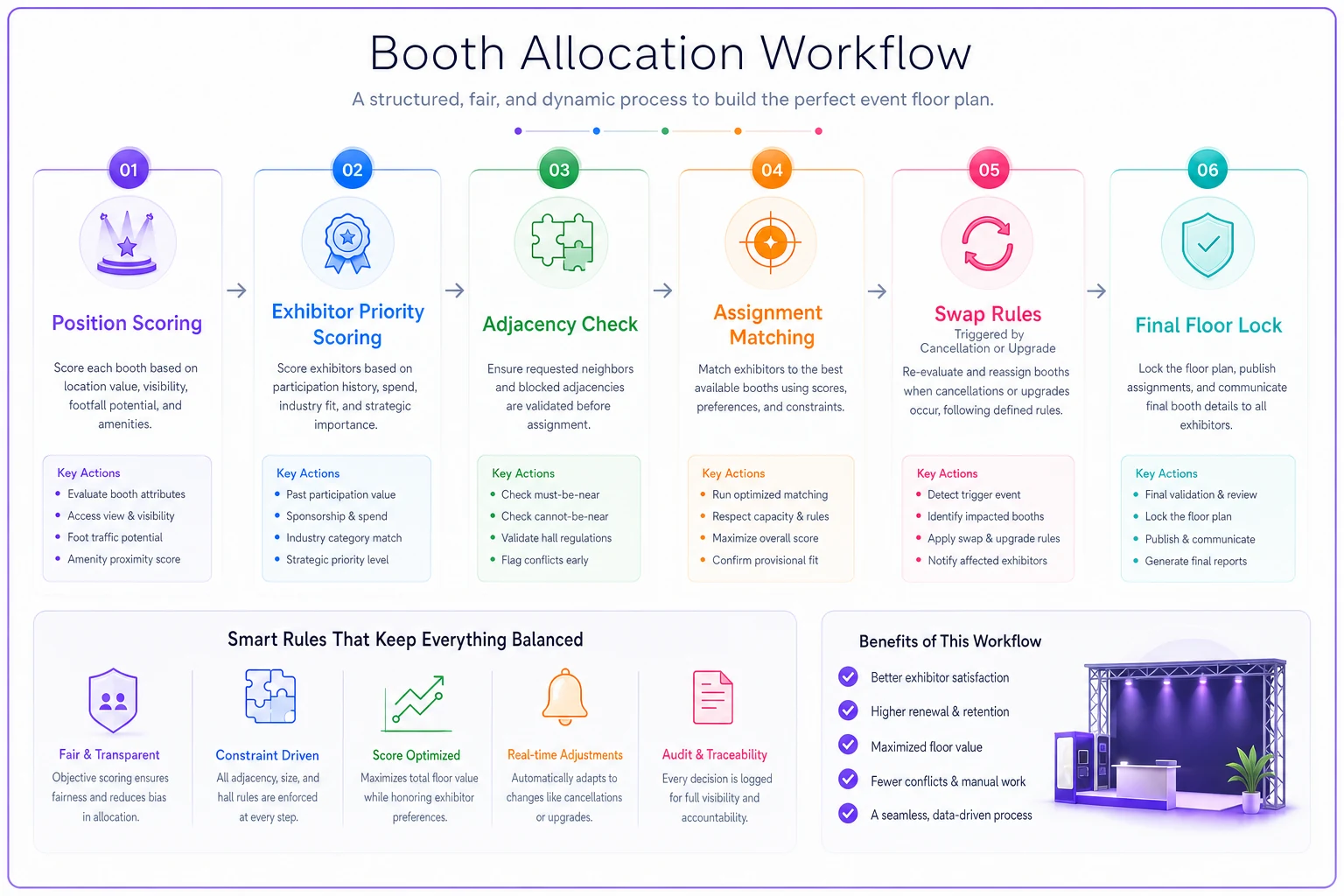
The flow doesn't change much show to show. What changes is the data feeding into it — which is exactly why writing the rules down once and running the same process every time saves hours during crunch.
When this system makes sense — and when it doesn't
Use the full matrix when you have more than around 40 booths, meaningful variation in spot quality, and exhibitors paying different amounts. That's where subjective placement quietly costs you renewals and the scoring pays for itself.
Skip it when you're running a 15-booth community event where every spot is roughly equal and everybody knows each other. The overhead isn't worth it. A simple first-come map is fine.
Be careful if your event has heavy contractual placement commitments across most sponsors. At that point the matrix becomes more of a documentation and dispute-defense tool than an optimization tool — still useful, but manage expectations about how much freedom you actually have to move people. For complex formats — especially anything with a virtual component where "traffic" splits across physical and digital — the placement logic needs to account for both audiences, which is a different problem set covered in Operational Rules for Hybrid Events.
A short pre-assignment checklist
Before you assign a single exhibitor, confirm:
-
[ ] Every eligible booth position has a score out of 20
-
[ ] Traffic weight and sightline were scored separately, not merged
-
[ ] Every exhibitor has a priority score with historical activation included
-
[ ] You've walked the plan for adjacency violations aisle by aisle
-
[ ] Contracted placements are locked and flagged as immovable
-
[ ] Corner and end-cap booths are reserved for exhibitors who'll actually activate them
-
[ ] Your swap rules are written down before doors, not invented during the crisis
Where the value really lands
Where the value really lands
The scoring matrix doesn't just produce a better floor plan. It produces a defensible one.
When an exhibitor challenges their placement — and someone always will — you're answering with a position score, a priority score, and a rule, not an apology.
That shift changes the whole conversation around renewal. Exhibitors stop feeling like placement is arbitrary favoritism, because you can show them exactly what drove the decision and what would earn them a better spot next year. Booth allocation rules only work when they're transparent enough to survive a challenge and specific enough that you'd make the same call twice. Build the two scores, hold the adjacency rules firm, and keep your swap rulebook one click away for the 48 hours when everything moves at once.
The scoring matrix doesn't just produce a better floor plan. It produces a defensible one. When an exhibitor challenges their placement — and someone always will — you're answering with a position score, a priority score, and a rule, not an apology. That shift changes the whole conversation around renewal. Exhibitors stop feeling like placement is arbitrary favoritism, because you can show them exactly what drove the decision and what would earn them a better spot next year. Booth allocation rules only work when they're transparent enough to survive a challenge and specific enough that you'd make the same call twice. Build the two scores, hold the adjacency rules firm, and keep your swap rulebook one click away for the 48 hours when everything moves at once.
Ready to elevate your event management?
Join 5,000+ event organizers using Festoly to save time, improve coordination, and deliver memorable experiences.