

Three weeks ago, a conference organizer called me at 11pm. Their hybrid product launch had just crashed—not technically, but operationally. The virtual audience couldn't hear the Q&A. The in-person team was scrambling to fix audio issues while online moderators had no idea what was happening on stage. Their backup streaming platform wasn't configured. The whole thing became a 3-hour mess that lost them about 40% of their virtual audience and probably $200k in follow-up business.
Most organizers treat hybrid events like they're running two separate events that happen to share content. They're not. A hybrid event is a single operational system with multiple delivery channels, and when you don't map that system correctly, both audiences suffer.
The hybrid complexity multiplier nobody talks about
Running hybrid isn't just streaming your in-person event. It's managing two completely different operational rhythms that must synchronize perfectly.
Your in-person operation runs on physical time—doors open, people walk in, sessions start. Your virtual operation runs on attention spans—people join late, multitask, drop off when bored. These aren't compatible by default.
A medical device company learned this the hard way last year. They ran their annual conference hybrid for the first time. In-person attendance: 450 people. Virtual registrations: 2,800. Sounds like a win, right? Except their average virtual session attendance was 12 minutes. Their in-person sessions ran 45 minutes. They basically produced 33 minutes of dead air for their largest audience segment.
The operational load doesn't add linearly either. You're not running 1.5x the work—it's closer to 2.3x when you factor in coordination overhead. Every decision now has two contexts. Every piece of content needs two delivery methods. Every technical failure has two fallback plans.
Think about something as simple as a speaker running over time. In-person? You signal them, maybe cut the Q&A short. Hybrid? Now you're managing the in-room experience, the streaming timeline, virtual audience engagement dropping, recorded session editing points, next speaker's tech check for both channels, and moderator handoffs across platforms.
Each element compounds. This is why most hybrid events feel disjointed—organizers underestimate the operational complexity by about 60%.
Mapping what actually needs to be where
Must be in-person only:
Eliminate event chaos with Festoly.
Manage every aspect of your event seamlessly — from planning to execution.
- Centralized event scheduling
- Real-time attendee tracking
- Vendor & resource coordination
No credit card required
-
Physical product demos requiring touch/feel
-
Equipment or workspace setup training
-
Regulated activities requiring verified presence
-
True networking (not "virtual networking")
-
Hands-on workshops with materials
Must be virtual-enabled:
-
All keynotes and main stage content
-
Educational sessions
-
Product announcements
-
Q&A segments (with proper moderation)
-
Agenda and schedule information
Works better as virtual-only:
-
Pre-event training and onboarding
-
Post-event follow-up sessions
-
Extended Q&A or office hours
-
Recorded deep-dive content
-
International speaker sessions
The expensive mistake? Organizations try to make everything work for both audiences equally. That's impossible and wasteful. Some experiences don't translate. Accept it and design around it.
A construction industry trade show figured this out after wasting roughly $85k on "virtual booth experiences" that nobody visited. Next event, they split their approach: in-person for equipment demos and deal-making, virtual for technical education and certification sessions. Engagement went up 4x for virtual attendees because they got content designed for their context, not a watered-down version of the floor experience.
Label each agenda item with its intended delivery channel so attendees know what to expect.
Here's a simple workflow to map content to channels.
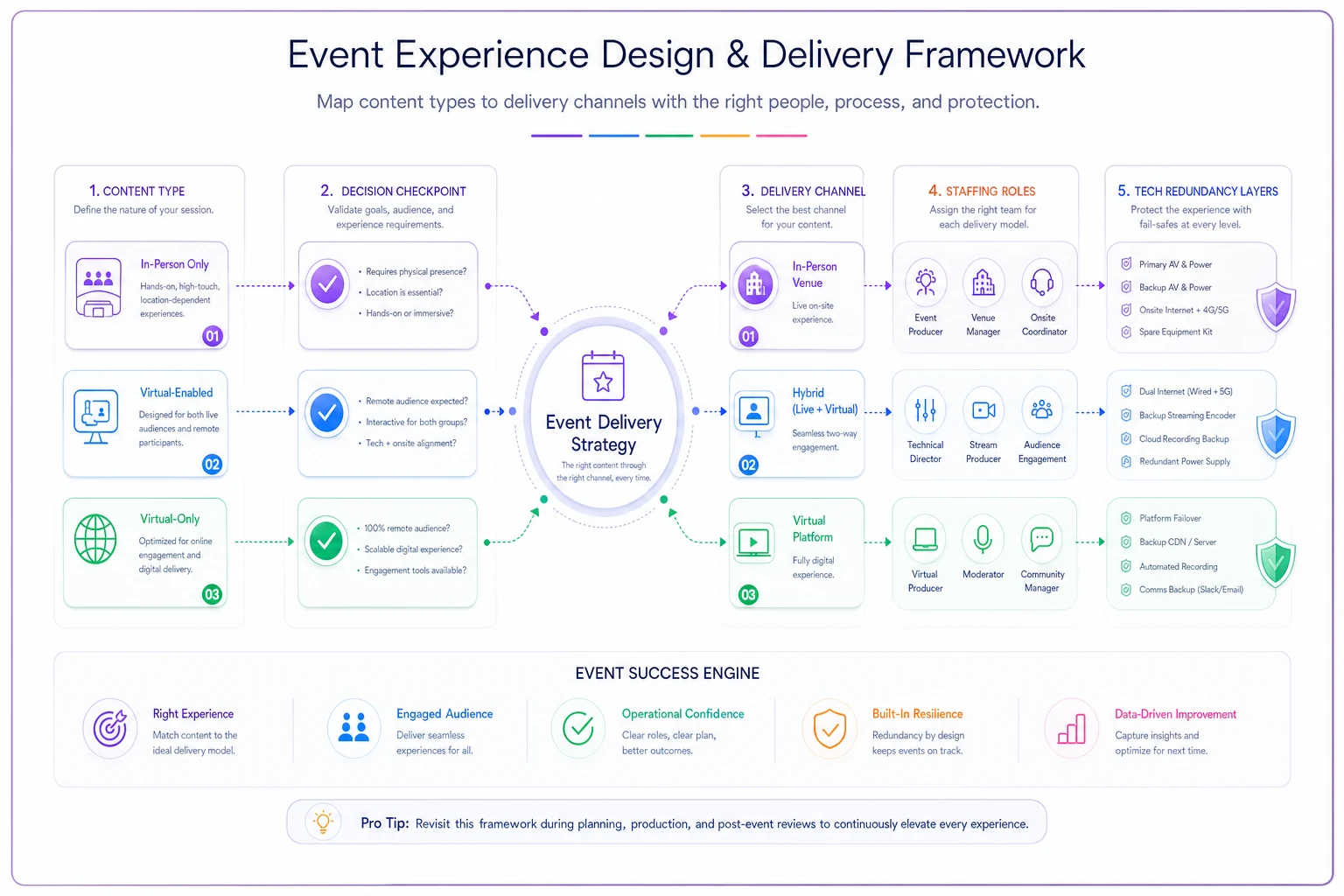
Use this mapping to decide where each experience belongs and avoid trying to force one design to serve both channels equally.
The staffing model that actually works
Most hybrid events fail because they staff like it's 2019 with a streaming add-on.
Core Production Team:
-
Hybrid Producer (not event producer)
orchestrates both channels
-
Technical Director
manages all streaming and AV
-
Virtual Experience Manager
owns online audience entirely
-
In-Person Experience Lead
owns physical venue
-
Content Coordinator
ensures both channels get appropriate materials
Channel-Specific Roles:
Virtual channel needs:
-
Dedicated moderators (1 per 150 attendees)
-
Chat managers for Q&A triage
-
Technical support (1 per 300 attendees)
-
Backup streaming operator
In-person channel needs:
-
Standard venue staff
-
AV technicians
-
Registration/info desk
-
Room monitors
Bridge roles (serve both):
-
Speaker success manager
-
Crisis communications lead
-
Master scheduler
-
Analytics coordinator
The ratio:
| Audience | Staff per 100 |
|---|---|
| In-person | 3-4 production staff |
| Virtual | 2-3 digital staff |
For every 100 in-person attendees, you need about 3-4 production staff. For every 100 virtual attendees, you need 2-3 digital staff. Seems backwards? It's not. Virtual attendees need more active management because they can't solve their own problems by walking to an info desk.
Tech redundancy that prevents the 11pm phone calls
Your tech stack for hybrid events needs three layers of redundancy. Not backup—redundancy.
Primary streaming failure protocol:
-
Automatic failover to backup stream (15-second switch)
-
Pre-configured backup platform with all settings cloned
-
Local recording running independently
-
Mobile hotspot for critical streaming machine
-
Hardwired internet plus wireless backup
A finance conference learned this after their venue's internet crashed 20 minutes into day one. They had no cellular backup, no local recording. Lost 3 hours of content and refunded about $130k in virtual tickets.
Communication redundancy map:
-
Primary
Production headsets
-
Secondary
Slack/Teams on phones
-
Emergency
WhatsApp group
-
Critical
Phone calls for core team
-
Public
Status page for attendees
Each channel serves different urgency levels. When headsets fail, you don't want your first backup to be running across the venue.
Content delivery redundancy:
-
Live stream
-
Local backup recording
-
Cloud recording
-
Downloadable materials pre-staged
-
Email backup of all presentations
This isn't paranoia. It's about maintaining operational flow when individual components fail. Because they will fail. The question is whether your operation notices or crumbles.
Audience flow playbooks that keep both groups engaged
Virtual and in-person audiences move through your event completely differently.
In-person flow pattern:
-
Arrive early, coffee and networking
-
Attend opening keynote
-
Pick 2-3 sessions before lunch
-
Lunch and informal conversations
-
2-3 afternoon sessions
-
Happy hour or evening event
Virtual flow pattern:
-
Join 5 minutes late to opening
-
Watch 20 minutes, check email
-
Skip to specific session of interest
-
Disappear during "lunch break"
-
Maybe catch one afternoon session
-
Download recordings later
Your operational playbook needs to account for both.
Virtual audience retention tactics:
Keep sessions to 20-minute blocks with 10-minute breaks. One software company switched to this format and saw completion rates jump from 35% to 78%.
Build in virtual-only segments. While in-person attendees are at lunch, run virtual-only expert panels or office hours.
Use engagement triggers every 7 minutes:
-
Polls
-
Chat prompts
-
Speaker callouts to virtual audience
-
Breakout rooms for discussions
-
Live Q&A prioritization
In-person audience experience protection:
Don't sacrifice room energy for streaming quality. A dead-quiet room with perfect audio sounds great online but kills in-person engagement. Use confidence monitors so speakers can see virtual audiences without turning their backs.
Run parallel experiences, not identical ones. In-person gets the energy and spontaneity. Virtual gets the clarity and convenience.
When everything breaks at once (because it will)
Decision tree for hybrid crisis:
Streaming platform crashes:
-
Switch to backup within 30 seconds
-
Notify virtual audience via email/app
-
Continue in-person without pause
-
Upload recording within 2 hours
Internet fails completely:
-
Continue in-person event
-
Record everything locally
-
Communicate via social media on mobile
-
Offer replay plus exclusive make-good content
Speaker can't connect virtually:
-
Pre-recorded backup plays
-
Or
In-person moderator presents slides
-
Or
Reschedule to virtual-only session later
-
Never
Make everyone wait while troubleshooting
Power outage:
-
Generator kicks in for critical systems
-
Virtual event continues if internet works
-
In-person moves to daylight spaces
-
Reschedule if necessary
Each scenario needs a specific owner. The Hybrid Producer makes the call, but someone else executes. You can't troubleshoot and communicate simultaneously.
The coordination nightmare of hybrid Q&A
Nothing exposes bad hybrid event operations faster than Q&A sessions.
What typically happens: In-person attendees line up at microphones while virtual questions pile up in chat. The moderator bounces between them randomly. Virtual folks feel ignored. In-person folks wonder why they're waiting while "easy" chat questions get answered.
Pre-submission phase (10 minutes before session ends):
-
Virtual questions open in platform
-
In-person can submit via app
-
Moderator triages and groups similar questions
Live Q&A structure:
-
Alternate
virtual, in-person, virtual, in-person
-
Time box
2 minutes per question maximum
-
Visible queue
everyone sees question order
-
Hard stop
End on time, continue virtually if needed
Post-session overflow:
-
Speaker does 15-minute virtual-only follow-up
-
Recorded and shared with all attendees
-
Deeper dive on complex questions
-
More intimate setting for virtual audience
This structure serves both audiences without making either feel secondary.
Building operational software that handles the chaos
The average hybrid event uses 12-15 different software platforms. Registration, streaming, virtual platform, mobile app, scheduling, speaker management, sponsor portals—the list goes on. Each one generates its own data, its own workflows, its own potential failure points.
Smart organizers are moving toward integrated operational platforms that connect these pieces. Not another event app—operational software that manages the actual workflows.
The difference matters. Event apps focus on attendee experience. Operational platforms focus on making sure that experience actually happens. They track:
-
Which speaker has confirmed their tech check
-
Whether backup streams are configured correctly
-
If virtual moderators are in position
-
When registration numbers indicate bandwidth issues
-
Where staff should redeploy based on attendance
AI automation in these platforms handles the coordination overhead that burns out event teams. Instead of manually checking 15 systems, the platform monitors everything and alerts you to issues before they become crises.
For example, when virtual attendance in a session drops below 40%, the system can automatically trigger engagement prompts to moderators. When a speaker hasn't joined their virtual green room 10 minutes before start, it alerts both the speaker success manager and readies the backup content. This isn't about replacing human judgment—it's about freeing humans to focus on what matters instead of checklist management.
The economics of hybrid that nobody mentions
You're not saving money by going hybrid. You're changing what you spend money on. Virtual platform licenses, streaming infrastructure, additional staff, redundant systems—it adds up fast. A typical 500-person in-person event might cost $200k. Make it hybrid for 500 in-person and 1,000 virtual? You're looking at $280k-$320k, not the $250k most organizers budget.
But the revenue potential shifts too. Virtual tickets at $50-150 each. Sponsor upgrades for digital exposure. Extended content life through recordings. One tech conference pulled in an extra $175k from virtual attendance while only adding $95k in costs. The key was understanding that virtual attendees aren't discount customers—they're a different customer segment entirely.
The operational efficiency comes from reuse. That keynote you paid $25k for? Now it reaches 3x the audience. The training content you developed? Becomes an evergreen virtual workshop series. The sponsor activations? Extended from 3 days to 3 months through virtual platform access.
Virtual presenters and the studio-from-home problem
About 60% of your virtual presenters will have terrible setups. Webcam laptops in dark rooms with WiFi that cuts out every time someone uses the microwave.
Pre-event technical requirements:
-
Mandatory tech check 48 hours before
-
Backup pre-recording required for virtual presenters
-
Minimum specs clearly communicated
-
Test session recorded as emergency backup
Day-of presenter support:
-
Dedicated tech support joins 30 minutes early
-
Green room for final checks
-
Clear escalation if issues arise
-
Ready-to-go backup content
Presentation alternatives:
-
Speaker sends slides, moderator advances
-
Pre-recorded with live Q&A
-
Audio-only with slides (better than bad video)
-
In-person moderator presents on their behalf
One association stopped fighting this reality and started requiring pre-recordings from all virtual presenters. Live Q&A still happens, but the content delivery is guaranteed. Reduced their technical issues by 85% and actually improved presentation quality since speakers could do multiple takes.
Systems thinking for hybrid success
Hybrid event operations aren't about running two events simultaneously. They're about building an operational system that serves multiple audiences through different channels while maintaining coherent experience delivery.
The organizations succeeding at hybrid have stopped trying to make virtual feel exactly like in-person. Instead, they've built operational playbooks that leverage each channel's strengths while managing their weaknesses. They've invested in redundancy that prevents cascading failures. They've staffed for coordination complexity, not just task execution.
Most importantly, they've recognized that hybrid is here to stay. Not because of pandemic habits, but because it makes business sense. You can reach broader audiences, generate more content value, and create more sponsorship opportunities. But only if your operations can actually deliver on that potential.
The next time you're planning a hybrid event, start with the operational system, not the content agenda. Map your workflows before your sessions. Build your redundancies before your registration page. Design your staffing model before your speaker list.
Because when that streaming platform crashes 20 minutes into your opening keynote—and it will—your operational system determines whether you recover in 30 seconds or lose half your audience. The difference isn't luck. It's preparation built into the system from day one.
Ready to elevate your event management?
Join 5,000+ event organizers using Festoly to save time, improve coordination, and deliver memorable experiences.