

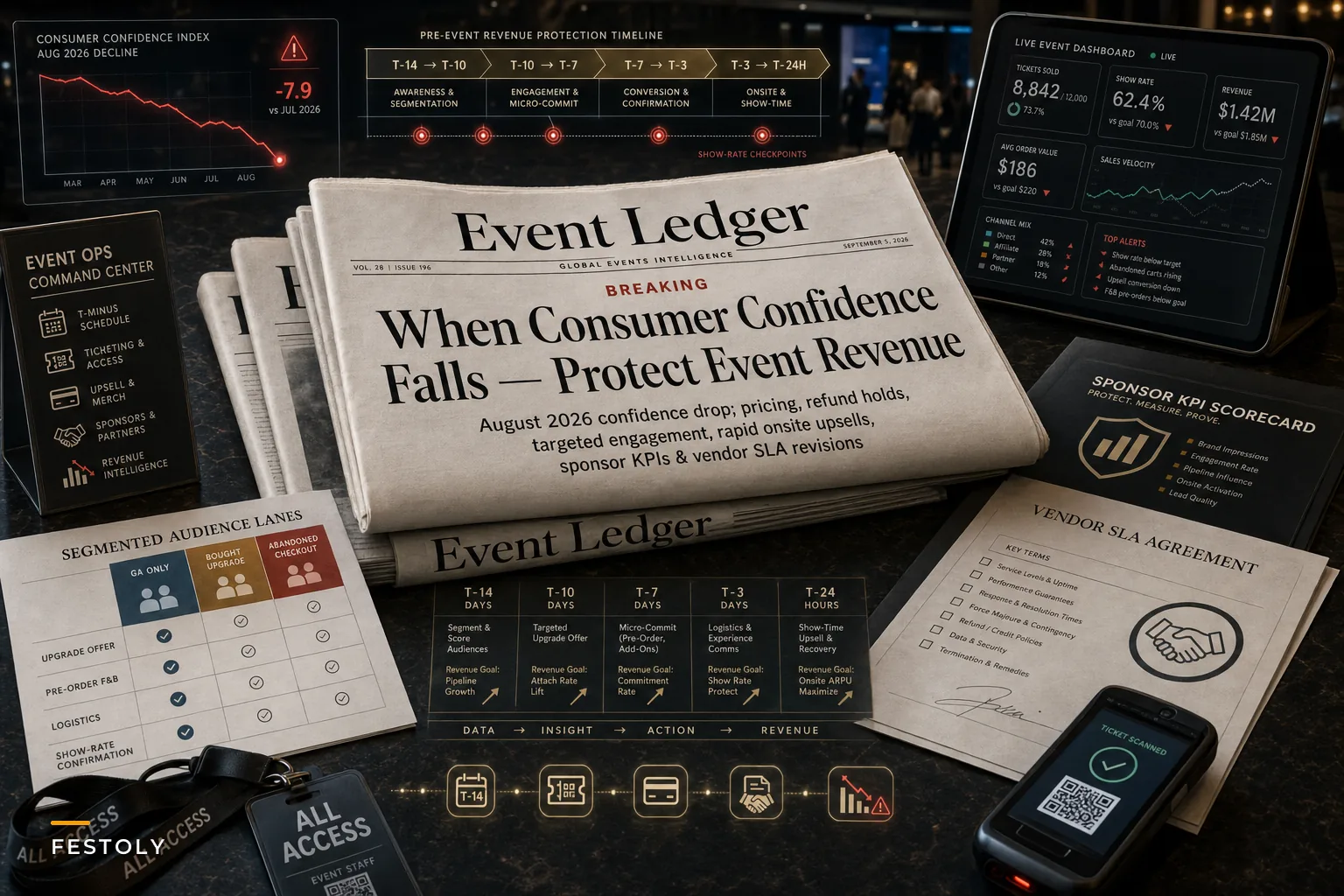

The August 2026 confidence print wasn't dramatic. The Conference Board's index ticked down to 89.4 from 90.2, a small move on paper. But the part that actually matters for anyone selling tickets this fall isn't the headline number—it's which component slipped. The Expectations Index (income, business conditions, jobs) fell, while the assessment of current conditions held up.
That distinction matters more than most planners realize. Expectations drive discretionary decisions weeks out. When people feel uncertain about their income six months from now, they don't cancel groceries—they defer the $180 conference pass, skip the VIP upgrade, and decide to eat before they arrive rather than buying the $16 arena burrito. Reuters framed it as a softening in short-term outlook, and for events that's exactly the window where advance sales and add-on revenue get decided.
So this post isn't really about a survey. It's about what a shift in expectations exposes in the way most events are financially built—and what you can actually adjust before it shows up in your settlement.
The revenue you're actually exposed to (it's not ticket volume)
Most planners react to a confidence dip by obsessing over gross ticket count. That's the wrong dashboard. The exposure isn't just "will people buy?"—it's the timing and composition of what they buy.
-
Purchases move later. Buyers who would've committed five weeks out now wait until ten days out, hoping for a discount or just keeping options open. Your advance-sale curve flattens.
-
Attach rate drops before headcount does. People still come, but they buy fewer upgrades, less merch, and cheaper F&B. Per-head revenue erodes quietly while attendance looks fine.
-
Refund and no-show sensitivity rises. A softer outlook makes people more willing to eat a sunk ticket cost rather than spend the additional money that attending actually requires—parking, travel, on-site spending.
The trap is that the first two problems don't show up in the metric planners check most often. Attendance can look flat or even slightly up while average revenue per attendee quietly falls 8–15%. You find out at settlement, when F&B and merch numbers come in soft against a headcount that looked healthy all week.
A useful reframe: in a confidence-soft environment, defend ARPU and cash timing, not just gross registrations.
Where the money leaks first
Not every revenue line reacts the same way. Some are far more elastic than others, and knowing the order helps you focus your defensive energy where it actually counts.
Eliminate event chaos with Festoly.
Manage every aspect of your event seamlessly — from planning to execution.
- Centralized event scheduling
- Real-time attendee tracking
- Vendor & resource coordination
No credit card required
| Revenue line | Sensitivity to soft expectations | Why it moves | Where to focus |
|---|---|---|---|
| VIP / premium upgrades | Very high | Pure discretionary, easy to skip | Reframe value, not price |
| On-site F&B (impulse) | High | Decided day-of, easily pre-empted | Bundling, pre-order |
| Merchandise | High | Deferrable, "buy online later" | Limited-run scarcity |
| Sponsorship activations | Medium-high | Sponsors get nervous about ROI | Guarantees, reporting |
| General admission | Medium | Anchored, planned in advance | Payment plans, urgency |
| Multi-year / renewal | Low-medium | Habitual, relationship-driven | Protect at all costs |
Cutting VIP price 20% usually just trains buyers to wait and cannibalizes the people who'd have paid full anyway. The premium buyer isn't price-shopping the same way a GA buyer is—they're value-shopping.
If your VIP tier feels soft, a clearer and more concrete benefit stack almost always outperforms a lower number.
The underlying problem: your revenue model assumes stable intent
A confidence dip exposes something most event P&Ls quietly assume—that attendee intent is stable once someone registers. It usually isn't, and soft expectations widen the gap between "registered" and "shows up and spends."
-
You assume the buyer at registration is the same buyer on event day. Their financial mood shifted in between. Nothing in your workflow re-engages them to reconfirm value.
-
You assume on-site spend is a given. A lot of it is actually decided in the 48 hours before the event, when the attendee mentally sets a budget for the day.
-
You assume sponsors will renew on last year's terms. When their own customers pull back, sponsors get twitchy about soft metrics and start asking for guarantees they didn't need before.
Fixing this isn't about finding a magic pricing lever. It's about tightening the operational loop between selling the ticket and actually realizing the full revenue behind it.
Defend the front door first: attendance is the base of everything
Every upsell, F&B dollar, and sponsor impression sits on top of one thing—the person actually walking in. When expectations soften and no-show risk rises, a sold ticket that doesn't convert to a body in the room takes the entire on-site spend with it.
This is where the pre-event engagement window earns its keep. The interventions that reduce no-shows are the same ones that reset attendee intent and re-anchor spend. If you haven't built a structured cadence for the weeks and days before doors open, the timeline of tactics that actually cut no-shows is a practical backbone—week-out, day-out, and hour-out touchpoints that measurably lift show rate. In a soft-confidence period, you run that playbook harder and layer spend-priming into it: pre-order F&B, reserve the upgrade, claim the limited merch drop.
Pro-tip: prioritize segmentation by purchase behavior when planning your week-out and day-out messaging to maximize attach and show rate.
Reducing no-shows and protecting on-site spend are the same workflow, not two separate projects. Every message that reconfirms attendance is also a chance to lock in a purchase before day-of budget anxiety sets in.
A pre-event revenue-protection sequence that works
Below is a concrete cadence you can adapt. The exact days matter less than having a defined trigger and message for each stage, rather than just hoping people show up and spend.
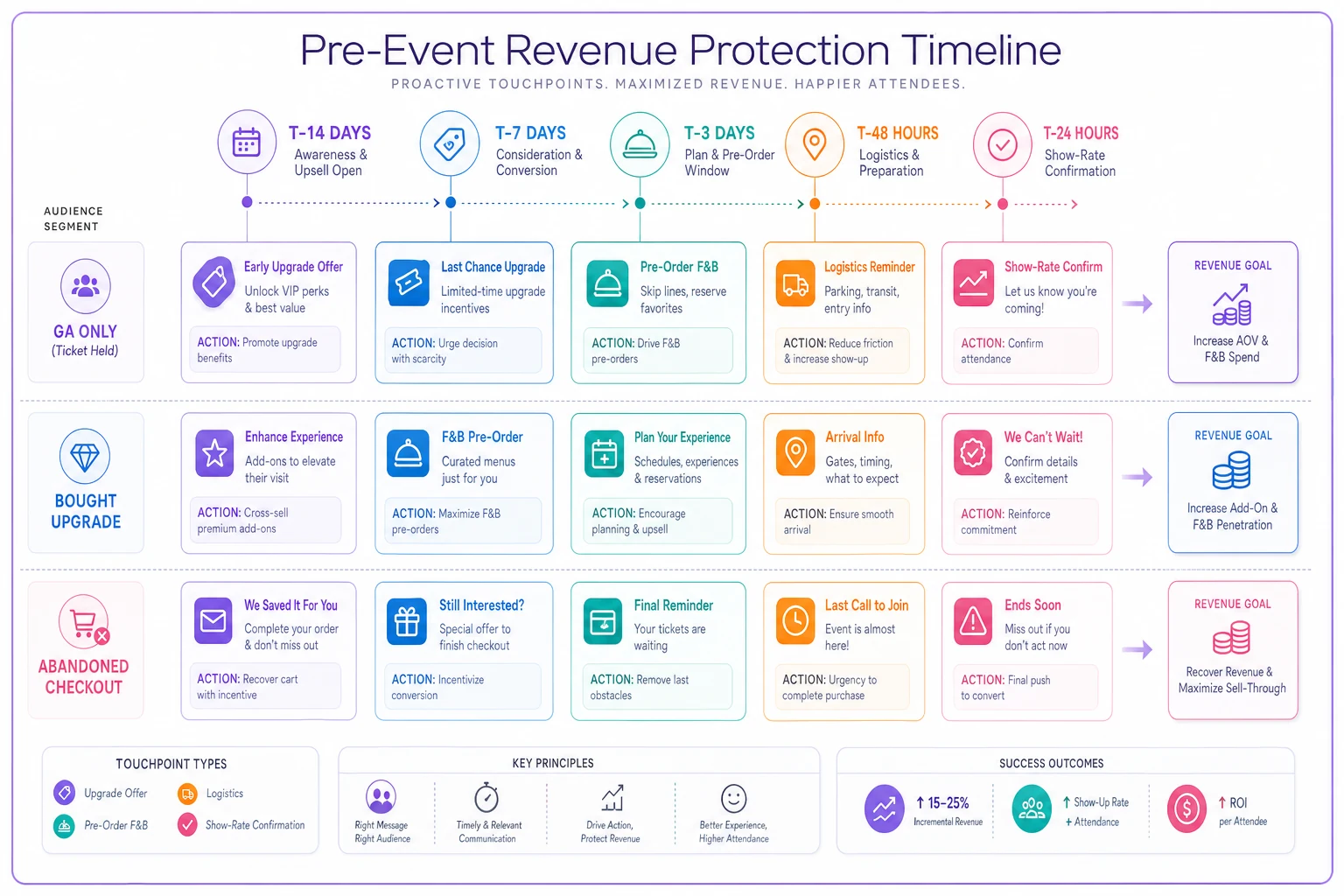
Use this timeline as a template for sequencing messaging, triggers, and revenue-focused actions.
-
T-14 days Segment your list into "bought GA only," "bought upgrade," and "hasn't finished checkout." Each gets a different message. The GA-only group gets a reframed upgrade offer built on value, not discount.
-
T-10 days Open pre-order for F&B bundles and reserved merch. Frame it around convenience and scarcity ("skip the line," "limited run")—this sidesteps the price-anchoring problem.
-
T-7 days Send the "why this is worth it" content—speaker highlights, agenda, one concrete outcome. Intent-reconfirmation aimed at the wavering buyer.
-
T-3 days Logistics plus a final low-friction upsell. Parking pre-pay, arrival window, and one clear add-on. This is where you capture the day-of budget before they set it lower.
-
T-24 hours Show-rate protection. Confirmation, what to bring, a small reason to arrive early—early-bird merch, a morning session. Highest-leverage no-show touch.
Run this and you're doing two jobs at once: lifting attendance and pulling forward spend that would otherwise be at the mercy of someone's mood on event morning.
Sponsors: get ahead of the guarantee conversation
When the broader outlook softens, sponsors don't wait for your recap deck—they start hedging. Expect more requests for performance guarantees, more scrutiny of lead quality, and in some cases a pause on activations "until we see the numbers."
Planners who handle this well do one thing differently: they bring the data conversation forward, before the sponsor asks. A short pre-event note—here's our current pacing, here's the audience quality, here's how we're protecting attendance—reframes you as a partner managing risk instead of a vendor hoping for the best.
When offering a guarantee makes sense:
-
You have reliable historical attendance and attach data to price the risk
-
The sponsor is a multi-year relationship worth protecting
-
You can tie the guarantee to a metric you control (verified attendance, badge scans) rather than a fuzzy one (leads generated)
When it's a bad idea:
-
You're guaranteeing an outcome that depends on the sponsor's own booth staffing and follow-up
-
Your measurement can't cleanly attribute the result
-
The guarantee would require a refund that breaks your own margin math
The mistake to avoid: agreeing to a lead-based guarantee measured by a system you don't fully trust. If your attribution is shaky, you're writing a check against a number you can't defend.
Tighten vendor SLAs to match a leaner budget
If revenue timing gets riskier, your cost structure needs to flex with it. A soft-confidence season is the wrong time to be locked into rigid minimums you can't adjust as your live forecast shifts.
-
Tiered minimums tied to confirmed headcount, with a check-in date close enough to reflect real registration rather than optimistic early projections.
-
Scale-down rights on staffing and F&B counts within a defined window, so a softer-than-expected sale doesn't force you to pay for capacity you won't use.
-
Clear force-timing on final guarantees—the later your commit date, the more your real numbers inform it.
-
Defined response and remedy terms so that if a vendor underdelivers on a lean plan, you're not absorbing the cost of their miss.
Rigid vendor contracts turn a modest revenue dip into a margin crisis because your costs don't move when your revenue does. That flexibility in the contract is what keeps a soft sale from becoming an actual loss.
A real scenario
A regional two-day professional conference—roughly 1,400 expected attendees, ticket revenue around $310k, with F&B, upgrades, and merch adding close to $90k in a normal year.
Heading into a soft-confidence fall, their advance-sale curve was running about two weeks behind the prior year. Attendance projections looked fine—the leak was in composition. Upgrade attach had dropped from about 18% to roughly 11%, and pre-orders were nonexistent because they'd never offered them.
-
Built a T-14 to T-24h engagement sequence with segmented upgrade and pre-order messaging
-
Opened F&B bundles and a limited merch pre-order at T-10
-
Renegotiated the caterer's guarantee date from 14 days out to 6, and added a scale-down band
Results were uneven but real. Upgrade attach recovered to about 15%—not all the way back, but a meaningful chunk of recovered premium revenue. Pre-orders captured roughly $14k that historically would've been left to day-of impulse. Moving the caterer's commit date closer saved them from over-guaranteeing around 120 meals against a headcount that came in slightly under projection.
Net, they protected somewhere between $25k and $32k of at-risk revenue without touching their price.
The lesson wasn't the specific tactics. It was that they defended ARPU and cash timing instead of panic-discounting the headline number.
Who should *not* overreact to this
Not every event needs to change its plan. If your audience skews toward committed professional or expense-account buyers, a small confidence dip may barely register—that segment's spend is anchored to career value, not personal discretionary mood. Scrambling your model in that case can do more harm than good, training loyal buyers to expect discounts they were never going to ask for.
The events that genuinely need to move are the discretionary, consumer-paid ones—festivals, hobby and lifestyle events, family-facing attractions, anything where the ticket competes directly with a night out or a weekend trip. Those are where softer expectations bite first and hardest.
A one-point move in a confidence index isn't a crisis. But it is a signal worth checking—specifically, whether your revenue model quietly assumes stable intent from your buyers, because that assumption is exactly what softens when their outlook does.
The work is unglamorous: defend attendance first, run a real pre-event engagement cadence, protect ARPU instead of chasing headline volume, get ahead of the sponsor guarantee conversation, and make sure your vendor contracts can flex when your forecast does. None of it requires a dramatic price war or a full model rebuild. Most of it is just closing the gap between selling a ticket and actually realizing the revenue behind it—which is worth doing whether confidence is up or down.
Ready to elevate your event management?
Join 5,000+ event organizers using Festoly to save time, improve coordination, and deliver memorable experiences.