

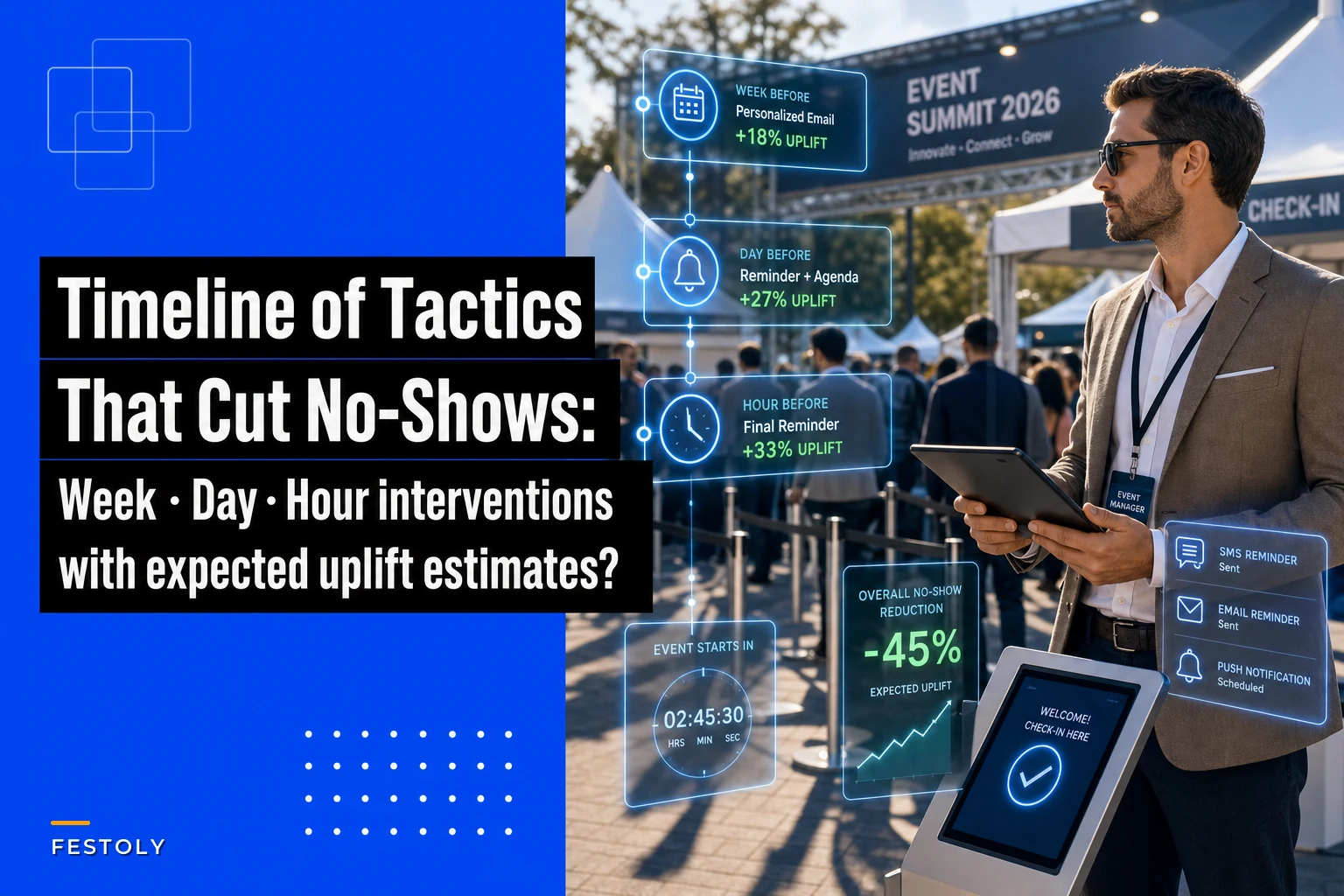

Event no-shows destroy budgets in ways most organizers don't calculate. You plan for 500, cater for 450, staff for 475, and 310 show up. That's not just wasted food—it's venue minimums you still owe, staff standing around, sponsors questioning their investment, and your reputation taking hits that compound over multiple events.
The standard advice tells you to send reminder emails. Great. Everyone sends reminder emails. The problem is timing, frequency, messaging, and understanding which registrants need different types of intervention. After working with event companies ranging from 50-person workshops to 4,000-attendee conferences, certain patterns become obvious. The registrants who sign up eight weeks early behave differently than those who register three days out. Corporate attendees need different nudges than community members. Free events bleed differently than paid ones.
What follows is a tactical breakdown of when to intervene, what messages work, and the actual uplift you should expect from each tactic. These aren't theoretical—they're based on tracking attendance patterns across hundreds of events and testing different intervention points.
The registration-to-attendance decay curve
Most organizers think linearly about attendance. Register 100 people, expect 80 to show. The reality follows a predictable curve based on registration timing and event type.
For free events, the decay looks brutal. Someone who registers six weeks out has about a 35% show rate. Registration at three weeks? Maybe 45%. Registration within 72 hours? Closer to 65%. The curve gets worse for evening events, weekend events, or anything requiring travel.
Paid events follow a different curve. Early-bird purchasers (8+ weeks out) actually show at around 82%. Full-price purchasers (2-4 weeks) hit about 75%. Last-minute buyers within 48 hours either show at 90% or don't show at all—there's almost no middle ground.
Corporate events with required attendance still see 15-20% no-shows due to last-minute priorities, travel issues, or simple calendar conflicts. Academic conferences hover around 12% no-shows even with registration fees. Community events without fees can hit 50% no-show rates without intervention.
Understanding your baseline decay rate for your specific event type, audience, and timing becomes the foundation for knowing which interventions actually move the needle versus just feeling productive.
Week-out interventions: Building psychological commitment
Seven days before your event, you're fighting attention, not logistics. People haven't thought about transportation, checked their calendar conflicts, or made the mental shift from "registered" to "attending."
Eliminate event chaos with Festoly.
Manage every aspect of your event seamlessly — from planning to execution.
- Centralized event scheduling
- Real-time attendee tracking
- Vendor & resource coordination
No credit card required
The most effective seven-day intervention isn't a reminder—it's a commitment escalation. Instead of "See you next week," you want micro-actions that create psychological investment.
Send a session selection email. "Pick your top 3 sessions for Thursday" with clickable options. Track who engages. Non-responders get flagged for aggressive follow-up. Responders just increased their psychological commitment by making choices about the event. This alone moves attendance rates by 8-12% for the responder group.
Use clickable session picks that record engagement clicks to quickly flag at-risk registrants for follow-up.
For workshops or smaller events, send a pre-event question. "What's your biggest challenge with [topic]? We'll address top questions during the event." Again, you're not reminding—you're creating investment. Responders show at 15-20% higher rates.
The week-out intervention should also trigger logistical prep. Include parking information with a Google Maps link. Add calendar holds for travel time. Mention weather expectations. You're removing future friction while they're still engaged with your email.
Skip the generic "We're excited to see you!" language. That's what everyone writes. Instead, create utility: "Thursday's agenda attached. Sessions start promptly at 9:15 AM. Coffee available from 8:30 AM." Specific, useful, actionable.
72-hour interventions: Removing friction points
Three days out, you're battling logistics, not awareness. People know about the event. Now they're figuring out if they can actually make it work.
This is where segmentation matters. Check your registration data. Who hasn't opened any emails? Who registered with a company email but it's a weekend event? Who's traveling more than 30 miles? Each segment needs different messaging.
For non-engaged registrants (no email opens), text messages deliver 3x the engagement of another email. "Quick confirmation for Thursday's event - reply YES if attending, NO if plans changed." Simple. Direct. Valuable data for your headcount.
For traveled attendees, send local context. "Parking at venue is $12. Alternative lot two blocks north is $5. Uber from downtown runs $15-18." You're solving problems before they become no-show excuses.
Corporate attendees need ammunition for their calendar defense. "Reminder: Thursday's event includes CPE credits. Certificate available immediately after." Or "Keynote speaker just added bonus Q&A session for early arrivals." Give them reasons to protect that calendar block.
The 72-hour mark is also when you deploy social proof. "387 professionals confirmed for Thursday. View attendee industries here." People hate missing what their peers are attending. Show momentum.
For paid events, this is when you mention no-refund policies. Not aggressively—just clearly. "Tickets non-refundable within 72 hours per policy. Transfer to colleague using this link." You'd be surprised how many people suddenly remember they can attend when refunds aren't an option.
24-hour interventions: Final friction removal
One day out, every intervention should remove a specific friction point. People are making final decisions about attendance, usually based on small logistics that feel bigger than they are.
Send three things:
-
exact timeline
-
exact location
-
exact first step
"Event tomorrow 9 AM. Venue: 425 Market St (map attached). Registration desk in main lobby—look for blue banners." Eliminate any uncertainty about the arrival experience.
Include a contact phone number that someone will actually answer. "Questions tomorrow? Text 555-0123. Sarah responds 7 AM - 8 PM." Real human availability reduces anxiety about logistics going wrong.
For virtual or hybrid events, send technical requirements. "Join link in your calendar. Test your audio here (takes 30 seconds). Backup phone dial-in: 555-555-5555." Assume technical problems and pre-solve them.
Weather becomes crucial at 24 hours. "Tomorrow's forecast: 78° and sunny. Event includes outdoor networking—sunglasses recommended." Or "Rain expected. Covered drop-off available at main entrance." Address the excuse before it forms.
This is also when you trigger FOMO for free events. "Final headcount: 412 attending. Waitlist activated for future sessions." Scarcity drives action even for free offerings.
Day-of interventions: Navigation and momentum
Morning-of messages have one job: get people out the door. Sent between 7-8 AM for a 9 AM start, these messages should feel like a helpful friend, not a desperate organizer.
"Event starts in 2 hours. Venue: 425 Market (map). Registration open now—no lines. Coffee ready." Short. Specific. Actionable.
Include a parking update if relevant. "Venue lot 70% full as of 7:45 AM. Street parking available on 5th Ave." Real-time information builds trust and urgency.
For anyone who hasn't checked in by 15 minutes after start time, send one final text. "Session starting now. Side door still open—enter quietly and grab materials at back table." You're removing the embarrassment friction of late arrival.
Virtual events need different timing. Send joining links 30 minutes before, 10 minutes before, and at start time. "Starting now: [LINK]. No worries if you're late—recording available." Remove the pressure while maintaining urgency.
Measuring uplift and setting expectations
Each intervention carries measurable impact, but results vary by audience and event type.
Week-out commitment emails typically move attendance 8-12% for engaged responders. Non-responders need aggressive follow-up but rarely convert above 5%.
72-hour text confirmations generate 65-70% response rates. YES responses show at 85%. NO responses obviously don't. Non-responders show at only 40%.
24-hour friction removal pushes fence-sitters by 10-15%. The weather acknowledgment alone prevents 5-8% dropout for outdoor events.
Day-of messages recover 12-18% of assumed no-shows. The "side door open" message specifically recovers about 3% who would otherwise turn around in the parking lot.
Combined properly, these interventions can move overall attendance from 60% to 78-82% for free events, or from 80% to 88-92% for paid events.
The key is measurement. Tag every registrant with their intervention response. Track show rates by segment. You'll quickly identify which messages work for your specific audience and which are just making you feel busy.
Segmentation strategies that actually matter
Not every registrant needs the same intervention cadence. Over-messaging your confirmed attendees while under-messaging your at-risk segments wastes effort and annoys people.
Early registrants (6+ weeks out) need periodic engagement to maintain connection. Monthly content updates, speaker announcements, or agenda additions keep the event present without overwhelming. These folks registered early for a reason—they're planners who appreciate structure and updates.
Last-minute registrants (within 72 hours) need immediate logistics. Skip the excitement-building and focus on parking, timing, and what to expect. They're making quick decisions and need quick information.
Group registrations need coordinator focus. If someone registered five people, that person becomes your key communication point. "Your team of 5 is confirmed. Individual calendar invites sent. Reply with any dietary restrictions." One engaged coordinator ensures five attendees.
VIP or speaker guests need white-glove treatment. Separate communication track, direct phone numbers, and proactive problem-solving. "Your airport pickup is confirmed for 3:15 PM. Driver will text upon arrival." These attendees influence others and deserve the extra attention.
Geographic segments matter for in-person events. Anyone traveling 50+ miles needs hotel recommendations, traffic timing, and local context. Anyone within 10 miles needs only parking and precise timing.
The micro-commitment ladder
Every touchpoint should ask for a small action that builds toward attendance. These micro-commitments create psychological investment that makes no-showing feel like breaking a promise.
Start with low-friction commitments. "Will you need vegetarian meal options?" Simple yes/no, but they're now thinking about being there for lunch.
Escalate gradually. "Select your afternoon workshop: Option A, B, or C." Now they're planning their day at your event.
Add social elements. "Who from your team should we expect?" They're committing publicly, even if just to you.
Request preparation. "Bring business cards for the networking session." They're taking physical action connected to attendance.
Each commitment increases the psychological cost of not attending. Someone who's selected sessions, confirmed dietary needs, and told colleagues they're coming has built enough investment that missing feels like real loss.
A/B testing framework that delivers insights
Most organizers send one message and hope. The smart ones test systematically and compound their learnings over time.
Here's a simple testing flow to visualize.
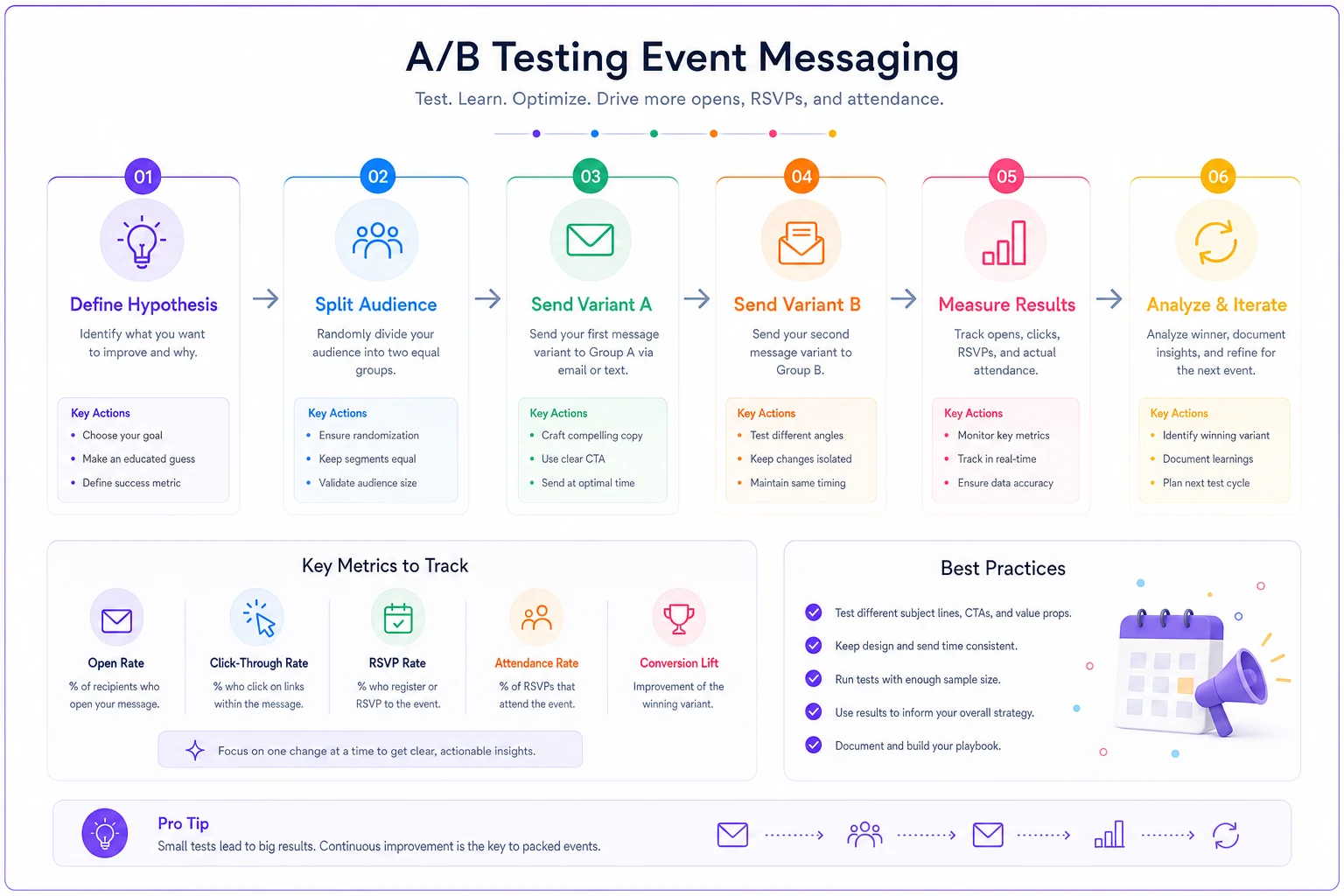
Test one variable at a time. Subject lines first—does urgency ("Tomorrow: Event Details") beat benefit ("Your Networking Opportunity Tomorrow")? Measure open rates, but more importantly, measure attendance rates by test group.
Message timing matters more than message content. Test 72 hours versus 48 hours for the same message. Test 7 AM versus 12 PM versus 5 PM for day-of reminders. Your audience has patterns—find them.
Channel testing reveals preferences. Email versus text versus phone for the same message. Some audiences respond to text but ignore email. Others find texting invasive. You won't know until you test.
Keep sample sizes reasonable. You need at least 100 people per test group for meaningful results. Below that, you're seeing noise, not patterns.
Track everything in a simple spreadsheet. Test date, variable tested, sample size, result. After five events, you'll have playbooks that consistently outperform generic advice.
Scripts that work (and expected results)
7-Day Email (12% uplift for responders): "Thursday's event agenda attached. Quick request: Pick your top 2 sessions so we can ensure adequate seating. [Session List]. Reply with your choices or click here to select online."
| Script | Copy |
|---|---|
| 7-Day Email (12% uplift for responders): | "Thursday's event agenda attached. Quick request: Pick your top 2 sessions so we can ensure adequate seating. [Session List]. Reply with your choices or click here to select online." |
| 72-Hour Text (65% response rate): | "Hi [Name] - Confirming your attendance for Thursday's [Event Name]. Reply YES if attending, NO if plans changed. Questions? Call 555-0123." |
| 24-Hour Email (15% fence-sitter conversion): | "Tomorrow: Doors open 8:30 AM at 425 Market St. Parking in attached map. First session 9:15 AM sharp. Weather: 72° and sunny. See you there!" |
| Day-Of Text (18% recovery rate): | "Starting now at 425 Market St. Late arrival OK—side entrance open until 9:45 AM. Materials at back table." |
Notice what these don't include: excitement, gratitude, or generic enthusiasm. They provide specific value, request specific action, or solve specific problems.
When intervention becomes annoyance
There's a line between helpful and harassing. Cross it, and you'll reduce attendance while damaging your reputation.
Five touchpoints is usually the maximum for a single-day event. Seven days, three days, one day, morning-of, and one recovery message. Beyond that, you're not adding value.
Multi-day events can sustain more contact. Daily agendas, next-day logistics, and session changes justify additional messages. But every message needs unique value—not just reminding them again.
Respect opt-outs aggressively. Someone who says they're not attending doesn't need four more reminders. Mark them out and move on.
Channel-switching feels aggressive. If someone doesn't respond to email, one text might be appropriate. Following up with phone calls, LinkedIn messages, and carrier pigeons makes you look desperate.
Pay attention to engagement metrics. If open rates drop with each message, you're training people to ignore you. Better to send three valuable messages than five annoying ones.
Automation that preserves the human touch
The volume of interventions needed to reduce event no-shows demands automation, but ham-fisted automation feels robotic and gets ignored.
Smart automation tracks behavior and adjusts. Someone who opens every email doesn't need a text message. Someone who hasn't opened anything needs channel escalation. AI-powered operational software can track these patterns and adjust messaging automatically.
Personalization goes beyond [FIRST NAME]. Reference their registration date, their company, their session selections. "Since you selected the Advanced Analytics session, here's pre-reading that'll help you get more from it." That's value, not just mail merge.
Timing automation should respect time zones and work patterns. B2B events should avoid Monday morning and Friday afternoon sends. B2C events might see better engagement on weekends. Your automation platform should optimize send times based on historical engagement.
Response handling needs intelligence. Someone who replies "Can't make it" to your confirmation text shouldn't get three more reminders. Modern platforms with AI automation can parse responses and adjust follow-up accordingly.
The best automation feels like a competent assistant, not a robot. It remembers previous interactions, adjusts based on behavior, and knows when to escalate to human intervention.
Post-event insights that improve future rates
Every event generates data that makes the next one better. The organizers who track and analyze outperform those who just move to the next event.
Track show rates by registration date. You'll find your sweet spot—maybe registrations 2-3 weeks out show best for your events. Adjust your marketing timing accordingly.
Measure intervention response rates. Which messages generated replies? Which drove attendance? Build your playbook based on what actually worked, not what felt right.
Survey no-shows specifically. "We missed you yesterday. What prevented attendance?" The answers are gold for future friction removal. Maybe parking was the issue. Maybe the timing conflicted with something unexpected. Maybe your reminders went to spam.
Compare predicted versus actual attendance. If your interventions predicted 420 attendees and 380 showed, figure out which segment underperformed. Refine your modeling.
Build segment profiles. "Corporate registrants from 10+ miles away who register 2+ weeks out" might show at 90%, while "Free registrants from 30+ miles who register day-of" might show at 20%. These profiles inform everything from catering guarantees to room setups.
Bottom line
Reducing event no-shows isn't about sending more reminders—it's about strategic intervention at specific moments with specific messages for specific segments. The timeline matters. The message matters. The channel matters. But mostly, the systematic approach matters.
Start with measurement. Know your baseline no-show rate by segment. Then add interventions methodically. Week-out commitment builders. 72-hour friction removers. Day-of navigation assistance. Track the uplift from each intervention.
The organizers who cut no-shows from 40% to 20% didn't find a magic message. They built a system that identifies at-risk registrants, intervenes at optimal moments, and removes friction before it becomes absence. They test, measure, adjust, and compound their learnings.
With the right operational approach—ideally supported by AI-powered event management software that can track patterns and automate interventions—you transform attendance from hope to process. The tactics above aren't theoretical. They're based on hundreds of events and thousands of experiments. Pick the ones that fit your event type, test them systematically, and watch your attendance rates climb while your stress levels drop.
The difference between amateur and professional event operations isn't budget or team size. It's the discipline to build systems that deliver consistent results. No-
The difference between amateur and professional event operations isn't budget or team size. It's the discipline to build systems that deliver consistent results. No-
Ready to elevate your event management?
Join 5,000+ event organizers using Festoly to save time, improve coordination, and deliver memorable experiences.