

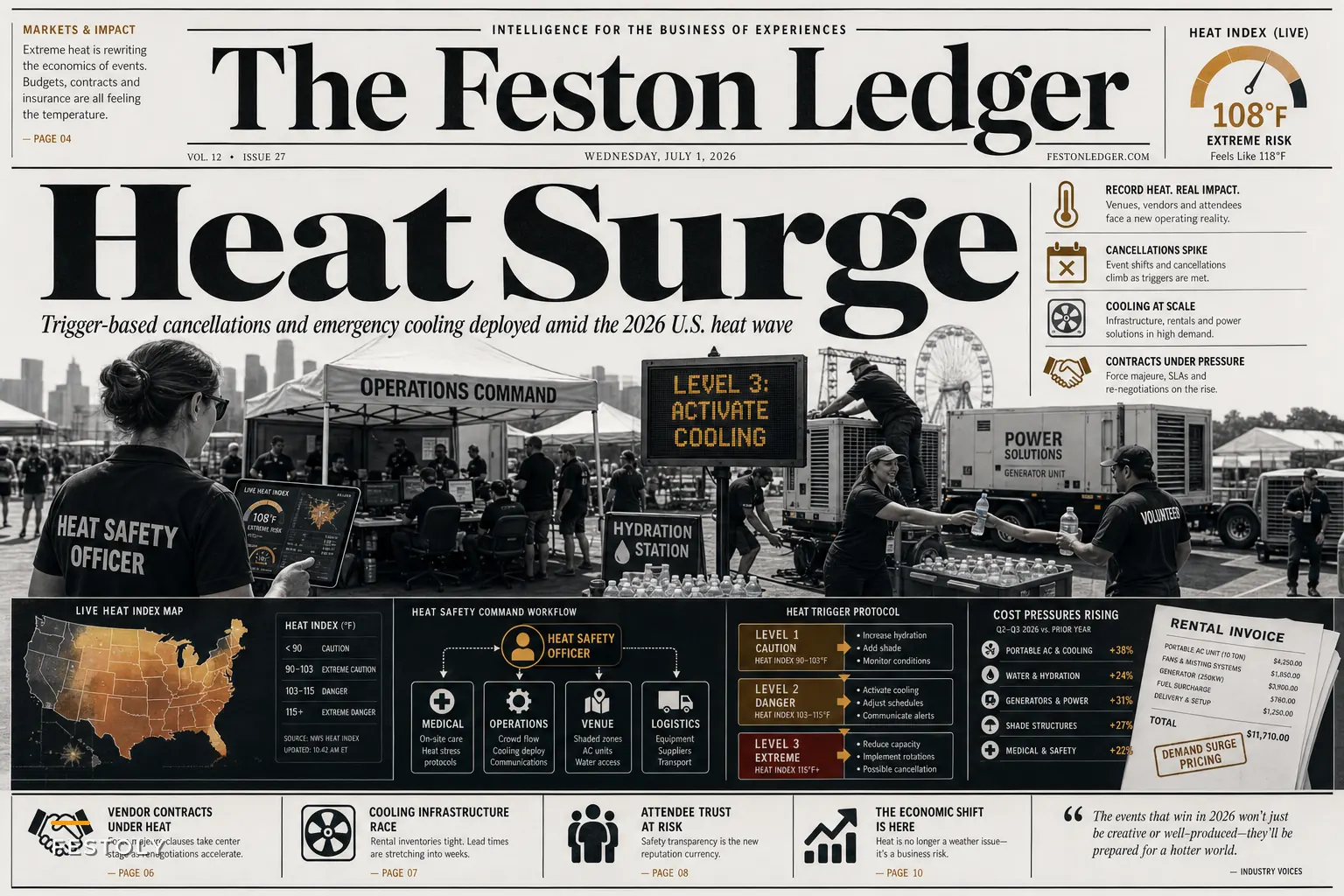

The heat dome sitting over most of the central and eastern U.S. right now isn't just another summer heat wave. NPR reports that temperatures are hitting record highs from Ohio to North Carolina, with the National Weather Service issuing widespread HeatRisk warnings through the July 4 weekend. For event planners with outdoor festivals, concerts, and community celebrations already on the calendar, this is an immediate operational crisis that goes well beyond adding a few extra water stations.
The timing is what makes this particularly brutal. July 4 weekend events have been locked in for months — vendor contracts signed, permits pulled, marketing running, tickets sold. You can't move a fireworks show to September. And the standard weather contingency plans most organizers have on file? Built for rain. Not for sustained 105-degree heat that turns asphalt into a medical hazard and overwhelms local EMT capacity.
The real problem isn't the heat itself — it's how late-stage heat warnings cascade through your entire operational stack. Your cooling trailer vendor who promised 10 units suddenly has 50 events calling for the same equipment. The venue's HVAC system that handles 95 degrees fine starts tripping breakers at 102. Your volunteer crew scheduled for 4-hour shifts needs rotation every 90 minutes, which throws your coverage math completely off. And insurance carriers who were fine with your standard safety plan two weeks ago now want documented heat protocols that frankly don't exist yet.
The cascade failure pattern nobody talks about
Most heat wave event planning focuses on attendee safety — hydration stations, shade structures, medical tents. That's table stakes. The operational breakdown actually starts earlier, in your supply chain.
First, infrastructure vendors hit capacity limits. A cooling equipment supplier might have 200 misting fan units across three warehouses. When every outdoor event within 300 miles needs them at the same time, price isn't even the issue anymore — availability is. Same with generators for additional cooling, refrigerated trailers for vendor food safety, even basic pop-up tents for shade.
Then your staffing model breaks. Security guards on fence lines in direct sun can't maintain 6-hour shifts. Parking attendants on blacktop lots start calling out. Food vendors can't keep workers at outdoor grills when ambient temperature plus cooking heat pushes past 115 degrees. The staffing ratios you calculated in March stop working when everyone needs double the break time.
Power infrastructure is the next failure point. Most outdoor venues plan electrical capacity around typical summer loads. Add 30% more cooling equipment, refrigeration units running constantly, and every vendor maxing their power draw, and you start popping breakers. The venue says they can bring in additional generators — but those generators are the same ones everyone else is hunting for, from the same suppliers already stretched thin.
Then your communication systems get overwhelmed. The CDC's extreme heat guidance recommends constant attendee updates about heat safety, which sounds manageable until you realize your event app wasn't built to push notifications every 30 minutes. Your PA competes with music stages. Your signage assumed people would stop to read it instead of rushing between shaded areas.
Building trigger-based response protocols
The mistake most organizers make is treating heat as a static condition — it's hot, so add cooling. What you actually need are dynamic triggers tied to specific temperature and humidity thresholds that automatically activate predetermined responses.
Eliminate event chaos with Festoly.
Manage every aspect of your event seamlessly — from planning to execution.
- Centralized event scheduling
- Real-time attendee tracking
- Vendor & resource coordination
No credit card required
Start with heat index breakpoints, not air temperature. Heat index factors in humidity and reflects what the body actually experiences. At 95°F heat index, trigger Level 1: double water stations, add electrolytes to concessions, increase medical staff by around 25%. At 105°F, Level 2: mandatory shade breaks for all outdoor staff, close certain activities like inflatable rides, open indoor cooling zones even if it means displacing other programming.
At 110°F heat index, you're in Level 3 territory — considering partial suspension of activities during peak heat hours (roughly 12pm–5pm), mandatory evacuation of unshaded parking areas, and potentially shifting evening events later to avoid late afternoon heat buildup.
Pre-assign specific owners for each trigger action to avoid confusion in the moment.
Each trigger level needs specific pre-assigned actions with clear ownership. Not "increase medical coverage" — instead, "Head of Safety calls AMR to dispatch two additional units to north gate staging by 11am." Not "provide more shade" — instead, "Operations lead deploys reserve tent inventory from Warehouse B to zones 3, 5, and 7, with setup crew Charlie assigned."
The coordination tax of distributed cooling
Adding cooling infrastructure sounds straightforward until you map the actual logistics. Every misting fan needs water supply and drainage. Every cooling tent needs power. Every refrigerated trailer needs level ground and generator access. Your February site plan didn't account for any of this.
Take the water supply issue alone. A typical misting fan system uses roughly 1.5 gallons per hour per nozzle. Run 20 fans with 4 nozzles each for 8 hours and you're looking at close to 960 gallons of water. Where does it come from? Where does runoff go? What happens when that water turns dirt pathways into mud?
Power distribution gets equally messy. Your main stage might have three-phase power, but the cooling stations throughout the grounds need standard 110v or 220v connections. Running that much temporary cable creates trip hazards, requires ground covering, and needs constant monitoring to prevent overheating. The generator you rent to supplement power needs fuel deliveries every few hours, adding truck traffic to an already congested site.
Placement matters too. Cooling stations need to sit on natural traffic paths, be visible from a distance, stay accessible to service vehicles, and be positioned so queues don't block other areas. That usually means redesigning your event flow from what you originally planned.
Vendor capacity wars and contract gaps
When extreme heat hits an entire region, every event scrambles for the same resources at the same time. The rental company that confirmed availability in your spring contract suddenly invokes force majeure. The "guaranteed delivery" becomes "best effort basis."
Smart organizers locked in heat-specific equipment with penalty clauses by early May. Not just primary vendors — secondary and tertiary backups too. Contracts need specific language around priority delivery, not just availability. A vendor might have the equipment, but if you're 30th on their list and they can only deliver to 20 events, it doesn't help you.
Mutual aid agreements between events matter here too. The festival running July 2–3 might loan you cooling equipment starting July 4, but only if you've pre-negotiated that arrangement. Same with sharing specialized staff like EMT crews who actually know heat illness protocols.
Real-time capacity management
Static capacity limits don't work in extreme heat. A venue rated for 10,000 people under normal conditions looks very different when everyone clusters in shaded areas at once. Your effective capacity shrinks without your headcount changing.
You need dynamic zone monitoring. If your main shade pavilion was designed for 500 people but 2,000 are packed in, you have a safety problem regardless of your overall attendance number. That means real-time counting at zone entry and exit points, not just main gates.
Queue management becomes critical. Lines for water stations, bathrooms, and cooling tents can quickly exceed safe exposure times. At 105°F, standing in direct sun for 20 minutes is a medical risk. You need active queue monitoring with set triggers — if water station lines exceed 15 minutes, deploy mobile water teams. If bathroom queues back up, open restricted facilities to public use.
Some organizers have shifted to heat-adjusted scheduling, spreading activities over longer timeframes to reduce density during peak heat hours. Instead of a concentrated 4-hour festival block, run 7 hours with mandatory indoor programming between 1pm and 4pm.
Financial implications and budget triggers
Heat wave preparations blow through standard contingency budgets fast. Equipment rental prices can triple when demand spikes. Rush delivery charges add another 50% to base costs. Staff overtime compounds quickly when everyone needs double break time.
Here's roughly what a mid-size outdoor event with around 3,000 attendees might face:
| Cost Category | Normal Budget | Heat Wave Reality |
|---|---|---|
| Cooling Equipment | $2,000 | $8,500 |
| Additional Staff | $3,000 | $7,200 |
| Extra Supplies | $1,000 | $3,500 |
| Emergency Services | $1,500 | $4,000 |
| Power/Generator | $2,000 | $5,500 |
| Insurance Adjustment | $0 | $2,000 |
That's close to $25,000 in additional costs landing a few days before your event. Your financial controls need override protocols for heat emergencies — normal approval chains are too slow when you're trying to secure the last available cooling units within 200 miles.
Insurance and liability shifts
Standard event insurance often carries temperature exclusions or requires specific heat protocols to maintain coverage. When forecasts exceed 100°F, many carriers want documented safety plans, additional medical coverage, and sometimes on-site inspections before they'll confirm your policy holds.
The liability calculation shifts too. A slip-and-fall might be simple negligence. A heat stroke case where you didn't provide adequate cooling is a different conversation entirely. Your post-event incident window also extends — attendees who suffer heat exhaustion might not show severe symptoms until hours after leaving.
Some organizers have started requiring signed heat acknowledgments at entry, similar to COVID waivers from a few years back. Whether they hold up legally is questionable, but they at least document that attendees were warned.
Day-of decision frameworks
When July 4 arrives and it's already 96°F at 8am, you need clear decision trees — not committee meetings. Establish your go/modify/cancel triggers before the day arrives.
-
GO conditions Heat index under 95°F, all cooling infrastructure operational, full medical staff present, power systems stable.
-
MODIFY triggers Heat index 95–110°F — implement time-based restrictions, activate all contingency cooling, increase medical patrols, potentially delay start times or push into cooler evening hours.
-
CANCEL thresholds Heat index over 110°F for three or more consecutive hours, power infrastructure failure affecting cooling systems, medical services reporting capacity overflow, or local authorities issuing mandatory heat emergencies.
The decision tree needs timestamps too. If you need to cancel, vendors need four hours notice to stop food prep. Attendees need two to three hours to change plans. Marketing needs an hour to update all channels. Work backwards from your start time and set hard decision deadlines.
Live operations command structure
During the event, heat response needs its own command structure, separate from regular operations. Designate a Heat Safety Officer with override authority on any operational decision. They monitor conditions, call triggers, and coordinate across medical, operations, and venue teams.
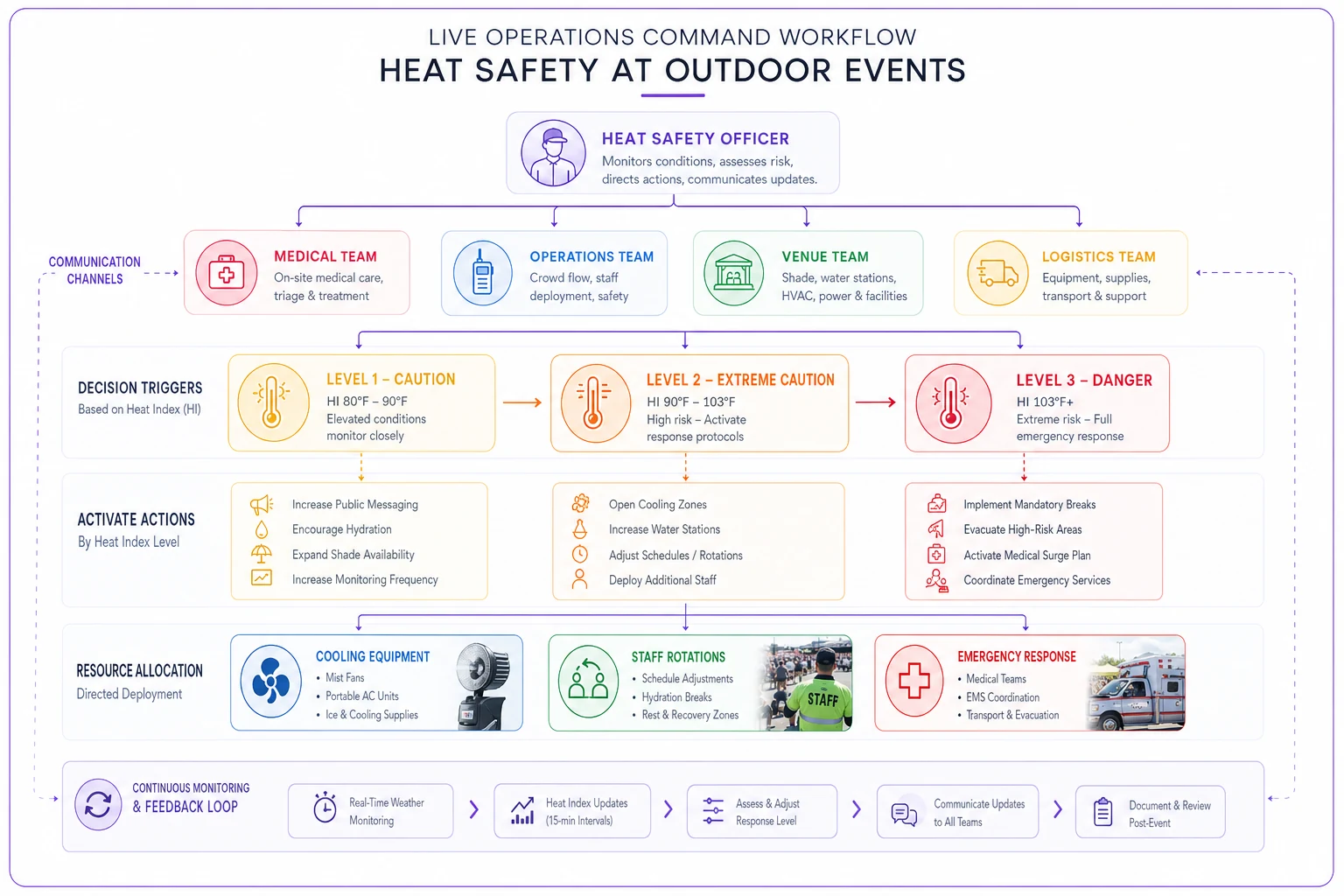
Use a separate radio channel and logging for heat incidents so requests and rotations are tracked independently from entertainment and production chatter.
Rotation schedules become living documents. The volunteer schedule you printed Thursday night is probably worthless by noon Friday when half your people need double break time. You need real-time schedule management with the ability to pull people from lower-priority areas to cover critical positions.
Post-event recovery operations
The event doesn't end when gates close. Heat-stressed staff and volunteers might not show symptoms until they're home. Your post-event medical monitoring should extend 24–48 hours, with clear protocols for following up on anyone treated on-site.
Equipment breakdown takes longer in extreme heat too. Cooling units need proper flush cycles. Generators need extended cooldown. Electronics exposed to high temperatures need gradual normalization. Budget an extra day of equipment rental because you can't strike immediately after the event closes.
Data capture matters here. Which cooling stations saw the highest use? Where did medical incidents cluster? What supplies ran out first? This isn't just for post-event reports — it's operational intelligence for next time.
Making heat wave event planning systematic
The events that handle extreme heat well don't just add more water stations. They've built systematic responses into their operational DNA. They maintain equipment relationships year-round, not just in crisis mode. They've worked heat scenarios into their standard decision trees for weather disruptions, with clear triggers and pre-assigned responses.
More than anything, they've stopped treating heat as just another weather condition to manage. They recognize it as a fundamental operational modifier that touches every part of event execution — vendor contracts, volunteer schedules, site design, financial controls, all of it.
Extreme heat events are becoming more frequent. July 4 weekend heat waves are not a fluke anymore. Organizers who build real heat response capabilities now won't just survive the next heat dome — they'll be the ones still operating when others have cancelled.
That operational resilience is a genuine competitive edge. When you can tell sponsors, vendors, and attendees that you'll run safely regardless of conditions, you win contracts others lose. The infrastructure investments and protocol development might feel excessive in April. Come July 4 weekend at 107°F, they're the difference between a successful event and a very public failure.
For organizers running AI-powered operational platforms, heat events are where dynamic resource allocation and real-time decision support actually earn their keep. When conditions shift by the hour and every call cascades through multiple systems, having centralized operational intelligence that can model scenarios, track resources, and coordinate responses changes what's possible. It doesn't replace human judgment — it gives your team the information architecture to make fast, grounded decisions when the heat index is climbing and 3,000 people are counting on you to keep them safe.
Ready to elevate your event management?
Join 5,000+ event organizers using Festoly to save time, improve coordination, and deliver memorable experiences.