

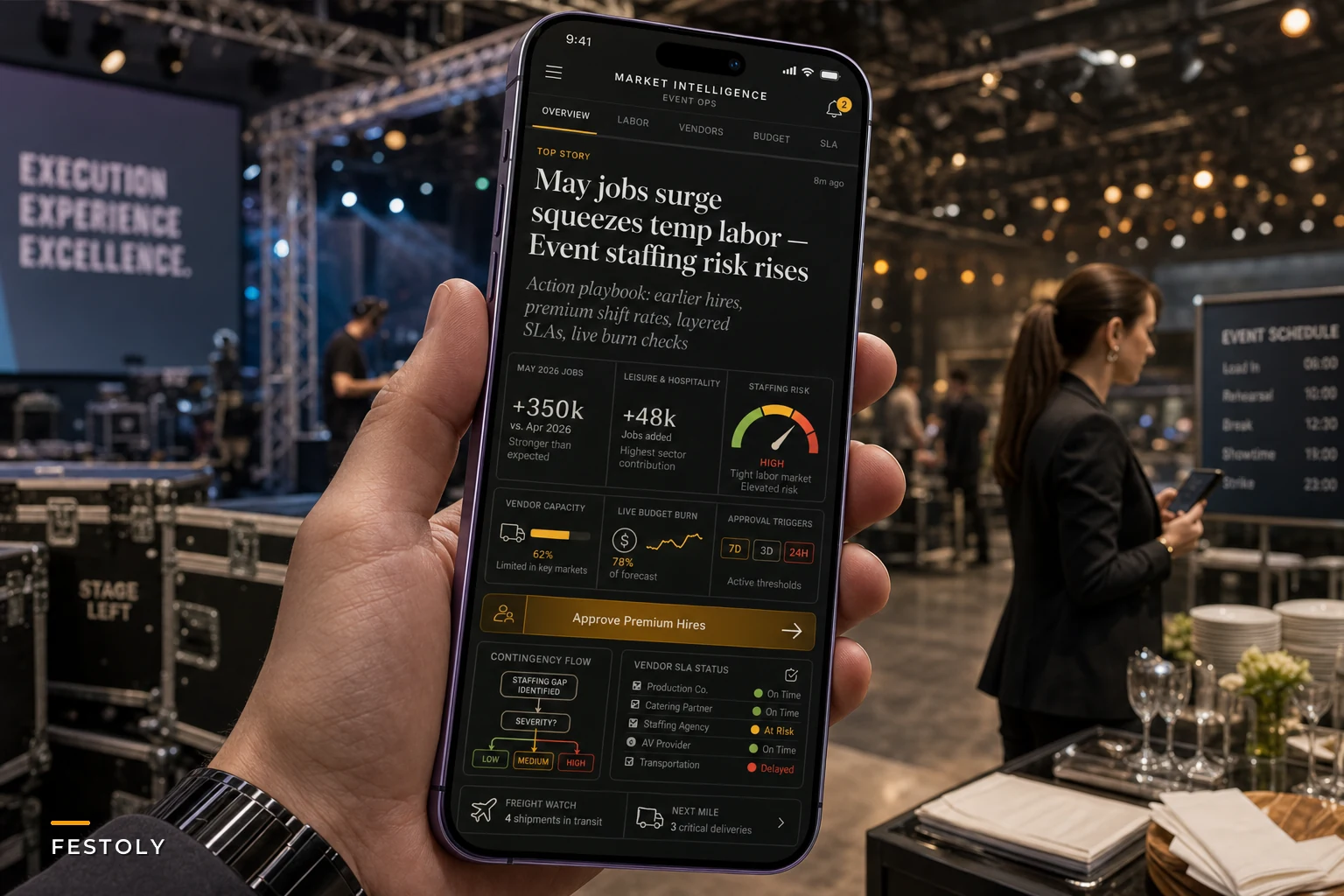

Last week's May jobs report dropped with 172,000 new jobs added and unemployment holding at 4.3%. Great for the economy. Terrible if you're trying to staff events this summer.
The hospitality sector saw major gains—restaurants, bars, hotels all hiring. That's the same talent pool event planners compete for. And we're heading into peak season when demand for temporary workers already spikes.
Summer staffing just got harder, and most planners aren't ready
What this means on the ground: that lighting tech you booked for three weddings? They just took a full-time hotel gig. Your catering crew? Half picked up steady restaurant work. The staffing agency that promised 50 bartenders for your music festival? They're scrambling and raising rates daily.
Tuesday I talked with four different planners. Every single one mentioned labor as their biggest headache. Not weather, not venues—finding qualified staff.
Event staffing costs are destroying budgets
When unemployment sits at 4.3% in a growing economy, temporary workers have options. They're not waiting by the phone for your call anymore.
Eliminate event chaos with Festoly.
Manage every aspect of your event seamlessly — from planning to execution.
- Centralized event scheduling
- Real-time attendee tracking
- Vendor & resource coordination
No credit card required
A production manager in Chicago is paying $42/hour for basic setup crew—positions that ran $28/hour last summer. Sound techs who charged $450 daily are asking $650. And that's if you can find them.
The real damage comes from cascading failures. You secure crew at premium rates, then two people no-show for better offers. Now you're understaffed:
-
Setup takes longer, triggering venue overtime
-
Existing crew works harder, increasing injury risk
-
Quality drops, leading to client complaints
-
You scramble for emergency replacements at even higher rates
One festival organizer showed me staffing costs from three years:
-
2024
$127,000 budgeted, $141,000 actual
-
2025
$155,000 budgeted, $189,000 actual
-
2026 (projected)
$210,000 budgeted, tracking toward $240,000
That's not inflation. That's fundamental labor scarcity hitting peak demand.
Vendor SLAs miss the staffing problem entirely
Standard agreements focus on deliverables and timelines but ignore the staffing component.
Your catering contract says "provide service for 500 guests from 6-10pm." When they show up with 8 servers instead of 12, they're technically "providing service"—just terrible service with hour-long bar lines.
AV vendors specify equipment and setup times. When their crew is 40% rookies because experienced techs are unavailable, your event suffers. Good luck proving breach when the lights work but need constant adjustments.
Rewrite SLAs to include specific staffing requirements:
-
Minimum crew sizes with experience thresholds
-
Named key personnel who can't be swapped without approval
-
Financial penalties for understaffing, not just non-performance
-
Right to source supplementary staff and back-charge vendors
A corporate planner in Atlanta added "staffing guarantee clauses" that trigger automatic discounts for short-handed vendors. In three months, she collected $18,000 in credits—money that went straight to contingency budgets.
Building labor contingency systems that work
Forget "add 10% buffer to staffing costs" advice. That's bringing an umbrella to a hurricane. You need structured contingency planning with clear triggers and pre-approved responses.
Start with labor pool mapping. Document every staffing source:
| Source Type | Lead Time | Premium Rate | Reliability | Best For |
|---|---|---|---|---|
| Primary staffing agency | 2 weeks | Standard | 85% | Core positions |
| Secondary agency | 1 week | +15% | 70% | Fill-ins |
| Freelance network | 3 days | +25% | 60% | Specialists |
| Emergency temp service | Same day | +50-75% | 40% | Desperation |
| Internal staff overtime | Immediate | +50% | 90% | Critical gaps |
Create trigger conditions for each escalation level. Not vague "if we're short-staffed" but specific metrics:
-
Level 1
Missing 10% of confirmed positions 7 days out
-
Level 2
Missing 15% of confirmed positions 3 days out
-
Level 3
Missing any critical position 24 hours out
Each level authorizes different spending without additional approvals. Level 1 allows freelance network at premium rates. Level 3 authorizes flying in crew from another city.
Here's a quick workflow for escalation:
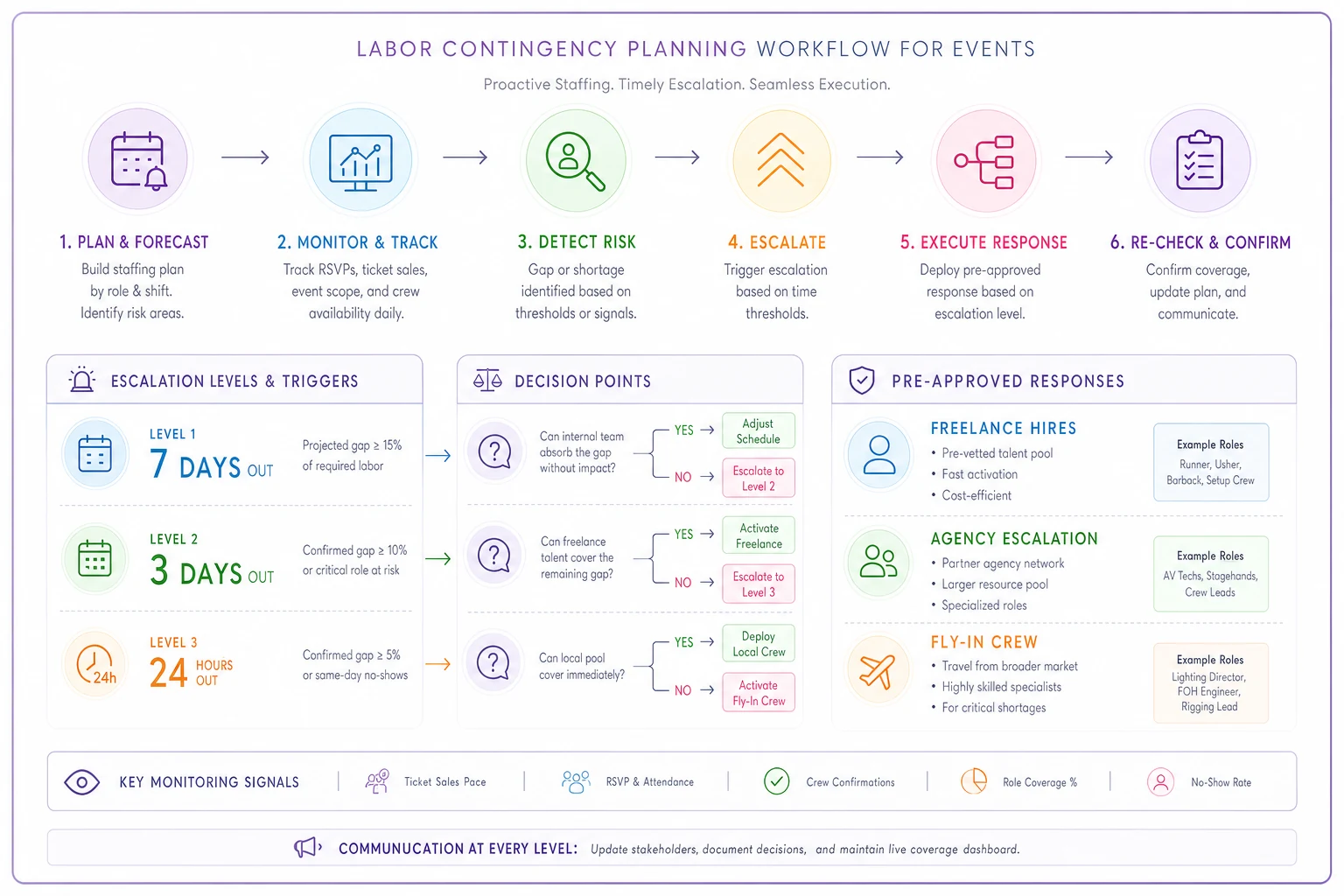
Use this flow to align triggers with authorized spend.
Protecting month-of budgets from labor volatility
Traditional budgets lock costs months ahead. But your actual staffing costs won't be known until the event happens. That gap destroys margins.
Smart planners separate labor budgets into three buckets:
-
Committed costs
Deposits, guaranteed minimums, contracted rates
-
Variable costs
Hourly staff, overtime, contingency hires
-
Surge reserve
Emergency premiums, last-minute replacements
The surge reserve should be 25-30% of variable costs in this market. Huge, yes. But better than explaining to clients why their event was understaffed.
Implement spend velocity tracking. Don't wait for invoices to know you're over budget. Track labor confirmations daily starting two weeks out. If you're burning contingency faster than planned, you'll know while there's time to adjust.
Track labor confirmations daily starting two weeks out.
A tech conference coordinator tracks this in a simple spreadsheet, updated each morning:
-
Positions confirmed vs required
-
Rate variance from budget
-
Contingency funds remaining
-
Projected final cost
By day 10, she could see they'd blow budget. Instead of panicking day-of, she negotiated reduced scope with the client, cutting two breakout sessions to free funds for core staffing.
Your staffing model might be broken
Most event staffing assumes abundant labor supply. They're built on the idea you can always find someone if you pay enough. That's increasingly false.
Consider switching from just-in-time to retained crew approaches. Costs more upfront but often works out when you factor in:
-
No emergency premium rates
-
Lower no-show rates (people protect steady gigs)
-
Better quality from experienced crews who know your standards
-
Reduced time sourcing and vetting new people
A Miami wedding planner retains core crew with monthly minimums. She guarantees $2,000/month whether she books them or not. In exchange, they block her dates first and maintain her rates even in peak season. Staffing costs went up 15% overall but eliminated emergency hiring entirely.
Another approach: crew partnerships with complementary businesses. Partner with planners running different event types or seasons. Share retained crews, spreading costs while maintaining availability.
Using operational software as early warning
Managing this complexity requires more than spreadsheets and phone calls. You need systems tracking labor availability in real-time, flagging issues before they become crises.
Hybrid event staffing models force you to document which roles can flex between in-person and remote support. When you can't find local crew, knowing which positions can be handled remotely becomes critical.
AI-powered operational platforms centralize staffing data—availability, rates, certifications, performance—then automatically flag gaps and suggest alternatives based on your contingency rules. Instead of manually calling vendors when someone cancels, the system already knows who's available and at what rate.
These platforms track patterns across events. They notice your lighting vendor missed staffing targets three times running, or Tuesday events consistently have higher no-shows. That intelligence helps adjust agreements and budgets before problems hit.
Having the uncomfortable scope conversation
Sometimes the math doesn't work. When labor costs spike 40% but client budgets don't, something gives. Planners who survive this market have hard conversations early.
Frame it as risk management, not failure. "With current labor conditions, we can deliver full program at 35% over budget, or adjust scope to maintain budget while preserving core experiences."
Document everything. Show clients:
-
Original staffing plan and budget
-
Current market rates with source documentation
-
Multiple scenarios with different scope adjustments
-
Risk assessment for each option
A nonprofit gala organizer faced this last month. Instead of compromising service quality with skeleton crews, she proposed eliminating cocktail hour and combining with dinner service. Saved $22,000 in labor while maintaining full staffing for the main event.
Your 30-day staffing security plan
For events in the next 60 days, implement immediately:
Week 1: Audit and document
-
List every staffing source used in two years
-
Document current pay rates for every position type
-
Identify single points of failure in your crew
-
Review all vendor SLAs for staffing language
Week 2: Establish contingencies
-
Create three-tier contingency trigger system
-
Pre-negotiate emergency rates with backup suppliers
-
Set up spend tracking for real-time budget monitoring
-
Draft scope reduction scenarios for each upcoming event
Week 3: Strengthen agreements
-
Add staffing guarantee clauses to vendor contracts
-
Negotiate retention deals with critical crew members
-
Document cross-training plans for versatile staff
-
Create written backup plans for every key position
Week 4: Operationalize the system
-
Implement daily staffing confirmation processes
-
Set up automated alerts for staffing gaps
-
Train team on contingency trigger responses
-
Run tabletop exercise for staffing crisis scenario
For events in the next 60 days, implement immediately:
What's coming in this labor market
The latest employment data from Reuters suggests this tight labor market isn't loosening soon. For event planners, these aren't temporary adjustments—they're the new operational reality.
Planners who'll thrive are already restructuring their entire approach. They're building retained crews, strengthening vendor accountability, and using technology to spot problems weeks ahead instead of hours.
The biggest shift is mental. Stop thinking of staffing as procurement—source people, pay rate, done. Start treating it as risk management. In this market, labor availability might be the biggest threat to your event's success.
The question isn't whether staffing costs will impact your operations—they already are. It's whether you'll adapt systems and processes fast enough to maintain quality while protecting margins.
Planners who wait for conditions to "return to normal" are going to get expensive education in the new economics of event production.
Ready to elevate your event management?
Join 5,000+ event organizers using Festoly to save time, improve coordination, and deliver memorable experiences.