

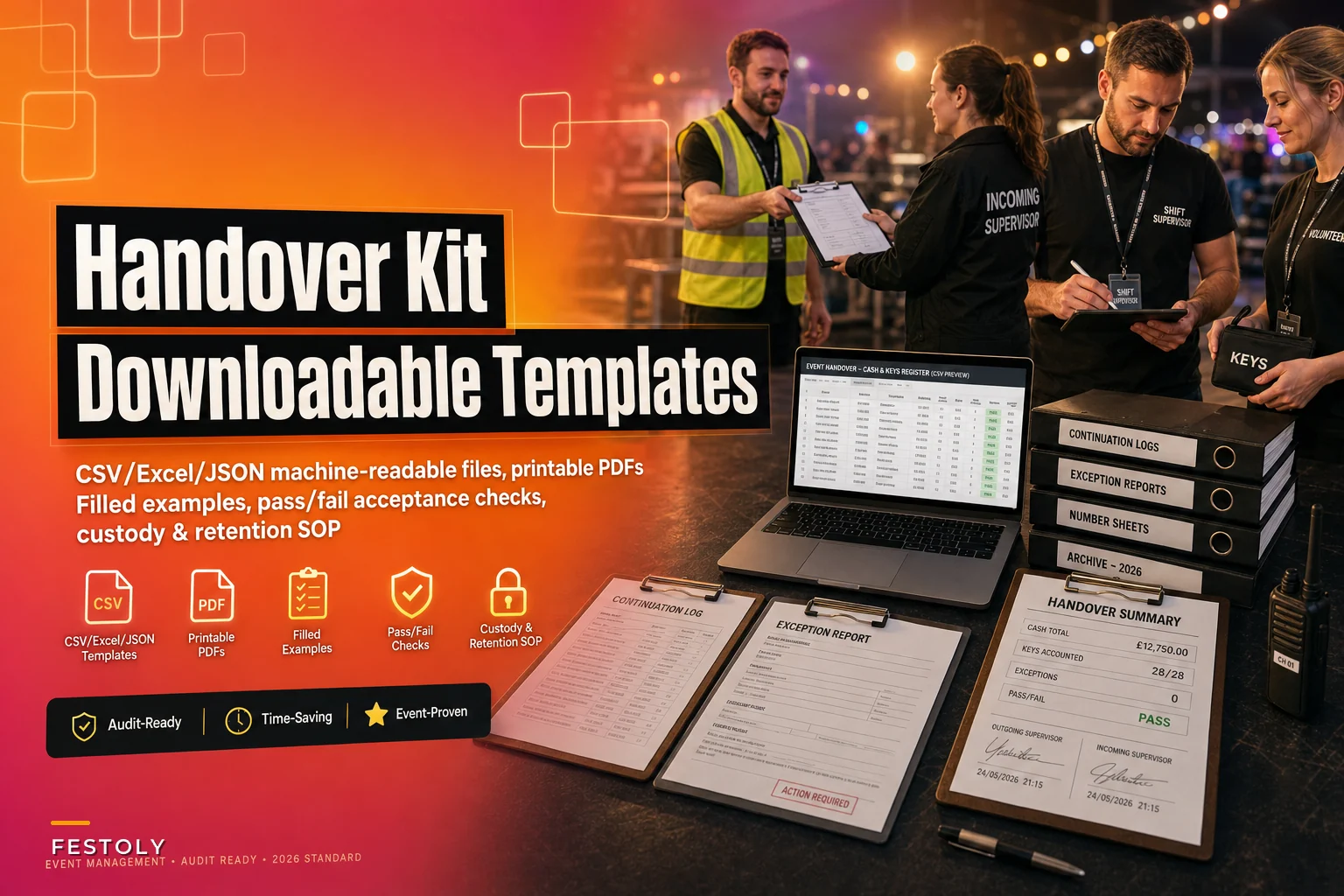

Most handover problems don't show up at handover. They show up around 11am the next morning, when someone on the day crew makes a decision based on information that was either never written down, written down in a format nobody could search, or buried in a WhatsApp thread three hundred messages deep.
That gap — between "the night team knew something" and "the day team can act on it" — is where festival operations quietly bleed money and trust. This kit is about closing it with artefacts that are both printable for the radio room and machine-readable for whoever has to reconcile numbers at the end of the run.
If you want the broader operating rhythm this sits inside — daily handoffs, RACI, repeatable checklists — that's covered in A Modular Operations Playbook for Multi‑Day Events. This piece zooms all the way in on the handover artefacts themselves and the pass/fail checks that make them trustworthy.
Why handovers fail even when people "did a handover"
The common assumption is that a handover fails because someone forgot to pass on a fact. In practice, it's rarely a single forgotten fact. It's structural.
What tends to happen on a three-day festival is that each shift invents its own format under pressure. Friday night's team leaves a half-page of notes in a notebook. Saturday day shift types theirs into a shared doc. Saturday night does voice notes. By Sunday nobody can answer a simple question like "how many radios are unaccounted for across the whole event" — because the data lives in four incompatible shapes.
-
Open items with no owner. A note says "generator 3 sounded rough" but doesn't say who's watching it, so everyone assumes someone else is.
-
Numbers that don't tie out. Cash floats, radio counts, and key logs get recorded at different times by different people, so a discrepancy at Sunday close can't be traced to a specific shift.
-
Verbal-only exceptions. The incoming lead gets told about a problem but nothing is signed, so when it escalates there's no record of what was known and when.
-
No acceptance check. The handover "happened" because two people stood in a room together. Nobody verified the information was actually complete before the outgoing lead left site.
The fix isn't more documentation. It's fewer, stricter documents in formats that both a tired human and a spreadsheet can read.
The four core artefacts
1. Continuation Log
Eliminate event chaos with Festoly.
Manage every aspect of your event seamlessly — from planning to execution.
- Centralized event scheduling
- Real-time attendee tracking
- Vendor & resource coordination
No credit card required
This is the running list of anything that crosses a shift boundary — open tasks, watch items, pending deliveries, half-resolved issues. The rule that makes it work: every row has a status and a named owner, or it doesn't get closed out.
Minimal column set:
| Field | Example value | Why it matters |
|---|---|---|
item_id | CL-SAT-014 | Lets you reference it on radio without ambiguity |
opened_shift | SAT-NIGHT | Traces origin for later reconciliation |
description | Water point 4 low pressure, plumber notified | The actual content |
owner | J. Okafor (Site Ops) | Kills the "someone else has it" problem |
status | OPEN / WATCH / CLOSED | Forces a decision |
dueorreview_by | SUN 09:00 | Gives the incoming lead a trigger |
notes | Contractor ETA 08:30 | Context for the handover |
A filled Continuation Log for a mid-size festival might carry 15–40 live rows going into a shift change. If it's carrying 90+, that's usually a signal that items are being opened but never genuinely resolved — worth a conversation before the next handover.
2. Exception Report
The Continuation Log is for ongoing items. The Exception Report is for things that went wrong and need a record for safety, insurance, or dispute reasons — a near-miss, a crowd surge that triggered a hold, a vendor that breached terms, a medical event.
The distinction matters because exceptions have a different retention and escalation profile. You want these separable and individually signed. Key fields include timestamp, category, severity (1–4), immediate action taken, escalation path used, and whether it's been closed or carried forward.
A practical pattern: anything logged at severity 1 or 2 should automatically appear as a cross-reference row on the next Continuation Log, so the incoming team can't miss it even if they skim the Exception Report.
3. Number Sheet
This is the one people skip and then regret. It's the single reconciliation sheet for countable things at shift change: cash floats, radios, keys, high-value equipment, consumable stock that matters (medical caches, cashless top-up stock, and so on).
The Number Sheet's job is to make discrepancies locatable. If 42 radios went out Friday and 39 come back Sunday, the Number Sheet tells you which shift the count first dropped. Without a per-shift count you just have a missing number and no trail.
Structure it as counts captured at each handover, not just at open and close:
-
Expected count (from issuance)
-
Counted-in at shift start
-
Counted-out at shift end
-
Variance
-
Variance explanation (ties to a Continuation Log or Exception Report ID)
4. Signed Handover Summary
The cover sheet. One page. It references the other three artefacts, lists the top 3–5 things the incoming lead absolutely must know, records the time of handover, and carries two signatures: outgoing and incoming. The signature isn't bureaucracy — it's the moment the incoming lead formally accepts that the information is complete as presented.
The summary is what you reach for first when something goes sideways and you need to know what the previous shift actually knew.
Acceptance criteria: the part most kits skip
Templates alone don't fix handovers. A handover can be fully filled in and still be useless. So the kit includes explicit pass/fail acceptance checks the incoming lead runs before signing. This is the most valuable piece, because it turns "we did a handover" into "the handover met a standard."
Run these as a hard checklist. If any item fails, the handover is not accepted until it's resolved or explicitly waived in writing on the summary.
-
[ ] Every Continuation Log row has a
statusand a namedowner— no blanks. -
[ ] No row has a
review_bytime that's already in the past without a note explaining why. -
[ ] Every severity 1–2 exception appears cross-referenced on the Continuation Log.
-
[ ] Number Sheet variances are either zero or have an explanation ID attached.
-
[ ] Cash float counted and agreed by both leads (two-person count, not one).
-
[ ] Keys and high-value equipment physically sighted, not just ticked.
-
[ ] Handover Summary top-items list is populated (never blank, even if it says "nothing critical").
-
[ ] Both signatures present with timestamp.
If a physical count differs, open an Exception Report on the spot before accepting the handover.
One rule worth pushing hardest: the physical count beats the written count. If the sheet says 12 keys and you can only touch 11, you do not sign — you open an Exception Report there and then. Handover is the one moment where the discrepancy is cheap to find. Twelve hours later it's an investigation.
Chain-of-custody for keys, cash, and equipment
Separate from the Number Sheet (which is about counts) is the chain-of-custody form, which is about who held what, when. These overlap but serve different purposes: the Number Sheet answers "how many," chain-of-custody answers "who's accountable."
A workable chain-of-custody form is a single row per transfer:
-
Asset (specific — "Cash bag, Bar 2, Sat takings" not "cash")
-
From (name + role, signed)
-
To (name + role, signed)
-
Timestamp
-
Condition / seal number (for sealed bags, the seal ID)
-
Witness (for anything above a cash threshold you set — often anything over a few hundred in float)
The non-obvious failure here is sealed cash bags being transferred without recording the seal number. If the seal number isn't logged at each transfer, a tampered or swapped bag is undetectable. Logging the seal ID at every hop is what makes the chain actually mean something.
The RACI and timing matrix — so the handover has a slot, not a scramble
A handover that happens "whenever the night lead is free" is a handover that happens badly. The kit includes a single-page RACI with named alternates, because the most common real failure is the designated person being asleep, off-site, or dealing with an incident at the exact moment the handover is due.
The alternates column is the whole point. For each handover role you list a primary and a named backup, so when the primary is tied up on a medical call the handover still has an owner rather than defaulting to whoever's standing nearby.
The timing matrix pins each handover to a window and a location:
| Handover | Window | Location | Primary | Alternate |
|---|---|---|---|---|
| Night → Day (Site Ops) | 06:45–07:15 | Ops Cabin | A. Lee | R. Mensah |
| Day → Evening (Site Ops) | 15:45–16:15 | Ops Cabin | R. Mensah | A. Lee |
| Bar/Cash reconciliation | 02:30–03:00 | Count Room | S. Virk | D. Park |
| Medical lead handover | 07:00–07:20 | Medical Tent | T. Obi | L. Haddad |
Keeping the window to around 30 minutes forces discipline. A handover that routinely runs over an hour usually means the Continuation Log is being used as a discussion forum instead of a status record.
KPIs and escalation triggers worth tracking
You don't need a dashboard of forty metrics. A handful of handover-specific KPIs tell you whether the system is healthy across a multi-day run:
-
Open-item carryover rate — how many Continuation Log items roll across three or more shifts without closing. A rising number means things are being deferred, not handled.
-
Count variance incidents — number of Number Sheet discrepancies per day. One is noise; a steady climb is a process or a trust problem.
-
Handover-on-time rate — percentage of handovers completed inside their window.
-
Unsigned / waived handovers — any handover that got signed with a failed acceptance check waived. These should be rare and reviewed.
Escalation triggers to agree in advance: any cash variance over a set threshold goes straight to the finance lead and gets an Exception Report regardless of amount. Any unaccounted key for secured areas escalates immediately. Any severity-1 exception still open after two shifts gets pushed to the event director.
When this level of rigour makes sense — and when it's overkill
When it makes sense: multi-day events, anything with overnight shifts, events handling meaningful cash on site, events with secured areas and controlled keys, and any festival where the day team and night team are largely different people. The more personnel rotate, the more the written artefact carries the load.
When it's lighter touch: a single-day event with one continuous crew barely needs a formal handover at all — a Number Sheet at close and a short exception log is plenty. Forcing the full pack onto a small one-day setup just creates paperwork nobody reads.
Who should not just copy this verbatim: events with regulatory or licensing conditions on cash handling or security staffing. Use the kit as a base, but make sure the chain-of-custody and retention rules match whatever your licence and insurer actually require — those override any generic template.
A short real scenario
A regional three-day music festival, roughly 18,000 capacity, had a recurring Sunday problem: bar cash never tied out and nobody could say where it went astray. The variance wasn't huge — usually somewhere in the low hundreds per day — but it was enough that the finance lead spent most of Monday trying to reconstruct the weekend from memory and scattered notes.
The actual cause turned out to be boring. Floats were counted once at the start of the event and once at the end, but never at shift changes, and sealed bags were handed over without logging seal numbers. So a discrepancy could have originated in any of six shifts.
The change was small: a per-shift Number Sheet and a chain-of-custody row with seal IDs at every transfer, both run as part of a signed handover. The variance didn't vanish — real cash handling always has some noise — but it became traceable. Instead of a weekend-wide mystery, a discrepancy now pointed at a specific shift and a specific bag, and most of them resolved to simple miscounts caught the same night. Monday reconciliation went from most of a day to under an hour.
The lesson wasn't "count more." It was "count at the boundaries, and sign for it."
A simple digital-artefact lifecycle and retention SOP
Machine-readable artefacts are only useful if you can find them later and you're not holding personal data longer than you should. A lightweight lifecycle:
-
Create — artefact generated from template at shift start (JSON/CSV preferred for anything you'll reconcile later).
-
Sign — exported to PDF at handover with signatures; the signed PDF is the canonical record, the machine-readable version is the working copy.
-
Aggregate — Number Sheets and Exception Reports consolidated nightly into a single run-level file.
-
Retain — keep signed Handover Summaries, Exception Reports, and chain-of-custody records for the period your insurer and any licensing conditions require (often longer than you'd expect; check before you pick a number).
-
Minimise — anything containing personal data (staff names, attendee incident details) gets reviewed and either anonymised or deleted once its operational and legal purpose has passed.
-
Archive — final consolidated files stored somewhere searchable, named consistently (
EventNameYearArtefactType_Date), so next year's team can actually learn from them.
The naming convention sounds trivial. It's the difference between next year's planning team pulling up last year's exceptions in thirty seconds versus not bothering because they can't find anything.
Bringing it together
A good festival handover isn't a conversation — it's a set of artefacts that pass a check and get signed. The four documents give you structure, the acceptance criteria give you a standard, the chain-of-custody gives you accountability, and the retention SOP keeps the whole thing findable and compliant after the site's packed down.
Keep the pack tight. Four core artefacts, one acceptance checklist, one chain-of-custody form, a one-page RACI with alternates, and a timing matrix. That's enough to stop the night team's knowledge from evaporating by mid-morning — which is really the only thing a handover has to do.
This simple workflow captures the handover lifecycle from shift start to archive:
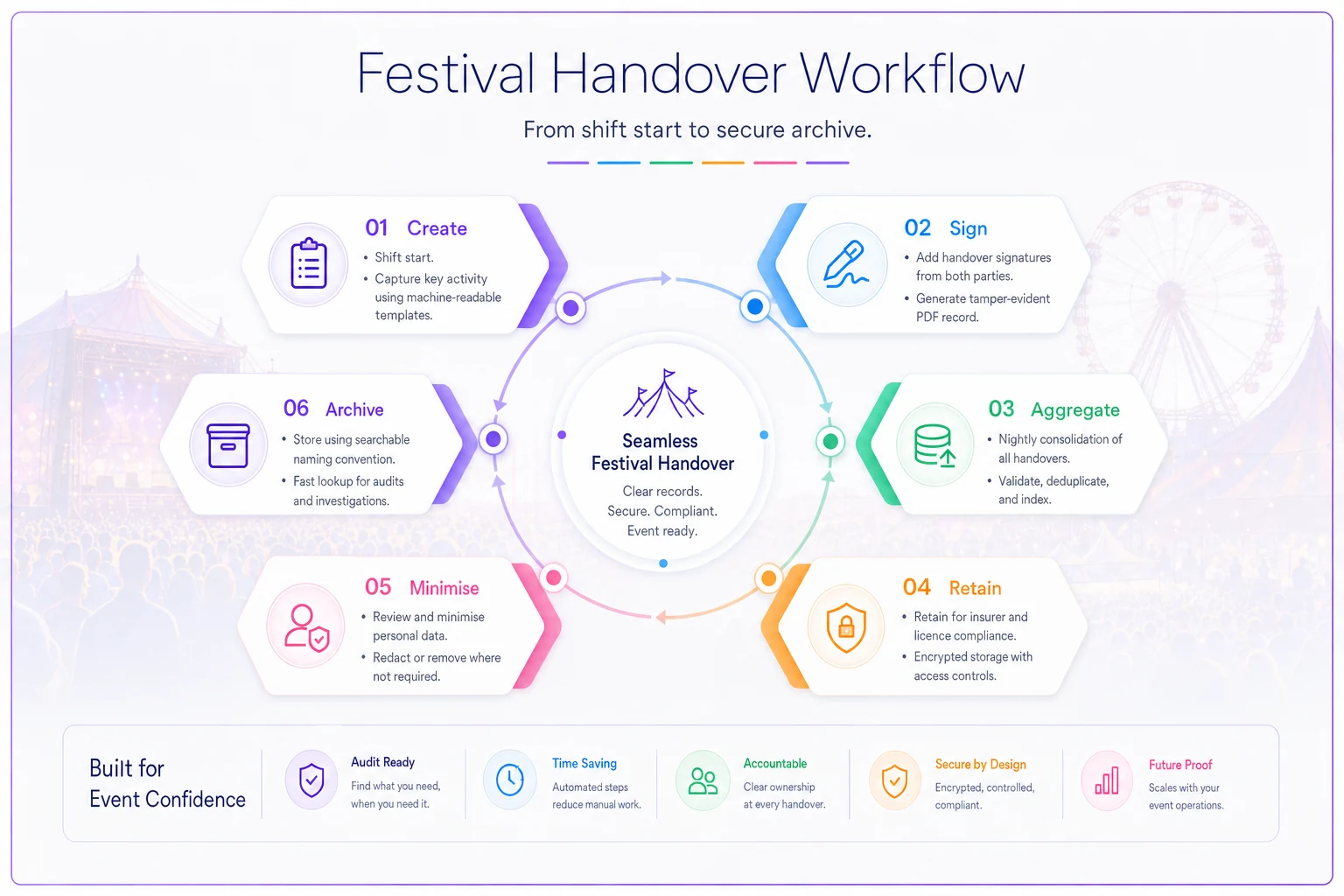
A quick visual to pin this down — it's the process you want your leads to follow, every shift.
Keep the pack tight. Four core artefacts, one acceptance checklist, one chain-of-custody form, a one-page RACI with alternates, and a timing matrix. That's enough to stop the night team's knowledge from evaporating by mid-morning — which is really the only thing a handover has to do.
Ready to elevate your event management?
Join 5,000+ event organizers using Festoly to save time, improve coordination, and deliver memorable experiences.