

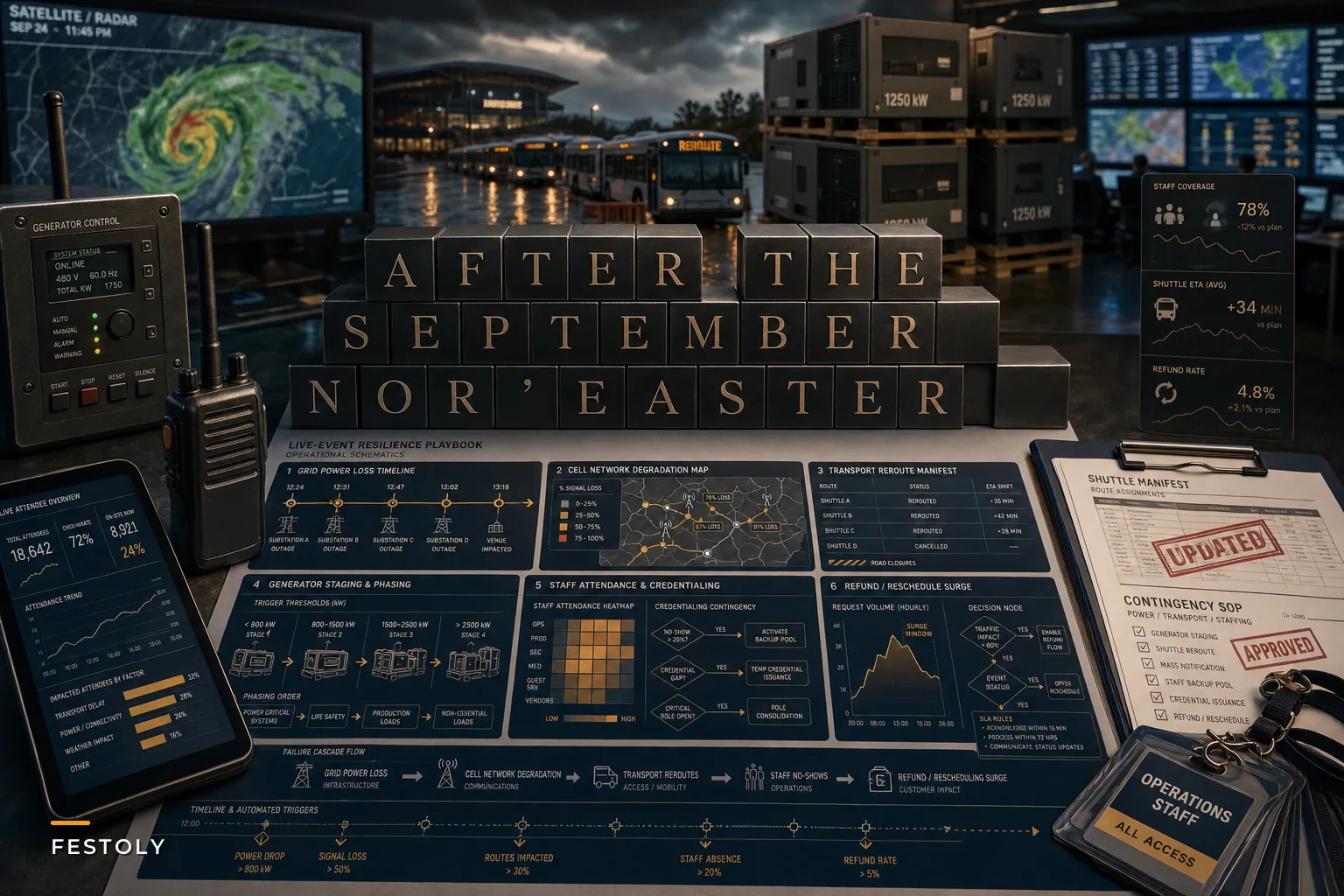

The late‑September nor'easter that hammered the coast from the 24th through the 27th did more than cancel a few outdoor gatherings. It knocked out power for well over 100,000 customers across the Northeast, flooded venues, grounded flights, and forced emergency declarations in multiple states, according to Reuters reporting on the outages and travel disruption. For anyone running an event that weekend — or anyone with an event on the books for the rest of autumn — it was a stress test nobody asked for.
The storm didn't create new problems, though. It revealed the ones already baked into most event plans that just hadn't been triggered yet. A plan that looks complete on paper tends to fall apart the moment three things fail at once: the grid goes down, the shuttle route floods, and half your day‑of staff can't get in. That specific combination is where most operations teams discover their "contingency plan" was really just a single‑point backup dressed up as resilience.
So skip the storm recap. Here's what actually breaks, in what order, and what you can do about it before the next system comes up the coast.
The failure cascade nobody maps until it's happening
Most event teams plan for failures in isolation. Power failure? Call the generator vendor. Shuttle delay? Reroute. Staff no‑show? Pull from the backup list. Each of those is fine on its own. The trouble is that storms don't deliver problems one at a time — they deliver them in a cascade, and the cascade has a sequence that compounds.
-
Grid power drops at or near the venue, often with no clean warning.
-
Cell networks degrade as backhaul gets strained and backup towers kick in, so your comms slow down exactly when you need them fastest.
-
Transport reroutes trigger because of flooding or closures, which pushes arrival windows out and bunches attendees into unpredictable surges.
-
Staff and vendor no‑shows climb because the same roads and transit lines your attendees use are the ones your people use too.
-
Refund and rescheduling requests flood in while your team is already underwater on the first four problems.
The mistake isn't usually a lack of plans. It's that each plan assumes the others are still functioning. The power plan assumes comms work. The comms plan assumes staff are on‑site. The staffing plan assumes transport is moving. When everything degrades together, those assumptions quietly collapse and teams end up improvising under pressure.
A more useful framing: don't plan for individual failures. Plan for the state your operation is in when several failures overlap. "Degraded comms + reduced staff + grid down" is a state, and it deserves its own playbook — not three separate ones you're supposed to run simultaneously.
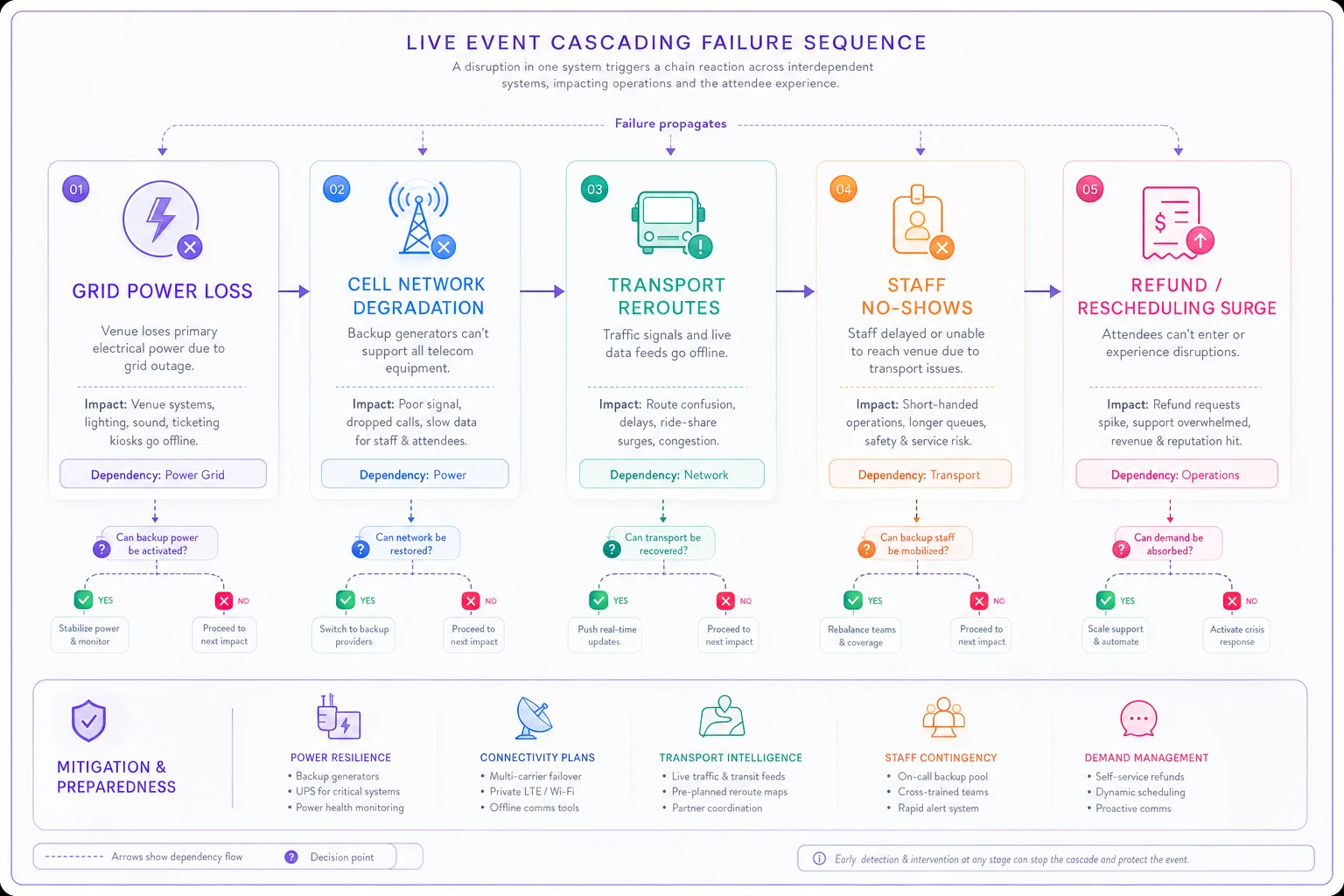
A quick visual of the cascade helps teams recognize the sequence and decision points.
Temporary power: where "we have a generator" isn't the answer
Power is the one everyone thinks they've solved, and it's the one that bites hardest. "We rented a generator" is not a power plan. It's a line item. The real questions are about load, phase balance, runtime, and what happens when the backup itself has a bad start.
Eliminate event chaos with Festoly.
Manage every aspect of your event seamlessly — from planning to execution.
- Centralized event scheduling
- Real-time attendee tracking
- Vendor & resource coordination
No credit card required
A pattern worth internalizing: the generator rated for your load on paper is frequently undersized for your actual load once you add the things nobody counted — extra heaters because it got cold, water pumps for the flooding, phone‑charging stations that attendees swarm when the grid dies. Temporary power demand during a storm is almost always higher than your fair‑weather estimate, because the storm itself creates new loads.
-
Runtime math, not just capacity math. A unit that covers your load but only carries four hours of fuel is a problem if the outage runs eight. Someone needs to own refueling logistics before the tank hits a quarter.
-
A defined failover drill. If the primary unit faults, how long until the secondary carries critical circuits? If the honest answer is "we'd figure it out," you don't have failover — you have a second generator sitting there.
-
Prioritized circuits. Not everything deserves backup power. Medical, comms, egress lighting, and refrigeration come first. Decorative lighting and non‑essential AV come last. Decide this in advance, because under pressure everyone argues their thing is essential.
If you want to go deep on load sizing, phase balancing, and running actual failover drills before you need them, the breakdown on temporary power for events covers the math and drill structure in detail. Short version for storm season: size for your worst‑case overlapping load, not your brochure load, and rehearse the handoff between primary and backup so it's muscle memory, not a scramble.
Transport reroutes: the arrival surge problem
When roads flood and transit gets suspended, the obvious issue is that people arrive late. The less obvious — and more damaging — issue is that they arrive unevenly. A reroute doesn't spread delay smoothly across the day. It clumps. You get a dead quiet hour followed by a wall of people hitting your gates at once because three delayed shuttles finally cleared the closure together.
That surge is where check‑in collapses, queues blow past capacity, and your early‑arrival staff get overwhelmed while reserve staff are still stuck on a detour somewhere.
The operational move is to decouple your arrival assumptions from your schedule assumptions. A few practical tactics:
-
Build at least two reroute options per critical shuttle corridor, pre‑validated against the roads most likely to flood. Don't discover your detour also floods.
-
Stage a buffer zone — covered if possible — where a surge of arrivals can hold without jamming the check‑in point. A surge you can absorb for ten minutes is manageable; a surge that backs up into the street is a safety problem.
-
Give your transport lead authority to hold or release shuttles based on gate capacity, not just the clock. The instinct is to run on schedule. During a reroute, running to capacity beats running to schedule.
| Scenario | Common instinct | Better operational move |
|---|---|---|
| Shuttle corridor floods | Wait for the route to clear | Switch to pre‑validated alternate route immediately, communicate new ETA |
| Three shuttles delayed together | Release all on arrival | Stagger release based on gate throughput to avoid check‑in surge |
| Attendees driving in, lots flooding | Reactively redirect at the gate | Push parking changes via comms before they leave home |
| Transit suspended mid‑event | Assume attendees will manage | Pre‑arrange rideshare staging or extended shuttle runtime |
The teams that handled the nor'easter best weren't the ones with the fanciest transport setup. They were the ones who'd already decided who makes the reroute call and what triggers it — so nobody wasted twenty minutes in a group chat debating whether to switch routes while attendees sat in rising water.
Vendor and staff contingencies: the no‑show math
During severe weather, your effective staff availability can drop meaningfully even when nobody formally cancels. People get stuck, delayed, or pulled toward their own flooded basements. A crew planned at full strength might show up at somewhere around 70–80% on the worst morning, and the gaps won't be random — you'll lose the people with the longest or most flood‑prone commutes, often meaning the ones coming from a single affected area all at once.
The common mistake is treating your backup list as a solution. A backup list only works if the backups can actually reach you, and during a regional storm they're facing the same roads. A reserve list drawn entirely from the same geography as your primary staff isn't redundancy — it's the same single point of failure with extra names.
-
Geographic diversity in your reserve pool. If your primary staff come from the north and the storm hits the northern approaches hardest, having reserves who live south of the venue is worth more than a longer list.
-
Role cross‑training for critical functions. When your check‑in lead can't get in, someone already trained to run that station is worth more than three untrained warm bodies.
-
Vendor SLAs with weather‑specific language. Many vendor contracts quietly exclude "force majeure" in ways that leave you holding the bag. Know, before the storm, which vendors are contractually obligated to show and which will simply vanish with no penalty.
On the vendor side, the pattern during the nor'easter was predictable: rental, catering, and specialty equipment vendors prioritized clients with the clearest contracts and the strongest relationships. If your agreement was vague about weather obligations, you were at the back of the line. Clarity in the contract beats urgency in the phone call.
Real‑time attendee communications: the channel that survives
When the grid drops and cell networks strain — something the CNN live coverage of the storm made clear was happening across affected areas — your communication plan gets tested in the one condition it was never casually built for. Email is slow. Push notifications stack up. The app nobody downloaded doesn't help.
The core principle: you need a message path that works when your primary one doesn't, and attendees need to already know where to look. A backup channel nobody knows about is useless. The time to tell people "if anything changes, check X" is in the confirmation email a week out, not in the chaos.
-
SMS as the resilient backbone. Text tends to get through when data‑heavy channels choke. Keep a pre‑segmented list ready so you can message "attendees arriving by shuttle" separately from "everyone."
-
Pre‑written message templates for each state. Delay, reroute, venue change, cancellation, all‑clear. Writing clear messages under stress produces mistakes; writing them in advance and filling in the blanks does not.
-
A single source of truth URL that you can update fast — a status page attendees are told to check. One place, updated once, beats five channels updated inconsistently.
-
Internal comms redundancy. If your staff radios depend on something that just lost power, your team goes dark at the exact moment attendees need answers.
The deeper problem storms expose is information fragmentation. During the nor'easter, the teams that struggled most weren't short on channels — they had email, SMS, social, an app, signage. They were short on coordination. Different team members pushed different information through different channels, and attendees got contradictory messages about whether the shuttle was running. The failure wasn't a lack of tools. It was that no single place held the current truth, so every channel told a slightly different story.
Put the single status URL in the confirmation email a week out so attendees already know where to check.
This is where centralizing your operational information actually earns its keep. When arrival data, staff status, transport conditions, and the current attendee message all live in one coordinated view — instead of scattered across texts, spreadsheets, and someone's memory — the person making the reroute call and the person writing the SMS are working from the same reality. Modern event operations platforms with real‑time dashboards and automated alert routing help here, not because they're clever, but because they kill the lag between "something changed" and "everyone who needs to know, knows." During a fast‑moving storm, that lag is where the damage happens.
A pre‑storm readiness checklist
Run this before the next system is in the forecast, not during:
-
[ ] Power plan sized for overlapping worst‑case load, with refueling owned and a rehearsed primary‑to‑backup failover
-
[ ] Critical circuits prioritized and agreed on in advance
-
[ ] Two pre‑validated reroutes per critical transport corridor
-
[ ] A surge‑absorbing buffer zone identified near check‑in
-
[ ] Reserve staff pool with genuine geographic diversity
-
[ ] Cross‑trained coverage for every critical role
-
[ ] Vendor contracts reviewed for weather/force‑majeure language
-
[ ] SMS list segmented and tested
-
[ ] Pre‑written message templates for every operational state
-
[ ] A single status URL attendees already know to check
-
[ ] Internal comms with a power‑independent backup
-
[ ] One named decision‑owner for each failure type
Run this before the next system is in the forecast, not during:
A real scenario: a mid‑size regional expo caught in the middle
A roughly 6,000‑attendee two‑day regional trade expo scheduled for that weekend had its first day land squarely in the storm. Their original plan was standard: one generator on standby, a single shuttle route from the nearest transit hub, and email as the primary attendee channel.
What happened on day one: the venue lost grid power mid‑morning, the shuttle corridor flooded, and about a quarter of their day‑of staff couldn't get in on time. The generator held — but only because someone made a last‑minute refuel run that wasn't in the original plan. The real damage was on comms and transport. With email as the main channel and networks straining, attendees didn't get the shuttle reroute in time, and several hundred people showed up at a hub with no running shuttle.
For day two, they rebuilt on the fly. Switched to SMS as the primary channel with a one‑line status page. Pre‑validated a second shuttle route the night before. Pulled two reserve staff from south of the venue who hadn't been affected. Day two wasn't smooth — storms don't allow smooth — but no‑shows dropped noticeably, the gate surge was absorbed in the buffer area instead of the street, and refund requests fell to a fraction of day one's volume, mostly because people actually knew what was happening.
The difference between the two days wasn't resources. It was coordination and a few decisions made in advance instead of under pressure.
Storms will keep coming up the coast, and the autumn calendar doesn't pause for them. The lesson from this nor'easter isn't "buy a bigger generator" or "add another channel." Event storm resilience depends far more on how your temporary power, transport reroutes, vendor contingencies, and attendee communications work together under simultaneous strain than on any single one of them performing well in isolation.
The teams that came through this weekend in decent shape had done the unglamorous work: they'd decided who makes which call, rehearsed the failover, segmented their comms, and built real redundancy instead of longer lists of things that all fail the same way. None of that is expensive. Most of it is just decided in advance.
Pick one weak link from the checklist above and fix it before the forecast turns. Then the next one. Resilience isn't a plan you buy — it's a sequence of small decisions you make while the sky is still clear.
Ready to elevate your event management?
Join 5,000+ event organizers using Festoly to save time, improve coordination, and deliver memorable experiences.