

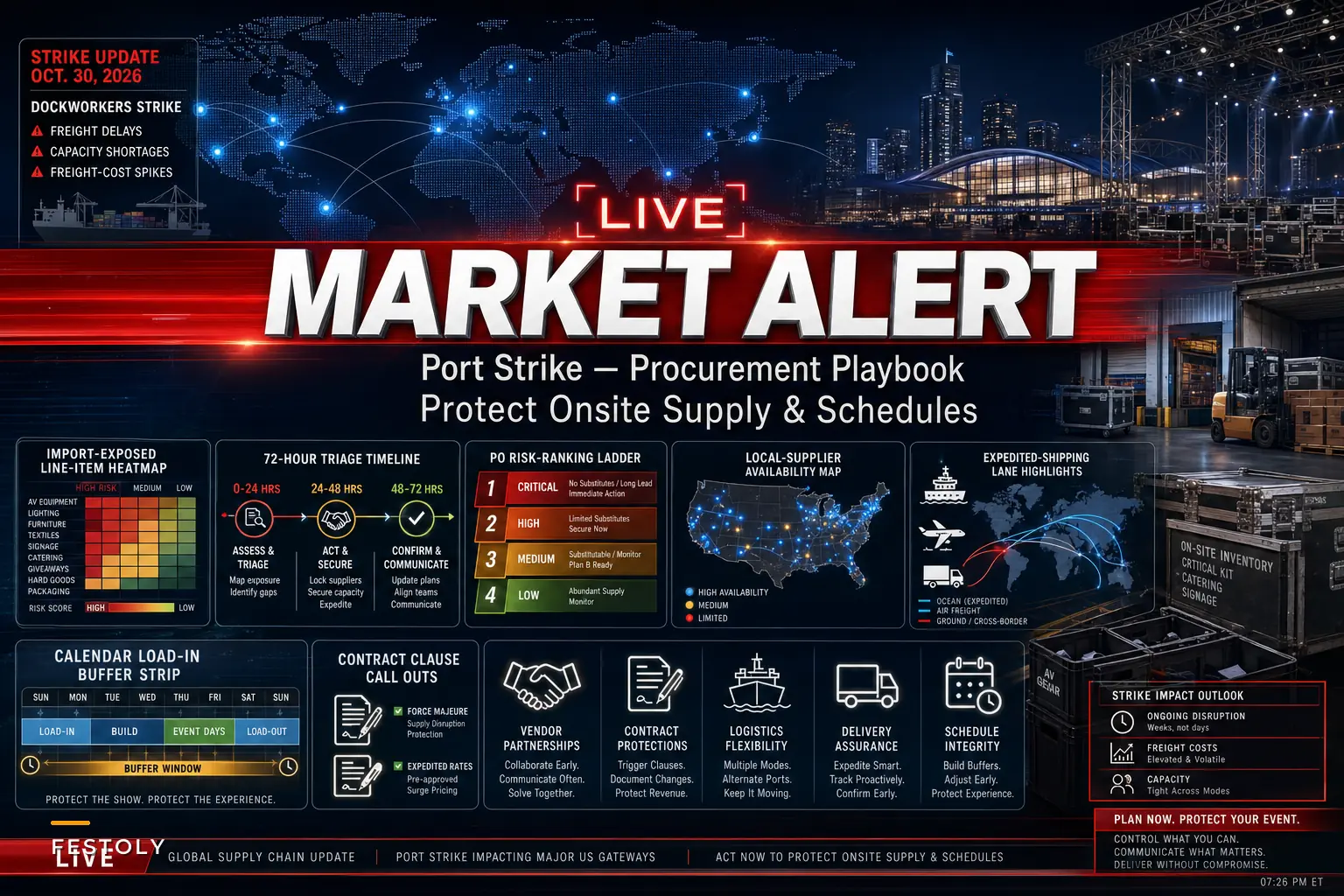

On October 30, dockworkers at more than 100 ports across 22 countries walked off the job in a coordinated action, pausing operations and threatening container flows headed to the Americas. Reuters covered the scope of the coordinated strikes across Europe and beyond, and the Associated Press reported on the range of ports affected across France, Greece, and Italy. The politics behind it aren't really the point here. The point is that a wall of containers stopped moving at the worst possible time of year, and a lot of that cargo is stuff event planners quietly depend on.
If you're running an in-person or multi-day event in the next 10–14 weeks, this isn't really a shipping story for you. It's a lead-time story, a vendor-reliability story, and eventually a contract story. Port disruptions don't hit you directly — they hit your vendors, and your vendors hit you. Usually about 72 hours before load-in, when you have no leverage left.
So this post covers where the disruption actually lands operationally, and then the part most planners skip until it's too late: the contract language that decides who eats the cost.
The supply chains event planners forget they're exposed to
Most planners think of "supply chain" as merchandise. T-shirts, tote bags, printed programs. Those matter, but they're the obvious exposure. The dangerous stuff is buried inside your vendor relationships, where you never see the inventory and have no visibility into where it's coming from.
-
AV and staging gear. A huge share of LED panels, rigging hardware, and specialty connectors are imported. Your AV vendor doesn't own three of everything. When a panel order is stuck on the water, they reshuffle their own calendar — and if you're not their biggest client that month, you get the older inventory or a "we had to sub in a different model."
-
Rental furniture and specialty décor. Linens, custom-fabricated backdrops, modular bars. A lot of this is sourced overseas and held in thin quantities.
-
Catering inputs. Not the proteins usually, but the packaging, disposables, specialty imported ingredients, and the single-use serviceware your caterer quietly assumes will arrive on time.
-
Branded structures and signage substrates. The aluminum extrusion, the fabric prints, the hardware kits.
Worth internalizing: the deeper an item is in your vendor's supply chain, the later you find out it's a problem. You'll hear about a delayed merch shipment weeks out because you placed that order directly. You'll hear about the substituted LED wall during load-in, because your vendor absorbed the problem silently right up until they couldn't.
Why this strike timing is genuinely bad for events
Container disruptions during a slow season are annoying. During the run-up to peak demand, they compound. Three things stack at once.
Eliminate event chaos with Festoly.
Manage every aspect of your event seamlessly — from planning to execution.
- Centralized event scheduling
- Real-time attendee tracking
- Vendor & resource coordination
No credit card required
First, spot freight rates spike when capacity tightens, so even cargo that eventually moves costs more to expedite. Vendors either absorb that or pass it along, and plenty of mid-size vendors will quietly pass it along as a "fuel surcharge" or "market adjustment" line item.
Second, lead times stretch unpredictably. It's not "add five days." It's a backlog that clears in waves once ports reopen, so some shipments clear fast and others sit for weeks with no clear logic. That unpredictability is worse than a flat delay because you can't plan around it cleanly.
Third, everyone reacts at the same time. When supply tightens, every planner and every vendor floods the same local substitutes. The regional rental house that had spare staging last week is booked solid by the time you call. Local sourcing is the right instinct, but the window to secure it closes fast because you're competing with everyone who had the same idea.
The underlying problem: your contracts assume supply is somebody else's problem
This is what the strike actually exposes. Most event vendor contracts are written as if the vendor's ability to perform is a given, and the only real negotiation is price and payment timing. Supply risk gets tucked into a vague "force majeure" clause nobody reads until it's being used against them.
In real operations, this is where planners get stuck. A vendor calls four days out, says a key shipment is delayed "due to circumstances beyond our control," and points to a force majeure clause that excuses them from both performance and refund obligations. Now you're scrambling for a replacement at spot pricing, and the original vendor keeps your deposit. The contract didn't protect you — it protected them.
-
Does a supply delay excuse the vendor from performing, or just from performing on the original spec — meaning are they obligated to source an equivalent substitute at their cost?
-
If they can't perform, do you get a full and fast refund, or do they get to hold funds while "attempting to resolve"?
-
Who pays the expedite premium if the fix requires rushed freight?
If your contracts don't answer those, you're exposed. There's a deeper breakdown of specific clause-level traps and negotiation moves in this post on vendor contract language — worth running every active vendor agreement against it this week.
A quick comparison: how different clause structures play out when supply breaks
Most planners assume their contracts are "standard" and leave it there. In practice, the difference between a contract that protects you and one that protects your vendor comes down to a few specific lines. Here's how those play out across common disruption scenarios.
| Scenario | Weak clause ("beyond our control") | Mid-tier clause | Strong event-specific clause |
|---|---|---|---|
| Key gear delayed by port backlog | Vendor excused, keeps deposit | Vendor must notify within X days | Vendor must source equivalent substitute at their cost |
| Substitute costs more | You pay the premium | Split or unclear | Premium capped or vendor-absorbed up to a defined limit |
| Vendor can't perform at all | Partial or no refund | Refund "when resolved" | Full refund within defined window + right to replacement vendor |
| Notification timing | Whenever | Vague "reasonable" notice | Hard deadline with escalation contact |
The difference between column one and column four isn't legal sophistication. It's whether someone sat down before signing and decided who carries supply risk. Most planners never have that conversation because they're negotiating price under a deadline.
What to actually do right now (procurement triage)
If you have events in the next quarter, run this sequence.
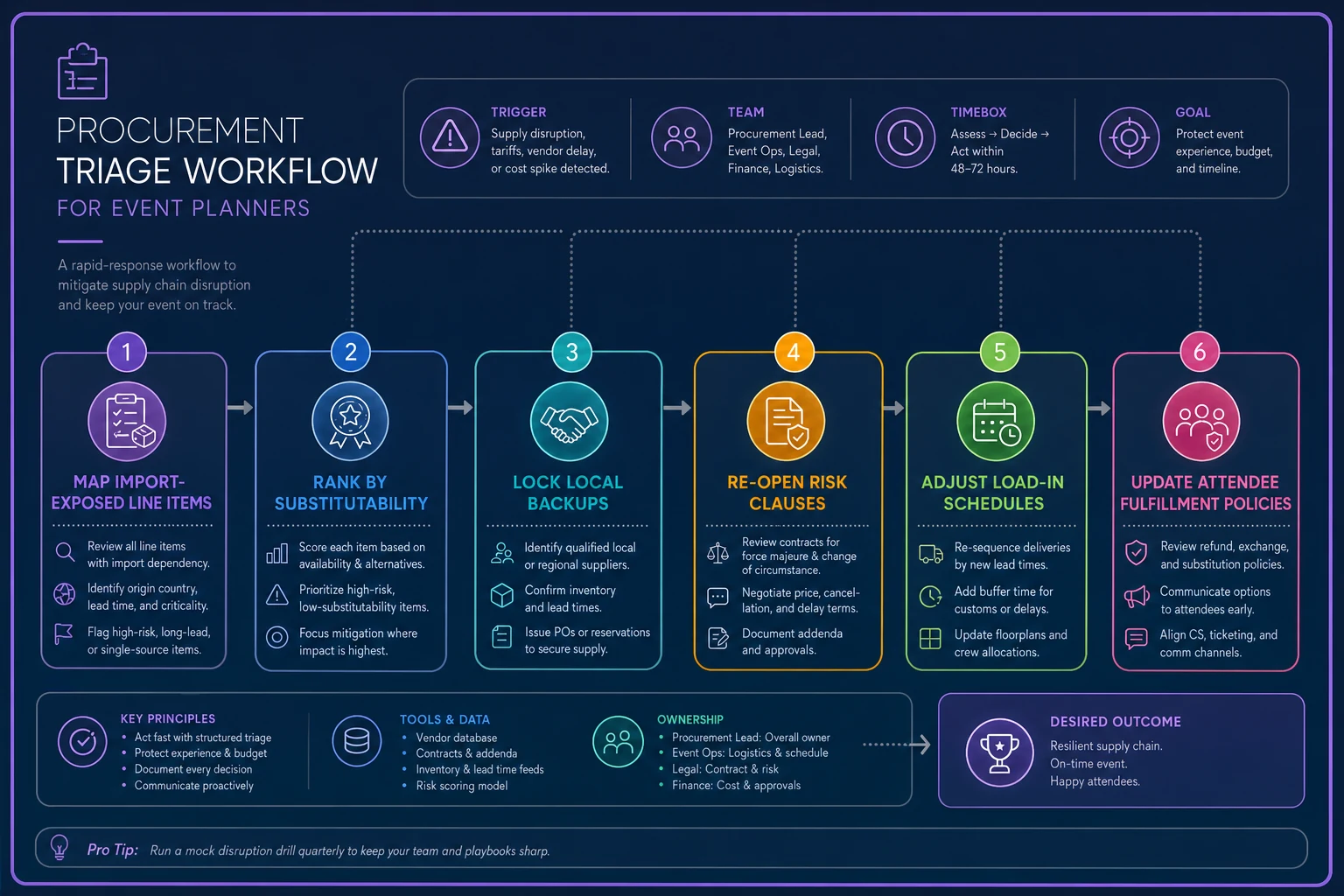
Below is a simple workflow to follow during procurement triage.
-
Map your import-exposed line items. Go vendor by vendor and ask directly: "Is any gear or product fulfilling my order sourced internationally, and what's your current lead-time estimate?" Push past "we're fine" — ask for the specific items.
-
Rank by substitutability. Some things have a dozen local alternatives (basic tables, generic signage). Some don't (a specific LED spec, custom-fabricated structures). Focus energy on the low-substitutability items.
-
Lock local backups now, not later. For your top three hardest-to-replace items, secure a contingency vendor this week, even if it means a small holding fee. The holding fee is cheaper than spot pricing in panic mode.
-
Re-open the risk clauses on signed-but-not-yet-delivered contracts. You have more leverage before the event than you think, especially if there's a future relationship at stake.
-
Adjust your load-in schedule to create slack. Build an extra buffer day for import-dependent deliverables so a late shipment doesn't collapse your whole install timeline.
-
Update attendee-facing fulfillment and refund policy language for anything merch- or product-dependent, so you're not improvising if a shipment misses the date.
It's ordered deliberately — identify exposure before you start renegotiating, because you can't prioritize contract conversations until you know what's actually at risk.
A checklist for the vendor calls you're about to make
Keep this in front of you when you get a vendor on the phone this week:
-
Are any of my ordered items import-dependent? Which ones specifically?
-
What's your realistic worst-case lead time if port backlogs persist?
-
If a shipment is delayed, are you contractually obligated to source an equivalent, or just to notify me?
-
What's the latest date you can tell me there's a problem and still let me activate a backup?
-
Who is my single escalation contact if this goes sideways during load-in week?
-
If costs rise due to expedited freight, who absorbs that under our current agreement?
-
What's your refund timeline if you genuinely can't perform?
The goal isn't to interrogate good vendors. It's to surface the silent assumptions before they surface themselves at the worst possible moment.
A real scenario: the regional trade show that got ahead of it
Consider a mid-size regional trade show — roughly 180 exhibitor booths, three-day run. Their AV and staging came from a single vendor whose LED inventory included a fair amount of imported panels. When the port disruption hit, the planner didn't wait for reassurance.
They called the AV vendor, got an honest answer that about a third of the planned LED package was tied up in delayed inventory, and immediately did two things: secured a local rental house as a backup for the main stage wall at a holding fee of a few hundred dollars, and re-opened the contract to add a clause obligating the primary vendor to source an equivalent spec at their cost if the original didn't clear customs in time.
The original shipment ended up arriving — late, about four days before load-in instead of the planned two weeks. Because they'd built a buffer day into the install schedule and had a backup on standby, the late arrival was essentially a non-event. The planner later estimated the whole exercise cost somewhere in the $400–$600 range in holding fees and a few hours of calls. The alternative — scrambling for a stage wall at spot pricing during a capacity crunch — would have run into the low five figures, assuming they could find one at all.
The lesson wasn't that they predicted the shipment timing. They didn't. It's that they stopped treating their vendor's supply chain as invisible and built a cheap hedge against it.
When aggressive contingency sourcing is *not* worth it
Not every item deserves this treatment, and over-hedging burns money and goodwill. Skip the heavy contingency work when:
-
The item is highly substitutable and locally abundant (standard furniture, generic signage, common disposables).
-
Your vendor carries deep domestic inventory and has a track record of absorbing disruptions quietly without passing problems downstream.
-
The deliverable is low-stakes enough that a last-minute substitution wouldn't meaningfully hurt the attendee experience.
Spending a day building a backup plan for folding chairs when a dozen local rental houses stock thousands of them is wasted effort. Reserve the energy for the handful of items that are both import-dependent and genuinely hard to replace. That's usually a surprisingly short list — often three to five line items across an entire event — which is exactly why ranking by substitutability early matters so much.
Keeping the information in one place
The operational failure mode during a supply disruption isn't usually a bad decision — it's scattered information. The lead-time estimate lives in one person's inbox, the backup vendor's quote is in someone's texts, and the revised load-in schedule exists in a planner's head. When a shipment slips and three people need to coordinate in an afternoon, that fragmentation is what turns a manageable delay into a fire drill.
Keep a single shared live document with vendor ETAs, escalation contacts, and backup vendor details so everyone is looking at the same status during crunch time.
Keeping vendor commitments, contract terms, delivery windows, and contingency triggers in a shared operational system pays for itself during these moments — not because of anything fancy, but because everyone touching the event can see the same current status and the same escalation contact. A solid operational platform mostly earns its keep by making sure the person on the load-in dock and the person on the vendor call aren't working from different versions of reality.
During a supply shock, that shared view is the difference between a quiet substitution and a full scramble. It's not glamorous infrastructure, but it's the kind of thing that looks obvious in hindsight when you're standing in a half-built venue trying to track down who last confirmed the freight ETA.
The strike will resolve. Ports will reopen, backlogs will clear in waves, and freight rates will settle. But the exposure it revealed doesn't go away when the headlines do. Most event supply risk is invisible until a vendor's problem becomes your problem, and the only real defense is doing the unglamorous work up front: mapping your import-dependent line items, hedging the hard-to-replace ones, and writing contracts that decide in advance who carries the cost when supply breaks.
Do that now, while you have leverage and the calls are easy. It's a lot cheaper than finding out during load-in week that "beyond our control" was in your contract the whole time.
Ready to elevate your event management?
Join 5,000+ event organizers using Festoly to save time, improve coordination, and deliver memorable experiences.