

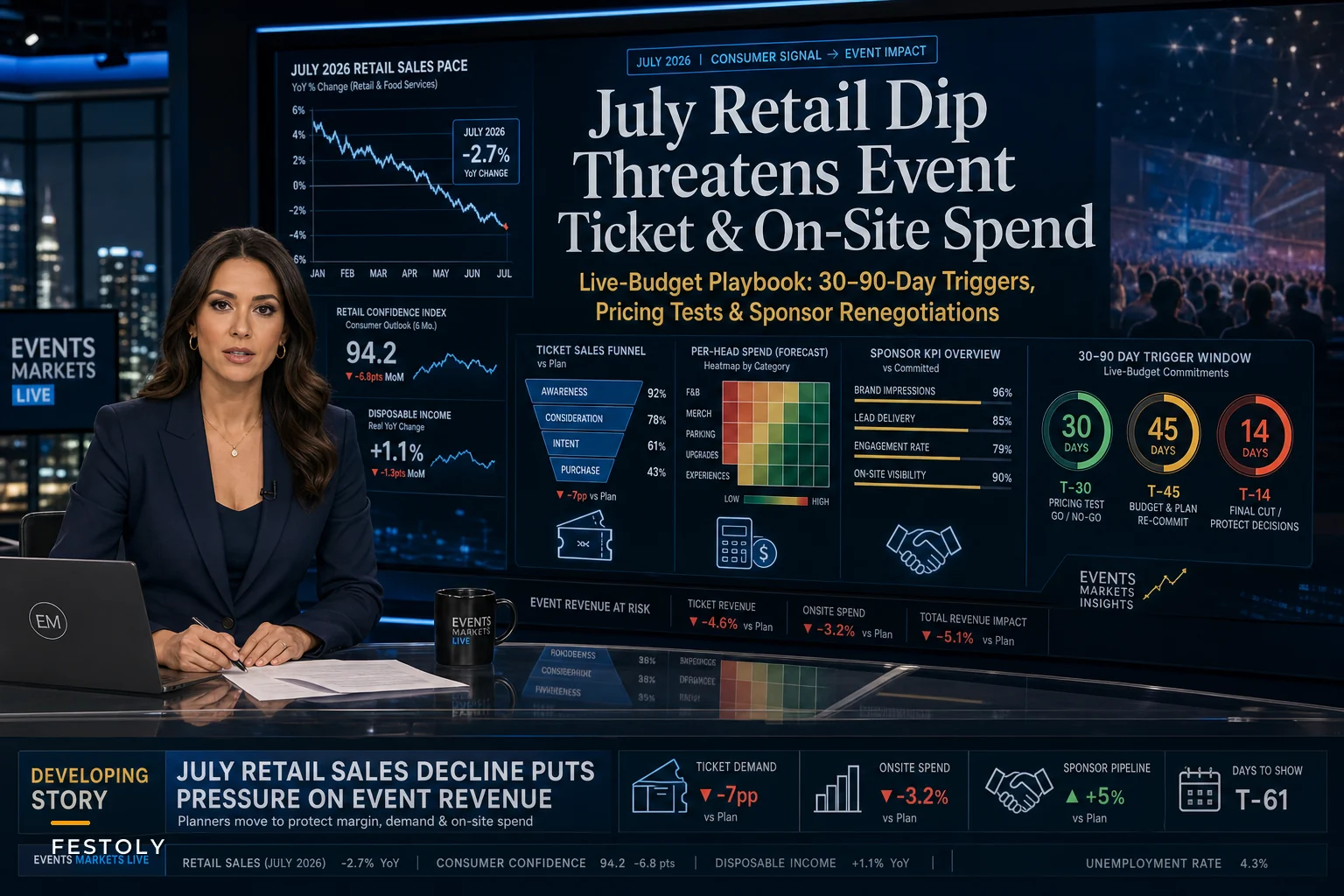

The July numbers landed harder than most planners expected. U.S. retail sales fell for the first time in nine months, according to a Reuters report published August 14, and it wasn't a rounding-error kind of dip. Discretionary categories cooled at exactly the moment fall and winter event seasons ramp up. Add in the fact that consumer prices were still running about 3.4% higher year-over-year per the BLS Economics Daily, and you get the worst combination for ticketed events: attendees have less to spend and what they do have buys less.
For most consumer categories, a soft month is noise. For events, it shows up in a very specific place — the advance-buy curve. If you're not watching that curve daily, you'll find out too late that your revenue assumptions were wrong. Here's where the damage actually shows up, because it's rarely where planners expect.
The first thing that breaks isn't sales — it's your pacing model
When discretionary spending tightens, ticket buyers don't stop buying. They delay. That single behavioral shift breaks almost every budget model built on historical pacing.
A typical mid-size ticketed event — say a two-day regional conference or a weekend festival with 4,000–6,000 attendees — builds its month-of budget on a pacing curve. By T-minus-45 days, you expect roughly 55–65% of tickets sold. That percentage is what you commit F&B guarantees, staffing headcount, and equipment orders against.
When demand softens, that same event might sit at 40–45% at T-45. Nothing is wrong yet. Buyers are holding out, waiting to see if a discount comes, waiting until payday, waiting until they're sure they're going. But your ordering deadlines don't wait. So planners face a brutal choice: commit to guarantees based on a curve that's now lying to them, or hold back and risk under-ordering if a late surge arrives.
The mistake that shows up repeatedly is treating a slow curve as a marketing problem — pouring more ad spend at the top of the funnel — when it's actually a pacing problem that requires rebuilding your commitment triggers, not your creative.
Where the money quietly leaks: three pressure points
In a soft-demand environment, the P&L doesn't collapse. It bleeds from three places at once, and each one masks the others.
Eliminate event chaos with Festoly.
Manage every aspect of your event seamlessly — from planning to execution.
- Centralized event scheduling
- Real-time attendee tracking
- Vendor & resource coordination
No credit card required
| Pressure Point | What It Looks Like | Why It's Dangerous |
|---|---|---|
| Advance ticket delay | Sales pace 15–20 points behind normal curve at T-45 | Forces guarantee commitments on bad data |
| Sponsor activation cold feet | Renewal conversations stall; sponsors ask to "revisit scope" | Sponsorship is high-margin; a 10% cut hits harder than ticket softness |
| On-site spend compression | Attendees still come but spend less per head on F&B and merch | Kills the revenue you counted on to close the budget |
The dangerous part is the interaction. You might hit your attendance number and still miss budget by a wide margin because per-head on-site spend dropped 12–18%. Attendance metrics tell you the room is full. They tell you nothing about whether wallets opened once people got inside.
Planners sometimes celebrate a "sold-out" event that still lost money because the entire model assumed a per-head spend that a price-sensitive crowd simply didn't deliver. Attendance was the vanity number. On-site yield was the truth.
Reprice, don't discount — the distinction that saves your margin
The reflex when advance sales slow is to slash prices. It's usually the wrong move, and the reasoning is pretty straightforward.
A blanket discount trains buyers to wait, punishes everyone who already bought at full price (hello, refund requests), and permanently resets the price anchor for next year. What you actually want is repricing architecture — controlling how and when value is exposed, not just cutting the number.
-
Stagger releases with real scarcity. Release tickets in dated tranches with genuine caps. A price-sensitive buyer responds to "this price ends Friday" far better than a permanent lower price, because the deadline overrides the "wait and see" impulse.
-
Bundle down, not price down. Instead of dropping a $180 ticket to $150, create a $180 tier that now includes a drink credit or priority entry. The buyer feels the value shift without you touching the anchor.
-
Protect the top, flex the bottom. Keep premium and VIP pricing firm — that buyer is less price-sensitive. Add a genuinely stripped-down entry tier for the budget-conscious segment rather than discounting your mid-tier.
-
Time-box any actual discount to a narrow window with a hard, visible end. Open-ended discounts are the ones that destroy anchors.
Events that navigate soft demand well tend to change which value is available at what time, not the fundamental price. Discounting is a blunt tool. Repricing architecture is a scalpel.
The sponsorship conversation you need to have now — not in October
Sponsorship revenue is where a soft consumer environment does the most quiet damage, because sponsors read the same retail reports you do. When their own consumer demand softens, event activation budgets are among the first line items they scrutinize.
The mistake is waiting for the sponsor to bring it up. By the time a sponsor emails asking to "revisit scope," they've already mentally cut you. You want to be ahead of that conversation.
What actually works is proactively reframing the deliverable around conversion, not impressions. A sponsor nervous about ROI doesn't want to hear about "50,000 brand impressions." They want to hear about qualified leads, sampled products that convert, or on-site actions you can actually attribute. Walk in and say "here's how we'll measure and report the leads you get, and here's what we'll do if we miss the guarantee," and you turn a cancellation risk into a renewal.
-
Offer performance guarantees instead of scope cuts. "We'll guarantee X qualified interactions or make up the difference next year" keeps the dollar amount intact.
-
Trade cash for in-kind where it helps both sides. A sponsor tightening cash might extend more product, staffing, or media in exchange for the same footprint — preserving your activation quality.
-
Split large sponsorships into modular tiers so a nervous sponsor can commit to a smaller, defensible piece now with upside options later, rather than walking entirely.
The planners who lose sponsorship revenue in soft years are almost always the ones who treated the sponsor relationship as set-and-forget after the contract signed.
A real scenario: the regional food-and-drink festival
Consider a two-day regional food-and-drink festival, roughly 5,000 daily attendance, that historically ran on about 60% advance sales by T-45 and counted on strong per-head F&B yield to close its budget.
In a softening spring, advance sales stalled around 42% at T-45. The instinct on the team was to blast a 25% off code. Instead they did three things: staggered a dated "final release" tranche with a hard Friday cutoff, protected VIP pricing while adding a stripped-down general entry tier, and rebuilt their F&B guarantee to commit in two waves instead of one big pre-commit.
Advance sales recovered to around 54% by T-30 — not back to normal, but close enough to commit confidently. More importantly, because they'd split the F&B guarantee into two waves, they avoided over-ordering against a curve that would have overstated demand. Final attendance came in a bit under a normal year, and per-head spend was still softer than usual, but the two-wave commitment meant they didn't eat the cost of unsold guarantees. The event landed close to break-even in a year where a blanket discount would likely have pushed it into a real loss.
The lesson wasn't any single tactic. It was that they stopped trusting a pacing curve they knew was compromised and rebuilt their commitment timing around live data.
Rebuild your month-of budget around live triggers, not the plan
This is the part that separates events that survive soft demand from the ones that get surprised. In a normal year, you can run a static budget — set it, commit against it, reconcile after. In a soft-demand year, a static budget is a liability, because every assumption baked into it three months ago is now suspect.
What you need is a live view of burn against actual pace, with commitment gates tied to real thresholds rather than calendar dates. If advance sales are 15 points behind curve at T-30, that should trigger a review of your F&B guarantee, your staffing headcount, and your equipment orders — before the deadlines force your hand blind.
This is exactly the discipline we broke down in our guide to live budget forecasting and spend controls for events — the trigger logic, approval workflows, and month-of burn checks that let you commit against reality instead of a plan that's quietly gone stale. In a year with softer demand, those triggers aren't a nice-to-have. They're the thing standing between a full room and a profitable one.
A workable live-budget workflow in a soft-demand month looks roughly like this:
-
Daily Pull actual sales pace and compare to the curve. Flag any category more than 10 points off.
-
At each commitment gate (T-45, T-30, T-14) Don't auto-commit to historical guarantees. Re-run the numbers against current pace and require a fresh approval to release the commitment.
-
On any 10+ point deviation Trigger a scope review — which orders can wave-commit, which staffing can flex, which sponsor conversations need to happen now.
-
Weekly Recheck per-head on-site spend assumptions against any presale signal you have (bundle uptake, VIP mix, add-on attach rates).
The key shift is as much psychological as operational: you stop treating your budget as a document and start treating it as something that actually reads the room.
Here's a simple visual of the live-budget workflow.
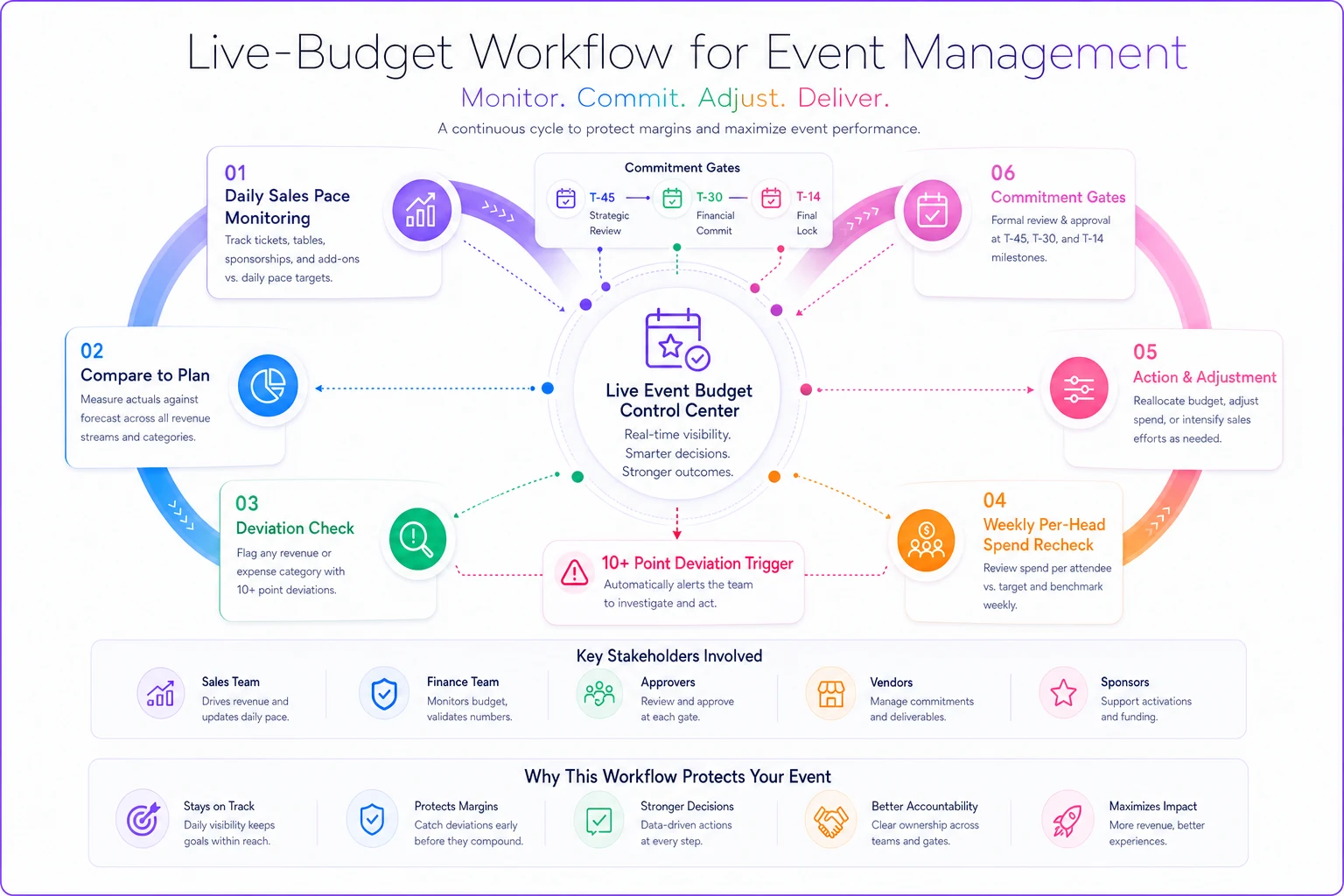
Keep the workflow tightly connected to your ticketing data and commit approvals so decisions are evidence-based, not calendar-driven.
Tie F&B and equipment commits to two-wave approvals so you only fully commit when pace justifies it.
In a year with softer demand, those triggers aren't optional — they're the operational reflex that keeps a full room from becoming a money loser.
When aggressive cost-cutting is actually a mistake
There's a counter-move worth naming, because tightening budgets in a soft year can backfire badly.
If you cut the parts of the experience that drive on-site spend — the atmosphere, the premium touches, the reasons people open their wallets once inside — you can end up in a doom loop. Lower spend leads to cuts, cuts lower the experience, a worse experience lowers spend further. The events that navigate softness well protect the yield-generating elements and cut the invisible overhead instead.
So before you slash: separate the line items that create per-head spend from the ones that merely support the event. Protect the former. A soft year that turns into a bad reputation is something you're still paying for two seasons later.
The takeaway
A single soft retail month doesn't decide your season. What decides it is whether your budget can see the softness coming and adjust before commitment deadlines force blind decisions. The planners who get hurt are the ones running last year's pacing model against this year's buyer behavior. The ones who come through are watching the advance curve daily, repricing with architecture instead of blunt discounts, getting ahead of sponsor nerves, and treating their month-of budget as something that reads live conditions rather than something they filed in March.
Consumer spending will move again. Your job isn't to predict it — it's to build the operational reflexes that let you commit against what's actually happening, right up to the day the doors open.
Consumer spending will move again. Your job isn't to predict it — it's to build the operational reflexes that let you commit against what's actually happening, right up to the day the doors open.
Ready to elevate your event management?
Join 5,000+ event organizers using Festoly to save time, improve coordination, and deliver memorable experiences.