

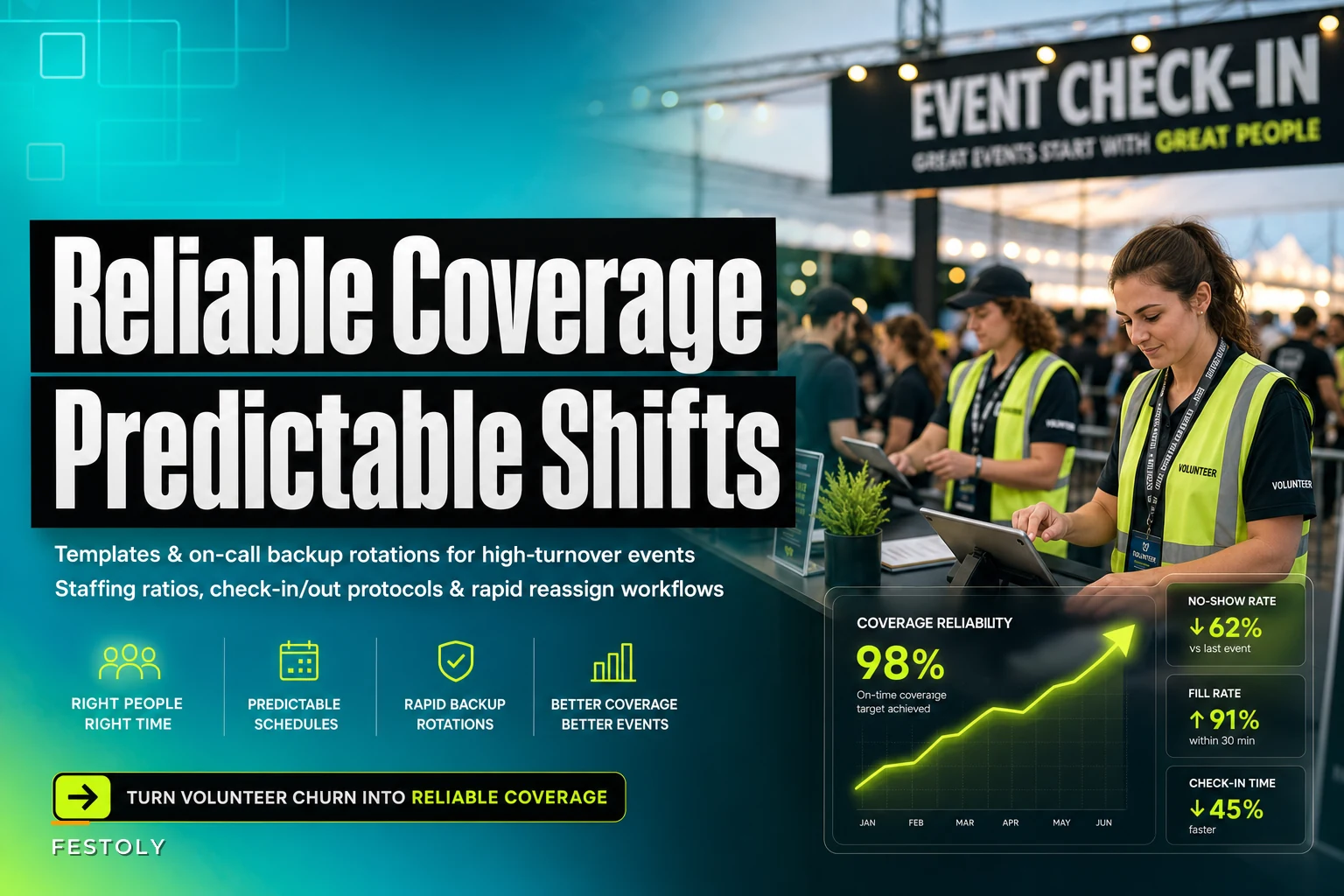

A volunteer coordinator at a 12,000-person music festival learned something harsh during load-in week: 38% of confirmed volunteers hadn't shown up, another 15% left after their first shift, and the remaining crew was pulling 14-hour days trying to cover the gaps. Their volunteer shift scheduling for events system—basically a spreadsheet and group texts—completely collapsed under the reality of volunteer behavior.
This isn't a motivation problem. It's an operational design problem.
Most event planners build volunteer systems assuming people will show up. After watching volunteer operations at roughly 200 events over the past few years, the pattern is clear: volunteer reliability follows a predictable curve. Day one sees 60-70% attendance. Day two drops to 50%. Multi-day events lose another 10-15% each subsequent day. Weather changes, parking hassles, or plain exhaustion trigger immediate dropoffs.
The events that maintain coverage don't have better volunteers. They have better shift architecture.
Why Traditional Volunteer Scheduling Breaks Down
Standard volunteer management looks logical on paper. You calculate the positions needed, add a 20% buffer, send confirmation emails, and hope for the best. This approach assumes volunteers behave like paid staff. They don't.
A regional food festival needed 85 volunteers across three days. They recruited 110, figuring the buffer would handle no-shows. By noon on day one, they had 52 people actually working. The parking team abandoned their posts when temperatures hit 95 degrees. The vendor check-in crew got pulled to help with crowd control. Information booth volunteers simply disappeared during lunch breaks.
The fundamental mistake: treating volunteer scheduling like employee scheduling. Employees have consequences for not showing up. Volunteers can ghost you without penalty.
The psychology matters too. Volunteers often sign up months in advance when enthusiasm runs high. As the event approaches, competing priorities emerge. That Saturday morning shift seemed fine in March. By June, sleeping in wins. Without structured accountability systems, attendance becomes optional in their minds.
Building Shift Patterns That Account for Reality
Effective volunteer shift scheduling for events starts with accepting the churn rate as a design constraint, not a problem to solve. Here's the framework that actually works:
Eliminate event chaos with Festoly.
Manage every aspect of your event seamlessly — from planning to execution.
- Centralized event scheduling
- Real-time attendee tracking
- Vendor & resource coordination
No credit card required
The 3-2-1 Coverage Model
For every critical position, you need three volunteers scheduled, two confirmed 48 hours out, and one physically present. This means scheduling 300% coverage for essential roles. Sounds excessive until you watch it play out. Gate positions, safety stations, and information desks require this level of redundancy.
For secondary positions like merchandise sales or survey collection, 200% coverage usually suffices. These roles can absorb temporary gaps without operational failure. The distinction: can this position being empty for 30 minutes cause cascading problems?
Shift Length Architecture
Four-hour shifts produce the highest completion rates, around 85% for first-time volunteers. Six-hour shifts drop to 70%. Anything beyond eight hours sees completion rates below 50%. The sweet spot varies by event type and weather conditions.
A craft beer festival tested different shift structures across three years:
| Year | Shift Length | Break Time | Completion Rate |
|---|---|---|---|
| 1 | 8 hours | 60 minutes | 42% |
| 2 | 6 hours | 45 minutes | 68% |
| 3 | 4 hours | 30 minutes | 84% |
Shorter shifts mean more handoffs and training time, but the reliability improvement justifies the coordination overhead.
On-Call Backup Rotation Systems
The military uses reserve forces for a reason. Events need the same concept. Your backup rotation isn't just names on a list—it's an active operational system with clear triggers and escalation paths.
Three-Tier Backup Structure
Primary backups live within 20 minutes of the venue and receive guaranteed minimum compensation (even just a meal voucher or priority parking). They're on standby for specific time blocks and check in via text every two hours.
Secondary backups can arrive within 45 minutes. They're usually volunteers who worked earlier shifts or different days. They get lesser perks but appreciate the flexibility to potentially help if needed.
Tertiary backups include staff from partner organizations, paid temporary workers on retainer, or reliable volunteers from previous events who didn't sign up this year but would help in an emergency.
A 5K charity run maintains a bench of 12 primary backups for a race requiring 60 active volunteers. On race morning, they typically activate 4-6 backups before 7 AM. The coordination happens through a group messaging system where backups confirm availability in real-time.
Staffing Ratios That Actually Work
Generic staffing ratios kill events. The "one volunteer per 100 attendees" rule completely ignores operational complexity. Better ratios focus on task density and failure impact.
Position-Based Ratios
Parking and transportation: 1 volunteer per 50 vehicles during peak arrival, dropping to 1 per 100 during steady state. Double these numbers if you're dealing with rideshare pickup zones.
Registration and check-in: 1 volunteer per 40 attendees per hour during peak check-in. Add 50% more if you're handling will-call or troubleshooting ticketing issues.
Information and wayfinding: 1 volunteer per 300 attendees, but positioned at decision points, not evenly distributed. The entrance needs more coverage than the midway.
Safety and medical: Follow venue requirements plus 20%. These positions cannot go unfilled, so over-scheduling is mandatory.
Vendor support: 1 volunteer per 8 vendors for load-in/out, 1 per 15 during operating hours.
The Surge Factor
Events aren't linear. A farmer's market sees 60% of its traffic in the first two hours. A concert venue experiences triple normal flow during the 30 minutes before showtime. Your staffing ratios need time-based adjustments.
Map your expected attendance curve, then add 40% more coverage during surge windows. Better to have volunteers standing around for 30 minutes than to have attendees waiting in massive lines.
Check-In and Check-Out Protocols
Physical presence verification changes everything. The events with the lowest no-show rates all share one trait: volunteers must physically check in before their shift is considered confirmed.
The Two-Touch System
First touch happens 48 hours before the shift. Volunteers respond to a text confirming they're still planning to attend. No response triggers immediate backup activation. This isn't harsh—it's operational reality.
Second touch occurs at physical check-in, minimum 15 minutes before shift start. This includes credential pickup, position assignment confirmation, and final instructions. Volunteers who check in late get reassigned to flex positions rather than critical roles.
Check-out matters equally. Volunteers sign out, return credentials, and confirm their next shift (if applicable). This creates closure and accountability. Events that skip check-out see 25% higher no-shows for subsequent shifts.
A street festival implemented QR code check-ins at volunteer headquarters. Scan in, get your assignment and materials. Scan out, confirm your hours and get your meal voucher. Simple system, but it cut no-shows by 35% because volunteers knew they were being tracked.
Rapid Reassignment Workflows
When volunteers don't show up, you have minutes, not hours, to adjust. The redistribution needs to happen fast enough that attendees never notice the gap.
The 15-Minute Rule
If a volunteer hasn't checked in 15 minutes before their shift, they're considered a no-show. Waiting longer hoping they'll appear just delays the inevitable scramble. Start reassignment immediately.
Not all positions are equal. Here's the fill order when gaps appear:
-
Safety and medical positions (must fill immediately)
-
Entry and exit points (attendee flow can't stop)
-
Registration and ticketing (revenue-critical)
-
Information and wayfinding (quality of experience)
-
Vendor support (can temporarily self-manage)
-
Activities and entertainment (nice-to-have)
Cross-Training Requirements
Every volunteer should be capable of handling at least one other position. During check-in, identify their secondary capability. The parking volunteer who mentions retail experience becomes backup for merchandise. The retired teacher checking tickets can shift to information booth.
A food truck rally maintains a "flex squad" of 8-10 experienced volunteers who know multiple positions. They start each day unassigned, filling gaps as they emerge. These versatile volunteers often get premium perks because they're essentially operational insurance.
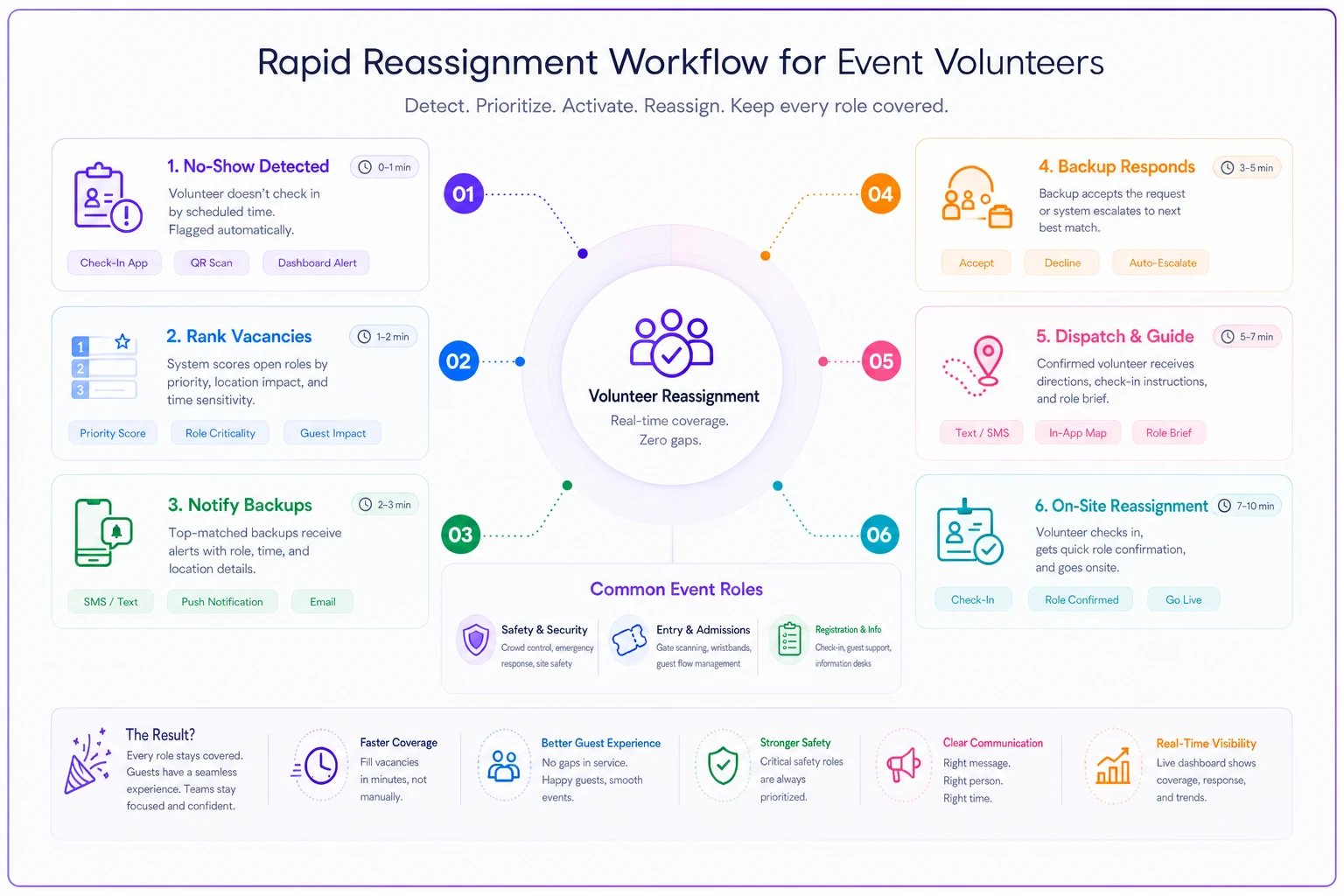
A simple visual of the rapid reassignment flow clarifies responsibilities and timing for on-site teams.
Technology and Coordination Systems
Manual coordination breaks at scale. Once you're managing more than 30 volunteers, you need systematic communication and tracking.
Real-Time Status Boards
Whether it's a shared spreadsheet, a planning app, or AI-powered operational software, you need live visibility into coverage. Every position shows green (fully staffed), yellow (partially staffed), or red (critical gap). Updates happen instantly as volunteers check in or positions change.
Automated Escalation
When positions go red, notifications trigger automatically. The volunteer coordinator gets an alert. The backup roster receives activation requests. The operations manager sees the coverage gap on their dashboard. This happens in seconds, not whenever someone notices the problem.
Communication Hierarchies
Not every message goes to everyone. Parking volunteers don't need updates about vendor load-in. Create communication channels by function. All-volunteer broadcasts handle weather and major changes. Department-specific updates stay focused. Individual position instructions remain targeted. Emergency notifications reach everyone instantly.
A regional art fair moved from group texts to a structured communication platform. Message delivery confirmation went from roughly 60% to 94%. Volunteers knew exactly which updates required their attention versus general information.
Modern AI-assisted operational platforms can automate much of this coordination. When a volunteer calls out sick, the system immediately identifies qualified backups, sends notifications, and updates status boards—reducing what used to take 20 minutes of phone calls to a 2-minute automated process.
Measuring and Improving Reliability
Track the right metrics, and patterns emerge quickly. Most events measure the wrong things.
Meaningful Metrics
Show rate by shift time: Morning shifts might see 80% attendance while evening shifts drop to 60%. Adjust recruitment accordingly.
Completion rate by position type: Parking volunteers might have 90% shift completion while beverage service sees only 70%. Some roles naturally have higher turnover.
Dropout triggers: Track when volunteers leave mid-shift. If 25% bail during the 2 PM-4 PM window, investigate why. Often it's basic issues like lack of water or nowhere to sit during breaks.
Repeat volunteer performance: Past volunteers who return typically show 95%+ reliability. First-timers hover around 70%. This ratio should influence recruitment targets.
The Feedback Loop
Exit conversations reveal fixable problems. A volunteer who left early because they couldn't find parking leads to reserved volunteer spots. Someone who bailed because they didn't understand their role highlights training gaps.
Create a simple post-shift survey—three questions maximum:
-
What worked well?
-
What was frustrating?
-
Would you volunteer again?
Responses show exactly where your operational design needs adjustment.
Flexibility Within Structure
Rigid systems break under real-world pressure. Your volunteer operation needs structure but also rapid adaptation capability.
A winter holiday market discovered their outdoor positions were unsustainable when temperatures dropped below freezing. Rather than watching volunteers abandon posts, they implemented 20-minute rotations with indoor warming breaks. Coverage stayed consistent even though individual shift patterns changed completely.
Weather triggers automatic adjustments. Rain means parking volunteers need larger crews to handle slower vehicle flow. Extreme heat triggers shorter rotations and mandatory hydration breaks. These aren't judgment calls—they're pre-planned operational adjustments.
Special circumstances require instant flexibility. When a volunteer's child gets sick, they leave immediately. Having the operational structure to absorb that loss without disruption separates professional events from amateur ones.
Building Your Coverage System
Start with the assumption that 40% of your confirmed volunteers won't complete their shifts. Design around this reality rather than fighting it. Build redundancy into critical positions. Create backup activations that happen automatically, not after someone notices a problem.
Track what actually happens versus what you planned. Every event generates data about volunteer behavior. Use it to refine your model. That 40% no-show rate might be 30% for morning shifts and 50% for evening ones. Your backup needs could be minimal on Saturday but critical on Sunday.
The goal isn't perfect attendance—it's consistent coverage despite imperfect attendance. Volunteer shift scheduling for events works when the system expects and handles failure gracefully. Build that expectation into your operational design from day one.
The events that run smoothly don't have better volunteers. They have systems that turn volunteer chaos into predictable coverage through smart shift architecture, backup rotations, and rapid reassignment protocols. Once you accept that volunteer behavior is predictable in its unreliability, you can build operations that deliver consistent results regardless of individual participation.
Ready to elevate your event management?
Join 5,000+ event organizers using Festoly to save time, improve coordination, and deliver memorable experiences.